


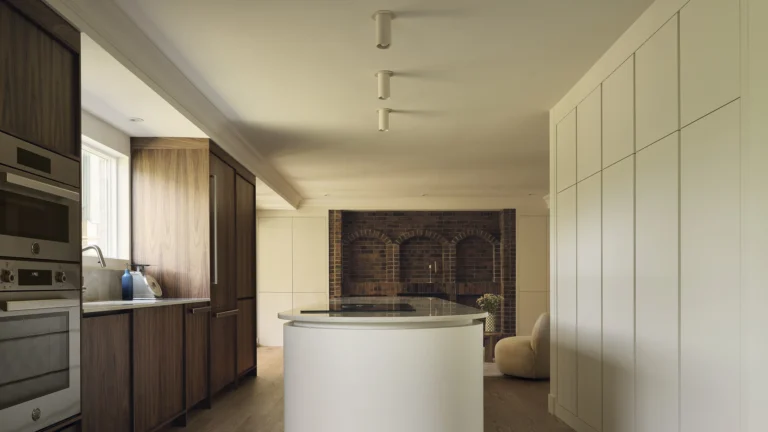
For a decade, the chandelier was the defining statement piece of aspirational interior design. Oversized, ornate, impossible to ignore: it announced itself from the moment you walked into a room and demanded your attention for as long as you stayed. It was maximalism made permanent, suspended from the ceiling.
Something has shifted. The rooms that feel most considered in 2026 are not the ones with the loudest fixtures. They are the ones where the lighting is so perfectly calibrated to the space that you feel it before you see it, where the quality of the atmosphere is unmistakable but the source is quietly present rather than loudly declared. This is the quiet luxury moment in lighting, and it is reshaping how the most design-forward homes are lit.
What quiet luxury actually means in a lighting context
Quiet luxury as a concept has been applied broadly across fashion and interiors, sometimes so broadly that it loses meaning. In a lighting context, it has a specific set of characteristics that distinguish it from both the maximalist chandelier era and the minimal-to-the-point-of-sterile aesthetic that preceded it.
Quiet luxury lighting is characterized by material quality over visual drama. A shade in natural travertine or hand-blown glass that rewards close inspection but does not demand it from across the room. Proportions that are deliberate and precise rather than exaggerated. Finishes that develop over time rather than looking identical in year one and year ten. The presence of a fixture that you notice when you look for it and forget when you are simply living in the space.
This is the opposite of a statement piece in the conventional sense. It is a considered piece: one whose quality is apparent without being announced.
Why the chandelier moment passed
The oversized chandelier worked as a design language when the primary goal was visual impact. In a showroom, a hotel lobby, or a dining room designed to impress on first entry, a dramatic ceiling fixture accomplishes exactly what it is asked to do.
The problem is that most people do not live in hotel lobbies. They live in spaces they return to every day, and an object designed to create maximum first impression tends to become visual noise in a space you inhabit continuously. The chandelier moment was also, in many cases, a shortcut: a way of achieving apparent luxury without the harder work of calibrating the rest of the space to match.
Quiet luxury lighting is harder to execute than a dramatic statement piece. It requires getting the scale exactly right, choosing materials that work both lit and unlit, and ensuring that the fixture contributes to the atmosphere of the room rather than dominating it. But the result is a space that holds up over years rather than one that delivers a single strong impression.
The materials defining the quiet luxury moment
Natural stone, hand-blown glass, and aged or patinated metals are the three material categories most associated with quiet luxury lighting in 2026. Each has qualities that align with the aesthetic logic of the trend.
Natural stone (travertine, onyx, alabaster) offers the combination of visual weight and material depth that defines quiet luxury. A stone shade reads as significant without being loud. It changes appearance depending on light conditions: dense and sculptural when unlit, luminous and alive when the light source is active. No two pieces are identical, which means the fixture carries an inherent sense of uniqueness without requiring an unusual form.
Hand-blown glass operates differently. Its quiet luxury quality comes from the visible trace of its making: the slight variations in thickness, the micro-bubbles, the gentle asymmetries that distinguish it from pressed or molded glass. Studios like Luminaire Authentik, based in Quebec’s Eastern Townships, have developed ranges that combine these natural materials with clean structural forms, producing fixtures that embody the quiet luxury aesthetic without referencing any particular historical style.
How to apply the quiet luxury approach in practice
The practical application of quiet luxury lighting starts with restraint. One well-chosen fixture per zone, selected for material quality and proportional precision rather than visual impact. A dining pendant that hangs at exactly the right height, in a material that complements the table surface rather than competing with it. A bedroom fixture that creates the right quality of light without drawing attention to itself when the room is in use.
Color temperature matters here more than it does in statement lighting contexts. Quiet luxury lighting is almost invariably warm: 2700K to 3000K, producing the amber-inflected glow that makes skin, wood, and natural textiles look their best. The light itself becomes part of the material story of the room.
If the distinction between a fixture that is merely understated and one that genuinely embodies quiet luxury is difficult to identify from product photographs, a custom lighting consultation with a studio that works in this territory can clarify quickly. The difference is usually apparent within minutes of seeing the actual materials in person or in a detailed rendered configuration.
The longer view
Quiet luxury in lighting is not a trend in the sense of something that will be replaced by the next thing in eighteen months. It is a return to a more durable set of values in design: quality of material, precision of proportion, objects that earn their place in a space over time rather than demanding attention on arrival. The rooms being designed this way now will look as considered in ten years as they do today. That, ultimately, is the point.
