


There’s a particular exhaustion that sets in around the famous corners of the Mediterranean in August. Capri is a queue with a view. Saint-Tropez is a parking problem with rosé. Mykonos has become a place people go to photograph themselves having gone there. The money is loud, the crowds are louder, and the thing everyone came for, some version of an effortless seaside summer, has been priced and postured out of reach.
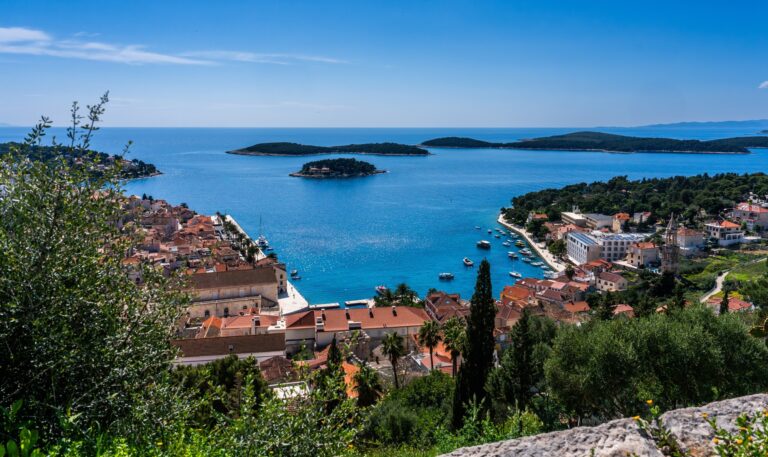
Hvar does it differently. Croatia’s most storied island has all the raw material of a glamour destination: a Venetian-era square, a hilltop fortress, superyachts idling in the harbor, and a climate that delivers around 2,700 hours of sunshine a year. What it doesn’t have, at least not yet, is the performance. Dinner is still a family konoba where the owner tells you what the boat brought in. The best beach club on the Pakleni Islands still serves lunch barefoot. Nobody is checking what you’re wearing.
An old resort, rediscovered
The island’s polish is not new, which may be why it wears it so lightly. Organized tourism here dates back to 1868, when locals founded a health society to host European visitors chasing the mild winters. The grand habit never left; it just went quiet for a few decades. What’s changed recently is where the discerning traveler sleeps.
The hotel scene in Hvar Town is pleasant but limited, and the interesting money has moved into private houses. The stock of luxury villas in Hvar has grown quietly and considerably: restored stone captains’ houses with walled gardens, architect-designed hillside builds with infinity pools facing the islands, waterfront estates near Sveta Nedjelja where the staff arranges a skipper for the day and a chef for the evening. It is the Capri experience without the Capri theater, and often without the Capri invoice.
How the quiet version works
The understated Hvar week has its own choreography. Mornings belong to the water, ideally from your own terrace or a flat rock you’ve come to think of as yours. Midday means a slow lunch, either grilled fish at a bay you reached by boat or something from the market cooked at home. In the late afternoon the island’s interior earns its keep: the UNESCO-protected Stari Grad Plain for a cycle through two-thousand-year-old field lines, or the steep southern vineyards where Plavac Mali grows almost into the sea.
The table deserves its own paragraph. The island’s konobas work to a logic that predates the word gastronomy: a wood grill, that morning’s catch, olive oil pressed a few miles away and vegetables from someone’s actual garden. The dish worth planning around is peka, lamb or octopus slow-cooked under an iron bell, ordered a day in advance and served without ceremony. The wine list is short and local and better for it. Plavac Mali from the island’s southern slopes is the serious red; Bogdanuša, a white grown almost nowhere else on earth, is what you drink at noon and think about for the rest of the year.
Evenings are a choice. Hvar Town will give you cocktails and people-watching if you want them. The villages of Vrboska and Jelsa will give you a stone quay, a glass of Bogdanuša and the sound of absolutely nothing happening. The luxury is that both are twenty minutes from your door and neither requires a reservation made three months out.
Timing it
Skip August unless the scene is the point. June and September are the connoisseur’s months: the sea is warm, the light is softer, the restaurants have time for you and villa rates drop meaningfully. May, when the lavender starts, is the island at its most photogenic and least discovered.
Quiet luxury has become a tired phrase for expensive beige clothing. On Hvar it still means what it should: comfort without audience, beauty without queue, and the increasingly rare feeling of having gotten somewhere before the noise did.
