


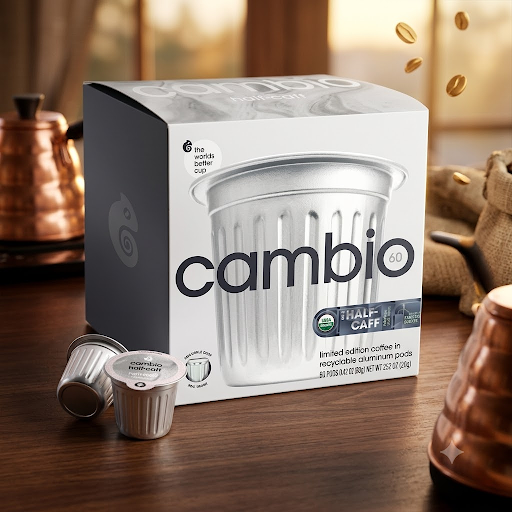
Coffee culture treats caffeine like a light switch. You are either fully on or fully off, drinking the real thing or drinking decaf, and the choice comes loaded with more identity than it deserves. That framing has quietly cost a lot of people their afternoons. Half caff K-Cups® exist because the switch was never actually binary, and a surprising number of coffee drinkers function best somewhere in the middle.
The concept is simple enough that it almost sounds like a gimmick. Blend caffeinated and decaffeinated coffee in roughly equal parts, and you land at about half the caffeine of a standard cup. What makes it interesting is not the arithmetic. It is what happens to the way you feel when you stop overshooting.
The Dose Problem Nobody Talks About
A standard eight-ounce cup of coffee delivers somewhere near 95 milligrams of caffeine. That figure was never calibrated to you. It is an artifact of brewing convention, and individual sensitivity varies enormously based on genetics, body composition, sleep debt, medication, and simple tolerance.
For a meaningful slice of the population, 95 milligrams in a single serving overshoots the target. The result is familiar to anyone who has lived it. A pleasant lift for forty minutes, then a jaw that will not unclench, a heart rate that feels a half step too fast, and a focus that has curdled into scattered urgency. That is not the caffeine failing. That is a dose mismatch.
Half caff K-Cups® cut the dose roughly in half, landing most cups in the range of 40 to 50 milligrams. That range is often enough to lift alertness and mood without pushing past the point where the benefits reverse.
Why Half Rather Than None
The obvious question is why anyone would bother with a blend rather than simply switching to decaf. The answer has to do with what caffeine does well when it is not overdone.
At moderate doses, caffeine blocks adenosine receptors, which is the mechanism behind reduced perception of fatigue. It modestly improves reaction time, sustained attention, and mood. Those effects are real and useful. What most people are trying to escape is not caffeine itself but the overshoot, the anxious edge and the sleep disruption that follow a dose calibrated for someone else.
Half caff K-Cups® let you keep the useful part of the curve. This matters most in the afternoon, when a full cup at three o’clock still has a substantial fraction of its caffeine circulating at bedtime. Caffeine’s half-life sits around five to six hours in typical adults, which means the math on a late full-strength cup is worse than most people assume. Cutting the dose in half meaningfully changes the amount still working on your nervous system when you are trying to fall asleep.
Who Tends to Benefit Most
Several groups find this format solves a problem they had stopped trying to solve.
People with genuine caffeine sensitivity often discover they are not actually caffeine intolerant. They are intolerant of a standard serving size, which is a different problem with a much easier fix. People tapering down from a heavy habit find half-caff K-Cups® useful as a step rather than a cliff, avoiding the headache and fog that come from an abrupt cut. Afternoon drinkers who want the ritual without the sleep cost get exactly that. And people who simply drink several cups a day find that halving the strength lets them keep the frequency without the accumulated load.
There is also the household case. When one person wants full strength, and another wants none, a half caff option in the same brewer settles the argument without maintaining three separate coffees.
What Separates a Good Half Caff Pod From a Mediocre One
Not all blends are built with equal care. The lazy version takes leftover regular coffee, mixes it with whatever decaf is on hand, and sells the result on the strength of the concept alone. The result is muddled, because two coffees roasted for different purposes rarely taste coherent together.
A well-made half caff blend is built as a blend. The caffeinated and decaffeinated components are chosen to complement each other, roasted to profiles that harmonize, and balanced so that the cup tastes like a deliberate coffee rather than a compromise between two others. When it is done right, you would not identify it as half caff in a blind tasting. It just tastes like a good medium roast.
Freshness matters more here than in most coffee, because decaffeinated beans are more porous and give up their aromatics faster once ground. Sealed single-serve portions protect that fragile half of the blend from oxygen, which is a real structural advantage of the format. This is one of the reasons half caff K-Cups® tend to taste more consistent than half caff sold as ground coffee in a bag that stays open for weeks.
It is also worth checking what the pod is made of. Aluminum pods, which can be recycled repeatedly without material degradation, have become a meaningful point of difference for people who think about where their morning cup ends up.
Making the Switch Without Overthinking It
The simplest approach is to change one cup rather than all of them. Keep full strength for the first cup of the day, when tolerance is lowest, and the effect is most wanted, and move everything after noon to half caff. Most people notice the difference in sleep quality within a week, which is a faster feedback loop than almost any other habit change.
A second approach suits people who drink coffee steadily throughout the day. Switch the entire rotation to half caff and keep the same number of cups. Total caffeine drops by roughly half while the ritual stays completely intact, which is usually the part people are unwilling to give up anyway.
The Takeaway
Somewhere along the way, coffee drinkers accepted that the only two options were all of it or none of it. That was never true. Half caff K-Cups® restore the dial that should have been there all along, and for a lot of people the setting they actually want is somewhere in the middle.
Try one week of half strength after noon. The afternoon cup stays, the evening gets easier, and nobody has to pretend decaf was what they wanted.
