


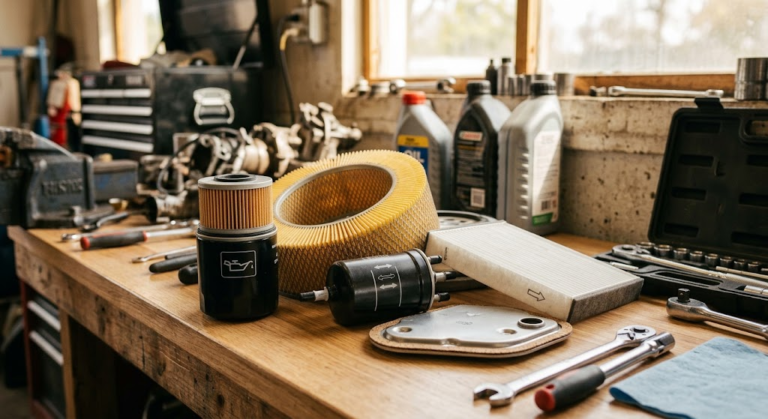
Filters are the highest-turnover consumable on almost any engine-driven machine. They’re cheap, they’re routine, and they’re the single easiest thing to defer when the shop is busy — which is exactly why so many expensive failures trace back to one that stayed in service too long.
Here’s a breakdown of the filters that get replaced most often, what each one actually protects, and how to tell when it’s overdue.
- Engine oil filter
The most frequently replaced filter in any fleet, simply because it changes with every oil service.
What it does: Captures wear metals, soot, and combustion byproducts before they cycle back through bearings, cam lobes, and cylinder walls. On most engines it also incorporates a bypass valve so oil keeps flowing if the media clogs or the oil is too cold to pass through.
Typical interval: 250–500 hours on off-road diesel; 5,000–10,000 miles on-road, though extended-drain oils and oil analysis programs push this further.
Symptoms of neglect: There often aren’t any until damage is done. A filter in permanent bypass is passing unfiltered oil, and the only evidence is rising wear metals in an oil sample. This is why oil analysis pays for itself.
Tip: Don’t reuse the old gasket, don’t over-torque (hand-tight plus the marked turn is the spec for a reason), and never pre-fill through the dirty side.
- Engine air filter
What it does: Dust ingestion is one of the fastest ways to wear out an engine. A gram of dirt through the intake causes abrasive wear on rings, liners, and turbo bearings. Most heavy-duty setups use a primary element plus a safety element behind it.
Typical interval: By restriction indicator, not by calendar. Replace when the gauge hits the OEM restriction limit — which might be 200 hours in a dusty quarry or 1,500 hours in a clean warehouse. Replace the safety element every second or third primary change, and only in a clean environment.
Symptoms of neglect: Power loss, black smoke, elevated exhaust temperature, poor fuel economy, and silicon showing up in oil analysis.
Tip: Stop cleaning air filters with compressed air. It opens pinholes in the media that let dirt straight through, and the filter looks fine afterward. Also check the intake boots and clamps every time you’re in there — a cracked hose downstream of the filter makes the filter irrelevant.
- Fuel filter and water separator
What it does: Modern high-pressure common rail injection runs at extreme pressures with clearances measured in microns. Fuel filters protect injectors and the high-pressure pump from both particulate and water. Most systems use a primary filter/water separator on the suction side and a fine secondary filter on the pressure side.
Typical interval: 250–500 hours, or annually — but sooner if fuel quality is questionable or the machine is fed from on-site storage tanks.
Symptoms of neglect: Hard starting, loss of power under load, engine derate, rough running, and eventually injector or pump failure that costs orders of magnitude more than the filter.
Tip: Drain the water separator on a daily or weekly schedule, not just at service intervals. Water in diesel causes corrosion and kills lubricity, and biological growth in storage tanks will clog a filter overnight.
- Hydraulic filters
What it does: On excavators, loaders, forklifts, and any machine with substantial hydraulics, contamination is the leading cause of pump and valve failure. Return-line, pressure-line, and case-drain filters each protect different parts of the circuit.
Typical interval: 500–1,000 hours, or on the restriction/bypass indicator. Always change after a major component failure — a failed pump seeds the entire system with debris.
Symptoms of neglect: Sluggish or jerky implement response, pump whine, elevated oil temperature, and erratic valve behavior.
Tip: Cleanliness during the change matters as much as the filter. Wipe down the housing before opening it, and don’t leave a reservoir open to a dusty shop.
- Cabin air filter
What it does: Protects the operator — and the HVAC blower motor and evaporator core. Frequently ignored, and it’s the one filter whose neglect a person actually breathes.
Typical interval: 500 hours or seasonally, much sooner in dusty or agricultural conditions.
Symptoms of neglect: Weak airflow, foggy windows that won’t clear, dust in the cab, musty smell, blower motor failure.
- Transmission and driveline filters
What it does: Protects clutch packs, valve bodies, and gearsets in powershift transmissions, torque converters, and final drives.
Typical interval: Usually tied to transmission fluid service — commonly 1,000–2,000 hours.
Symptoms of neglect: Delayed or harsh engagement, slipping under load, overheating, and metal in the pan.
- Crankcase ventilation / breather filter
What it does: Handles blow-by gases and separates oil mist before vapors return to the intake or vent to atmosphere. Closed crankcase ventilation systems on modern emissions-compliant engines use a serviceable coalescing element.
Typical interval: Often 1,000–2,000 hours; check the manual, because a plugged CCV can pressurize the crankcase and push oil past seals.
Symptoms of neglect: Oil leaks at seals and gaskets, oil in the intake tract, dipstick blowing out.
- Coolant filter
What it does: On many heavy-duty diesels, the coolant filter both traps particulate and slowly releases supplemental coolant additives (SCA) that prevent liner pitting and corrosion.
Typical interval: With coolant service or at scheduled intervals — and test the coolant chemistry rather than assuming.
Symptoms of neglect: Water pump failure, cavitation erosion on cylinder liners, scale in the radiator.
- DEF filter
What it does: On SCR-equipped machines, protects the dosing system from crystallized urea and contamination.
Typical interval: Commonly around 2,000 hours or per OEM schedule.
Symptoms of neglect: Dosing faults, derates, and expensive aftertreatment diagnostics.
What “high quality” actually means in a filter
Two filters can look identical on the shelf and perform very differently in service. The parts of the specification that matter aren’t visible from the outside:
- Media and efficiency. Look for a stated beta ratio at a given particle size — β₁₀ ≥ 200, for example, means 99.5% of particles at 10 µm are captured. “20 micron” without a rating standard behind it is marketing, not a spec.
- Dirt-holding capacity. More pleat area and better media mean the filter reaches its restriction limit later, which is what actually determines service life.
- Construction. Sturdy center tubes that don’t collapse under cold-start pressure, properly bonded end caps, and correctly formulated seals that stay elastic through temperature cycles.
- Valves. Bypass valves set to the right cracking pressure, and anti-drainback valves that actually hold on horizontally mounted spin-ons.
Stocking high quality filters from an established manufacturer costs marginally more per unit and removes an entire category of failure mode from the fleet. Against the price of a hydraulic pump, an injector set, or a turbo, the difference is rounding error.
The mistakes that cost the most
- Extending intervals without oil analysis to justify it. Data can support longer drains. Optimism can’t.
- Reusing gaskets or double-gasketing a spin-on filter — a classic cause of sudden total oil loss.
- Servicing filters in a dirty environment. More contamination is introduced during careless service than most filters remove in a full interval.
- Ignoring restriction indicators because the filter “looks clean.” Air filters trap the finest particles deep in the media where you can’t see them.
- Not changing filters after a failure. New pump, old debris, same outcome.
Build a stocking plan, not a shopping trip
The most reliable fleets keep service kits made up in advance — every filter for a given machine’s 500-hour service in one labeled box, ready to grab. It removes the two most common reasons a filter doesn’t get changed: nobody knew which part number it took, and it wasn’t on the shelf.
Filters are the cheapest maintenance you’ll ever perform and the most expensive to skip. Change them on schedule, buy them on spec, and store them clean.
