


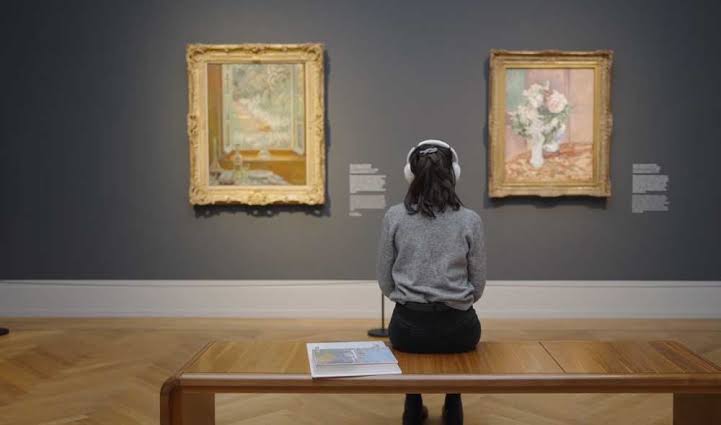
The relationship between visual art and sound has always been more intimate than gallery spaces typically acknowledge. Artists have thought about the sonic dimensions of their work for as long as there have been artists. Museums and galleries, by contrast, have historically treated audio as an operational detail — the ambient noise of the HVAC system, occasional recorded commentary through an audio guide, the hum of a crowd moving through a permanent collection.
That’s changing. Visitor expectations for experiential depth have evolved significantly, and the institutions that are gaining reputation and repeat visitors are increasingly the ones that treat the sensory experience of the space as a design problem — including the sound. AI music generation is one of the tools that makes ambitious audio programming accessible at a scale and cost that wasn’t previously practical for institutions with typical cultural programming budgets.
Ambient Audio Designed for the Collection
A gallery presenting a collection of nineteenth-century European landscapes sounds different from one presenting contemporary abstract expressionism, which sounds different from one presenting medieval ecclesiastical objects. These aren’t just aesthetic preferences — the sonic environment affects how visitors engage with the work, how long they spend in each space, and how much of the emotional register of the art they actually receive.
An ai song maker free generates original ambient audio from a description of the collection’s period, cultural context, and emotional qualities. “Nineteenth-century European, pastoral, the sound of wind through grass and distant water, no rhythm, no melody, ambient texture” for a landscape gallery. “Post-war American abstraction, urban, slightly tense, physical, the feeling of a studio at work” for an abstract expressionist collection. “Sacred, medieval, stone reverb, plainchant-adjacent, the feeling of height and light” for a collection of religious objects. Each description produces audio that was built for the specific cultural world of the collection rather than borrowed from a general ambient music category.
For temporary exhibitions — which are where most ambitious audio programming happens and where budgets are most constrained — generating original ambient audio for each exhibition from the curatorial brief creates a more coherent visitor experience than patching together licensed tracks from different sources.
Reinterpreting Music From an Artist’s Period
One of the most powerful applications for institutions focused on historical art is the ability to take music from an artist’s period and reinterpret it in ways that make it accessible and appropriate for a contemporary gallery context — keeping the musical character of the period while adapting the production to an ambient, non-distracting register.
An ai song cover generator handles this transformation. Upload music that a painter or sculptor would have known — a contemporary’s composition, a popular form of the period, a regional musical tradition relevant to the artist’s world — and reinterpret it at a gentler tempo, a lower dynamic register, and in a production that works as ambient audio rather than as a foreground listening experience. The musical world of the period is present in the gallery without demanding the visitor’s attention as music, supporting engagement with the visual work rather than competing with it.
For exhibition programming that wants to immerse visitors in the full cultural world of an artist or period — not just the visual artifacts but the sonic environment in which those artifacts were created — this capability allows the musical dimension of that world to be present in the gallery without the licensing complexity of using historical recordings or the expense of commissioning live period performance.
Audio Tours and Exhibition Documentation
Beyond ambient programming, museums produce extensive audio content: audio tour scripts, exhibition documentation for archives and educational resources, promotional content for exhibitions on social media and institutional websites. Each of these content types benefits from music that’s appropriate to the material being presented and legally clean for all distribution contexts.
Text to music generates music for specific institutional content uses from a description of the purpose and tone. “Educational, accessible, curious, the feeling of discovery, appropriate for a diverse museum audience” for audio tour background music. “Institutional, serious, respectful, celebrating a significant historical collection” for a gala or donor event video. “Engaging, contemporary, designed to stop a social media scroll, showcasing a new acquisition” for an Instagram promotional video about a new work entering the collection.
Each of these is a different brief producing different music — music that’s appropriate to its specific institutional purpose rather than repurposed from a general library. For institutions whose content is published across multiple platforms and contexts, original music that can be used anywhere without ongoing rights management removes a compliance overhead that has no obvious institutional benefit.
Connecting Digital Audiences to the Physical Space
Museums and galleries have invested significantly in digital presence — virtual tours, online collection access, social media content — and the challenge of communicating the experience of being in a physical space to a digital audience is ongoing. Visual content communicates what the work looks like but not what being in its presence feels like. Music is part of what can carry that experiential quality through a screen.
Social content for cultural institutions that includes original music generated from the institution’s collection and programming creates a more immersive impression of the institution than content without audio. A short video about a new acquisition, accompanied by music that was generated from the conceptual qualities of the work itself, gives a digital audience an experiential taste of what it might feel like to stand in front of the piece. That impression drives physical visits in a way that purely informational content about the acquisition doesn’t.
For institutions trying to rebuild visitation, attract younger audiences, and communicate the value of physical engagement with art in a world where everything is available digitally, audio that genuinely serves the work — rather than decorating content about the work — is one of the most underutilized tools available.
