


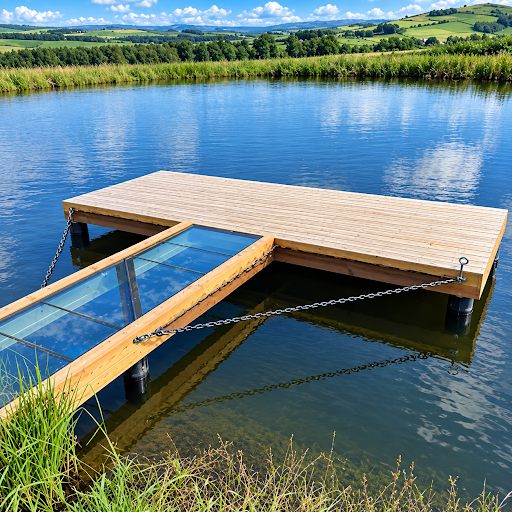
Ask anyone who owns a lake house where they spend their summer afternoons, and the answer is rarely “inside.” It is the dock, the swim platform, the end of the jetty. Yet most docks offer the same few options: a folding chair, a towel on warm boards, or a wobbly lounger that never quite stays level.
Over the past few years, a different idea has spread from tropical resorts to northern lakes and coastal cottages: a net stretched directly over the water. Lie on it and you feel the breeze from below, hear the water lapping under you, and watch fish drift past between the cords. It is part hammock, part deck, and unlike almost anything else you can add to a waterfront.
If you are considering one, a little planning goes a long way. Here is what to think through before you order.
Start with the spot, not the net
The best location is usually a space you are not using today. Walk your waterfront and look for gaps:
- The water between two dock fingers or between a dock and a boat lift.
- The end of a pier, where an open rectangle can extend the platform without new decking.
- The area under a raised deck or boathouse balcony that hangs over the shoreline.
- A corner beside the swim ladder, where people already gather to dry off.
Next, measure the height above the water. Lakes rise in spring and drop in late summer, and tidal sites change twice a day. The net should sit clear of the highest water you expect, including waves from passing boats. Note the prevailing wind, too. A spot sheltered from the strongest gusts will be more comfortable and puts less strain on the fixings.
Finally, check the posts or frame you plan to attach to. Pilings, sturdy dock frames and steel structures are ideal. Old, soft or cracked timber is not. If you are unsure, ask a dock builder to look before you go further.
Taut platform or soft hammock?
Over-water nets come in two broad styles, and the choice shapes how the space will be used.
A tensioned platform is stretched tight across its frame. It feels firm underfoot, a little like a trampoline on a catamaran. You can walk across it, sit cross-legged, lay out a picnic or let children crawl around under supervision. It works best when you want more usable surface.
A hammock-style net has deliberate slack. It cradles the body and invites you to lie still and drift off. It is less practical for walking but unbeatable for reading, napping or watching a sunset.
Some owners combine both: a firm section joined to the dock, with a softer lounging zone further out over the water.
Materials matter more over water
A net that lasts years in a back garden can fail within a season over a lake. Water changes everything. Cords stay damp for longer, algae finds a foothold, sunlight reflects up from the surface as well as down from the sky, and coastal sites add salt spray to the mix.
When comparing options, look for:
- Synthetic, rot-proof fibres such as high-tenacity polyester. Natural cotton or jute rope will mildew and weaken quickly.
- UV stabilisation, so the cords do not turn brittle or chalky after a few summers.
- Marine-grade hardware in stainless steel or another corrosion-resistant metal for every shackle, eyebolt and tensioner.
- A mesh size suited to the use. Smaller openings are more comfortable to lie on and safer around small feet. Larger openings let water and debris pass through and dry faster.
- A reinforced perimeter, such as a strong edge rope, which spreads the load evenly to each anchor point.
The nets used on sailing catamarans are a useful benchmark. They spend their lives exposed to sun, salt and constant movement, and the same construction translates well to a dock. Specialist makers such as Feelnets build dock and waterfront netting on exactly that marine foundation.
Why made-to-measure beats off-the-shelf
No two docks are alike. Post spacing varies, frames are rarely perfectly square, and ladders, cleats and boat slips all get in the way. A pre-cut net either sags where it is too large or overloads its corners where it is too small.
A net built to your exact dimensions can be shaped around obstacles, sized for the right tension and fitted with the hardware your structure actually needs. It also looks intentional: a clean, tight surface that reads as part of the design rather than an afterthought.
Safety around the water
A net over water is relaxing, but it still deserves the same care as any waterside feature.
- Supervise children at all times. A net reduces the open edge of a dock, but it is not a substitute for watching young swimmers or for life jackets.
- Respect the load limits given by the manufacturer, and do not jump on a net that was designed for lounging.
- Keep the entry point simple. Step on from the dock at the same level, rather than climbing over railings or from a boat.
- Avoid use in storms, strong wind or icy conditions, when cords become slippery and loads rise suddenly.
- Inspect fixings regularly, especially after high water or heavy weather.
Used sensibly, a well-tensioned net can make a dock feel safer, not riskier, because it closes off part of the drop into the water without blocking the view.
Looking after it through the seasons
Over-water nets need little maintenance, but they reward a regular routine. Rinse them with fresh water every few weeks in summer, especially near the sea. Brush off leaves, feathers and algae before they dig into the mesh. Use mild soap for stains and skip pressure washers, which fray fibres.
In regions with ice and snow, take the net down in autumn. Wash it, let it dry completely and store it somewhere dry and airy. Check every anchor and tensioner while the dock is bare, and refit in spring once the water level has settled.
A standout feature for rentals and resorts
For owners who rent out a cottage or run a lakeside or coastal property, an over-water net does double duty. Guests love it, and it photographs beautifully. A single image of someone stretched out above clear water, a coffee in hand, does more for a listing than another shot of a tidy kitchen.
A few tips for commercial use: keep clear guidance on use posted nearby, include the net in your regular safety inspections, and check that your insurer knows about it.
The bottom line
A net over the water costs far less than extending a dock, needs no extra decking, and creates a spot that quickly becomes everyone’s favourite. Plan the location carefully, choose marine-grade materials, have it made to fit your structure and look after it through the seasons. Do that, and it will reward you with many summers of lazy afternoons just above the surface.
About the author: Tony P. writes about outdoor living, lake houses and waterfront design. For made-to-measure over-water nets, see Feelnets dock and waterfront netting.
