


Think about the last time you opened a website on your phone. Did everything look perfect? Or did you have to zoom in, scroll sideways, or struggle to read small text?
This happens because many websites are still built using fixed pixel sizes. They are designed for one screen, but today we use many screens. Phones, tablets, laptops, TVs, and even foldable devices. Each one is different.
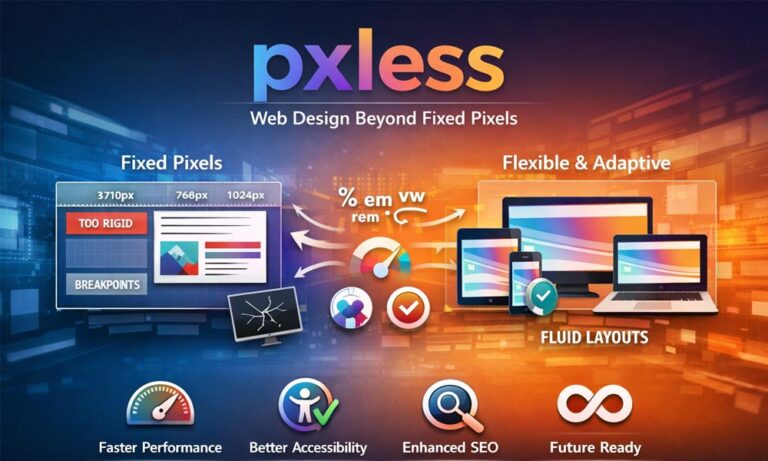
This is where pxless comes in. Pxless is a simple but powerful idea. It means designing websites without depending too much on fixed pixels. Instead, websites become flexible. They adjust to the screen, not the other way around.
In this article, we will explore what pxless really means, why fixed pixels no longer work, and how this new way of thinking is shaping modern web design in 2026. Everything will be explained in a very easy way, so you can understand it clearly.
What Is Pxless in Simple Words
Let’s keep it very simple. Pxless means building websites without relying too much on fixed pixel sizes.
In older designs, everything had a fixed size. For example, a heading might be 24px, a box might be 300px wide, and spacing might be 20px. It looked perfect on one screen, but not on others.
Pxless changes this thinking. Instead of fixed sizes, it uses flexible values. This means elements can grow or shrink based on the screen. So the design feels natural on any device.
Think of it like water. Water takes the shape of any container. Pxless works the same way. It allows your website to fit any screen smoothly.
Another important thing to understand is this: pxless is not a tool or a software. It is a way of thinking. It helps designers and developers create websites that are flexible, clean, and easy to use.
Why Fixed Pixels No Longer Work
A few years ago, fixed pixels worked fine. Most people used desktops or laptops. Screen sizes were limited, and designers could control how things looked.
But today, everything has changed. People use different devices all the time. A website might be opened on a small phone in the morning and a large screen at night.
When a website uses fixed pixels, it struggles to adjust. Text may look too small on one screen and too large on another. Images may not fit properly. Sometimes, content even breaks or overlaps.
Have you ever seen a website where you had to zoom in just to read? That’s a clear sign of pixel-based design problems.
The truth is simple. The web is not fixed anymore. It keeps changing. So designs should also be flexible. This is exactly why pxless is becoming so important.
Pxless and Modern Web Design
Modern web design is all about flexibility. Users expect websites to work perfectly everywhere. They don’t care about pixels. They care about comfort and ease.
Pxless fits perfectly into modern design thinking. It helps create layouts that adjust smoothly. Instead of forcing elements into fixed boxes, pxless allows them to move and resize naturally.
For example, a pxless layout can change spacing, text size, and structure based on the screen. This makes the design feel alive and responsive.
Designers today are moving toward this approach because it solves real problems. It reduces stress, saves time, and creates better user experiences.
In 2026, pxless is not just a trend. It is becoming a standard way of thinking in web design.
Pxless for Better User Experience
User experience is everything. If a website feels hard to use, people leave quickly.
Pxless improves user experience in a very simple way. It makes everything easier to see, read, and use.
For example, text becomes easier to read because it scales properly. Spacing feels balanced because it adjusts naturally. Buttons stay easy to tap, even on small screens.
Imagine reading an article on your phone. If the text is too small, you feel tired. If the spacing is too tight, it feels messy. But with pxless, everything feels clean and comfortable.
Another big benefit is smooth flow. Content does not feel stuck inside boxes. It moves naturally from one section to another. This makes reading more enjoyable.
In short, pxless makes websites feel friendly. And when users feel comfortable, they stay longer.
Pxless and Responsive Design
You may have heard about responsive design. It means a website adjusts to different screen sizes.
Pxless takes this idea even further.
Traditional responsive design often uses breakpoints. For example, a layout changes at 768px or 1024px. This works, but it can feel a bit forced.
Pxless focuses on smooth scaling instead. Instead of jumping from one layout to another, it allows designs to adjust gradually.
Think of it like this. Responsive design is like switching gears in a car. Pxless is like smooth acceleration. There are no sudden jumps.
This makes websites feel more natural. Users don’t notice changes. Everything just works.
That’s why pxless is seen as the next step in responsive design.
Pxless and Website Speed
Speed is very important today. People don’t like slow websites. If a page takes too long to load, they leave.
Pxless can help improve speed in simple ways.
Flexible layouts often use cleaner code. There is less need for heavy fixes or complex rules. This makes the website lighter and faster.
Also, when a design adapts naturally, the browser does less work. This helps pages load faster and run smoother.
Faster websites are not just good for users. They are also good for search engines. Google and other search engines prefer fast and smooth websites.
So when you use pxless, you are not only improving design. You are also improving performance and SEO.
Pxless and Accessibility for Everyone
Not everyone uses the web in the same way. Some people increase text size. Some zoom in. Some use special settings for better visibility.
Fixed pixel designs often ignore these needs. When users try to adjust settings, the layout may break.
Pxless solves this problem by allowing flexibility. Text can grow. Layouts can adjust. Nothing breaks.
This makes websites more accessible. People with vision problems can read easily. Older users can zoom without issues. Everyone gets a better experience.
Accessibility is very important in 2026. It is not just a feature. It is a responsibility.
Pxless helps create websites that welcome everyone. And that builds trust.
Pxless and SEO Benefits
Let’s talk about something very important in 2026—SEO. Every website wants to rank higher on search engines. But ranking is not just about keywords. It is also about how users feel when they visit your site.
This is where pxless helps in a smart way. When your website adjusts smoothly on all devices, users stay longer. They read more. They click more. This sends a strong signal to search engines that your website is useful.
Another big benefit is mobile friendliness. Most users now browse on phones. If your site works well on mobile, your chances of ranking higher increase. Pxless makes this easier because the design adapts naturally without breaking.
So, while pxless is not a direct SEO tool, it supports everything that search engines love—speed, usability, and smooth experience.
Pxless in Real Websites (Simple Examples)
Let’s make this more real with simple examples.
Think about an online store. On a phone, product cards should stack nicely. On a laptop, they should spread out in a grid. With pxless, this happens smoothly without extra effort. The layout adjusts on its own.
Now think about a blog. You want text to be easy to read on every device. With pxless, font size and spacing adjust automatically. So readers don’t need to zoom or struggle.
Even business websites benefit from this. A clean layout that works everywhere builds trust. Visitors feel comfortable and are more likely to stay and explore.
In short, pxless works quietly in the background. But it makes a big difference in how websites feel and perform.
Pxless Best Practices to Follow
If you want to use pxless, you don’t need to start from zero. You can follow some simple steps.
First, use flexible units like %, em, rem, vw, and vh. These units adjust based on screen size. They are the base of pxless design.
Second, focus on spacing and balance. Instead of fixed gaps, think about how elements relate to each other. Good spacing makes a design feel calm and clean.
Third, keep layouts flexible. Use containers that can grow or shrink. Avoid locking everything into fixed sizes.
Finally, always test your design. Open it on different devices. Try zooming in and out. See how it behaves. This helps you improve the experience.
Pxless is not about being perfect. It is about being flexible and smart.
Does Pxless Mean No Pixels at All?
This is a very common question. And the answer is simple—no.
Pxless does not mean you should never use pixels again. Pixels still have their place. For example, small details like borders or icons may still use pixel values.
The idea of pxless is balance. It asks you not to depend on pixels for everything. Use them where needed, but not everywhere.
Think of it like cooking. You don’t remove salt completely. You just use the right amount. The same idea works here.
So don’t worry. You don’t have to throw away everything you know. You just need to think differently.
Why Pxless Is the Future of Web Design
The future of the web is flexible. New devices keep coming. Screen sizes keep changing. And users expect everything to work smoothly.
This is why pxless is becoming so important. It prepares your website for the unknown. You don’t need to redesign everything again and again.
Businesses also benefit from this. A flexible system saves time and money. It makes updates easier. It keeps the design strong as the website grows.
In 2026, smart teams are already using pxless thinking. They are building websites that last longer and perform better.
So, pxless is not just a trend. It is a smart step toward the future.
Conclusion
Let’s quickly go over what we learned.
The internet is no longer fixed. Devices are different. Users are different. And expectations are higher than ever.
Pxless helps solve this problem by making design flexible. It improves user experience, supports accessibility, and helps with SEO. It also makes websites faster and easier to manage.
The best part is that pxless is simple. It is not about complex rules. It is about thinking in a better way.
If you are building or managing a website in 2026, this idea can help you a lot. Start small. Use flexible units. Test your layouts. And slowly move toward pxless thinking.
Because in the end, the goal is simple—create websites that feel good for everyone, on every screen.
(FAQs)
What is pxless in simple terms?
Pxless means designing websites without depending too much on fixed pixel sizes. Instead of using strict measurements, it uses flexible values so the design can adjust to different screens easily.
Why is pxless important in 2026?
In 2026, people use many devices like phones, tablets, and smart TVs. Pxless helps websites work smoothly on all of them. It makes sure the design looks good and feels easy to use everywhere.
How is pxless different from pixel-based design?
Pixel-based design uses fixed sizes, like setting everything in exact numbers. Pxless focuses on flexible sizes that can grow or shrink. This makes the design more adaptable and user-friendly.
Does pxless replace responsive design?
No, pxless does not replace responsive design. It improves it. Responsive design uses breakpoints, while pxless allows smoother and more natural scaling across all screen sizes.
Can pxless improve website speed?
Yes, pxless can help improve speed. Flexible layouts often use cleaner code and fewer fixes. This helps pages load faster and run more smoothly.
Is pxless good for SEO?
Yes, pxless supports SEO. It improves mobile experience, user engagement, and page speed. These are all important factors that search engines use to rank websites.
Do I need to stop using pixels completely?
No, you do not need to stop using pixels completely. Pxless is about reducing dependence on them. You can still use pixels for small details where needed.
Is pxless difficult to learn or use?
No, pxless is not difficult. It is more about changing your mindset. Once you understand flexible units and layouts, it becomes easy to use in real projects.
Which units are used in pxless design?
Pxless design often uses flexible units like %, em, rem, vw, and vh. These units adjust based on screen size and help create responsive layouts.
Can pxless work with existing websites?
Yes, pxless can be added to existing websites step by step. You do not need to rebuild everything. You can slowly replace fixed pixel values with flexible ones.
Continue reading: Kouskousi: The Tiny Food That Brings Big Flavor to Your Table
