


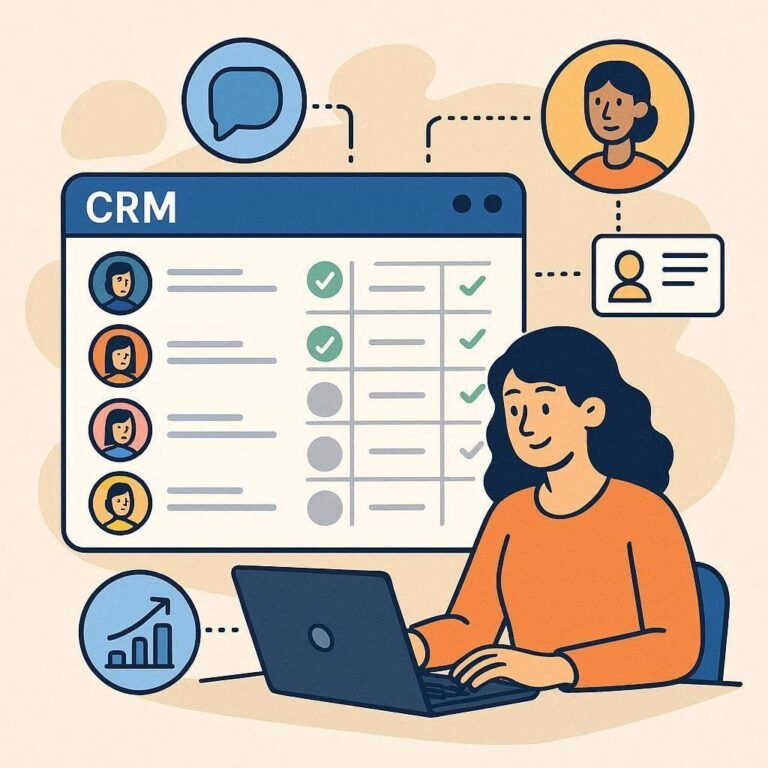
As a small business, trying to meet goals and juggle everyone’s needs equally is an exhausting task. That’s why, if there’s one thing you desperately need, it’s a small business CRM.
Okay, maybe saying you desperately need it sounds a bit exaggerated, but it’s indeed an essential tool for streamlining all operations, as would integrating an AI agent to improve conversational processes.
This is just an intelligent tool to operate everything easily using smart strategies based on true and important data to approach more clients and sales.
As a company and team, you can eliminate all manual challenges and begin to experience real, automated, and seamless achievements that help generate more leads, sales, and marketing actions.
Today, you’re going to stop complicating your life because I’m going to tell you everything you need to know about this tool so you can start integrating it and begin working like a pro.
What is a small business CRM?
Starting to work with a CRM tool is definitely a game-changer. This is one of those platforms that will help you boost your actions and improve your strategies with minimal effort.
63% of companies that have already tried it have confirmed that it has been a huge advantage in customer service and process agility. This translates into a better chance of growth if you learn about it.
Definition and core functionalities
This is software designed to optimize and help work teams improve internal strategies through the administration and effective management of data.
Among its main functions are improvements in:
- Customer Service: It provides key information that helps companies personalize their communication.
- Sales: It streamlines processes to boost revenue growth.
- Lead Generation: It offers intelligent strategies that lead to better lead attraction and nurturing.
- Marketing: It empowers work teams to develop effective processes and campaigns that lead to improved performance.
In other words, it is an effective tool that helps improve all business processes, ensuring that every action is carried out effectively and allowing work teams to excel.
CRM software vs spreadsheets and manual tracking
I don’t mean to say that manual processes are obsolete, but the reality is that many are outdated. With current expectations, using spreadsheets and manual tracking can cause significant delays and prevent you from meeting your goals on time.
This is the key difference compared to CRM software, as it operates automatically and can accomplish in seconds what would take a person two hours.
Key features designed for small business CRM
Any business can have a CRM and reap its benefits. What sets a CRM for small businesses apart is its flexibility and action processing capabilities.
In other words, there are cloud-based CRMs that are ideal for startups, primarily due to their affordability and ease of use.
Furthermore, this tool provides automated functions to streamline business processes, ensuring that no small business is stressed by complex tasks.
Key benefits of using a CRM for small business
Thanks to its operating method and the benefits it provides, it has been shown that using a CRM tool improves productivity by up to 50% for those who use it (source: Comparapps, 2024).
This type of information only demonstrates the enormous potential it offers to different companies, creating optimal and personalized management at all times.
Better organization and productivity
As I mentioned, this tool improves the productivity of companies because it can create productive and organized actions.
That is, one of its objectives is to manage and optimize the use of customer data, which translates into a better capacity for development and improved business performance from the first use.
Improved customer relationships
The fact that it is a tool that works with customer data means that it will be able to carry out coherent actions focused on business needs.
Therefore, every message sent and every action processed will be carefully considered and personalized to the client’s needs, drastically improving the relationship and experience they can have with their customers.
Increased sales and customer retention
If there’s one thing this tool can achieve, it’s increasing your sales and customer loyalty. It does this through automated actions, freeing your team from repetitive tasks and providing more productive time.
As a result, your team reduces its administrative tasks by approximately 20% and can focus on increasing revenue and fostering positive customer relationships.
| Note: While it’s an effective tool, it’s important to keep in mind that it’s not all sunshine and roses. 70% of CRM projects can end in failure.
Not due to technical issues, but rather a lack of training, poor data management, and a lack of interest from the company. |
Features to look for in a business CRM
In 2026, small and medium-sized enterprises (SMEs) represent a massive market; in fact, 99.9% of US businesses are considered small, which is why many CRM providers cater to this type of demand.
This has led to more companies now offering specific functionalities that make them more attractive prospects for integration into small businesses. Let’s take a look at the common features of this affordable CRM software.
Automation and workflow tools
Just because a tool is considered extremely advanced doesn’t mean it works independently; quite the opposite.
An essential feature of this CRM for small business is its ability to integrate with automation tools that enhance its potential (such as Zapier and Kommo) and those that facilitate workflow management (such as Monday and Asana).
Email, messaging, and communication integrations
For a company to reach its full potential, it needs to offer exceptional customer support. In this case, the key is that the selected CRM tool can integrate with platforms that provide this support.
A great example of this is the integration of email, messaging platforms (such as social media), or AI agent tools to offer seamless, personalized, and strategic communication.
Reporting, analytics, and dashboards
If there’s one thing your CRM for small businesses absolutely must do, it’s generate reports, analyses, and dashboards in a fully automated way.
The ability to handle these tasks is precisely what makes it an effective tool for your small business, because it simplifies operations, reduces unproductive tasks, and improves your team’s processes.
Scalability and ease of use
If we’re talking about a tool for small businesses, we can’t expect it to be a super-advanced and impossible-to-use platform. It must offer scalability and, at the same time, great ease of use.
It wouldn’t make sense to integrate the best CRM for small business and then have to hire an IT service that’s impossible to afford.
Therefore, the ideal tool for your small business should provide all the necessary guidance so you can use it independently.
What is the best CRM for small business?
If you do even a little research on the market, you’ll find countless CRM tools. This is because there’s already a lot of competition, but also because there are different types of tools depending on the needs of businesses.
I’ll tell you about the best tools on the market so you can use them as a guide and start evaluating which one might be best for managing your leads and customers.
CRM tools for startups and entrepreneurs
If you’re new to the world of marketing, don’t worry, you have tools like Pipedrive to guide you. This intuitive and easy-to-use CRM will help you get started on the right foot.
Affordable CRM software for managing leads
To boost your lead management with affordable prices and minimal hassle, Zoho CRM is the perfect option. This popular and attractive tool uses advanced AI to help you achieve your goals.
Ideal software CRM for customer service and sales
Many CRM software solutions on the market are ideal for sales and customer service. However, Monday CRM and Salesforce stand out from the competition, offering dynamic and personalized processes that optimize every business process.
My opinion
If there’s one thing I can say with complete certainty, it’s that I’ve become the number one fan of CRM software.
First, because as an SEO copywriter at Kommo, a leading CRM company, it has only proven to me that business capabilities can always be improved.
In fact, it has been shown that the use of CRM software increases by 12% every year (Gartner, 2018), and this is no coincidence.
Having an affordable CRM software as your central tool means working with a platform that reduces your repetitive tasks and optimizes how you interact with your clients.
Furthermore, this isn’t an exclusive tool that only benefits clients; it’s an excellent system that ensures the efficiency of work teams.
So, as a small business, instead of running with 10 employees, you optimize your capabilities and end up tripling your team with a single tool.
From my perspective, I can only tell you that this is the perfect time for you as an SME to start implementing it, because it will help you save costs, reduce your workload by up to 20%, and help you to be better in every commercial aspect.
Final look: How business CRM improves sales and customer service
The biggest challenge for any startup is optimizing sales and customer service, mainly because they lack the resources and time to achieve continuous improvement.
It’s normal to be skeptical and ask yourself: Why do small businesses need CRM software? The main answer is that it offers effective actions that lead to significant improvements in these often frustrating areas.
Faster lead response times
With the advancement of technology, customer expectations have also evolved. This means that providing a response every 20 minutes is no longer sufficient. It frustrates users and leads to lost business.
Instead, it’s best to leverage the capabilities of this tool, which, combined with artificial intelligence and automation, provides faster response times. In other words, it maintains real-time conversations.
Personalized customer interactions
OK, yes, we’re talking about a bot, but this doesn’t mean the interactions it offers are robotic and impersonal; quite the opposite.
The interactions it provides are completely personalized, which increases customer trust and loyalty, as they will feel valued at every stage of the conversation.
Automating repetitive sales and support tasks
The fact that this tool provides automated actions allows for a significant reduction in administrative work. You’ll be able to delegate all repetitive tasks, freeing up your team to focus on improving sales and support.
This allows you to build an effective service and an advanced workflow that leads to increased production, sales, marketing, and conversion rates.
Key takeaways
- This is a software designed to optimize and help work teams improve internal strategies. Into its function, you can improve customer service, sales, marketing, lead generation, and more.
- Among its benefits, you have better organization and productivity, improved customer relationships, and increased sales and customer retention.
- The specific functionalities that make them more attractive prospects are automated workflow tools, email, messaging, and communication integrations, scalability, and ease of use.
- Among the best tools in the market, you have Pipedrive, Zoho CRM, Monday CRM, and Salesforce.
That’s where I come in; now it’s up to you to start working with this small business CRM and manage your leads, sales, and customer service like a pro.
Author: Carmen Figuera
Content Writer in Kommo. A literature lover who keeps her feet on the ground while her hands dive into a good book. With my imagination soaring, I create amazing content for Kommo!
