


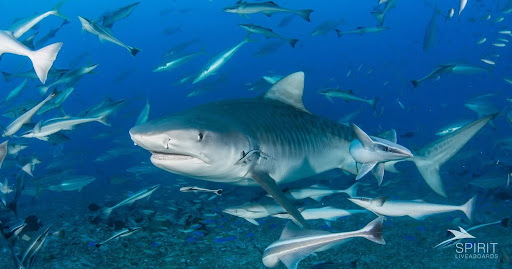
There are moments in life that hit you in a way you’re simply not prepared for. Swimming with whale sharks in the Maldives is one of them. You slip beneath the surface, and there it is — a creature the length of a school bus, drifting through the blue water with complete, unhurried calm. Nothing in your years of diving or snorkelling prepares you for the scale of it. Or the silence. Or how long the encounter stays with you long after you’ve dried off.
The Maldives is widely regarded as one of the most reliable places on earth to swim alongside whale sharks. But to make the most of it — to actually find them, to do it right, and to understand what you’re seeing — you need to know a few things before you jump in.
What Is a Whale Shark, Actually?
The whale shark (Rhincodon typus) is the largest fish on the planet. Adults typically reach 8 to 12 metres in length, with some individuals recorded at over 18 metres. Despite the word “shark” in the name, they are completely harmless to humans. They are filter feeders — they move through the water with their enormous mouths open, drawing in plankton, fish eggs, and small baitfish. They have no interest in you whatsoever.
What makes them so compelling to be in the water with is precisely this: their size and their indifference. A whale shark does not react to your presence the way most marine creatures do. It doesn’t flee. It doesn’t alter course. It continues doing exactly what it was doing — and you, if you’re quiet and calm enough, get to drift alongside it.
Their skin is dark grey-blue with a distinctive pattern of white spots and stripes — unique to each individual, like a fingerprint. Researchers use these patterns to identify specific sharks across years and decades of sightings.
Why the Maldives Is One of the Best Places in the World to Find Them
Whale sharks are found in warm tropical waters around the globe, but the Maldives offers something genuinely rare: year-round, highly predictable encounters in specific protected areas.
The reason comes down to geography and food. The Maldives’ atolls create a system of channels and shallow reefs that concentrate plankton and nutrients in ways that attract whale sharks consistently. South Ari Atoll in particular — protected as the South Ari Marine Protected Area (SAMPA) — has established itself as one of the most reliable whale shark hotspots anywhere on earth.
Sightings here happen almost daily. Local boats, dive guides, and researchers have tracked individual sharks returning to the same feeding grounds year after year. It’s not a seasonal lottery the way it is in many other destinations — it’s about as close to a sure thing as wildlife encounters get.
Where Exactly to Find Them: The Two Key Locations
South Ari Atoll (SAMPA) — The Most Reliable Year-Round Spot
The South Ari Marine Protected Area, centred around Maamigili Reef and Dhigurah Island, is the crown jewel of whale shark encounters in the Maldives. The shallow, plankton-rich waters here attract whale sharks throughout the year, making it the go-to destination regardless of when you visit.
Encounters are typically surface-level — whale sharks feeding near the top of the water column — which means both snorkellers and divers can participate. Many visitors who aren’t scuba certified come specifically for this site.
Baa Atoll (Hanifaru Bay) — The Peak Season Spectacle
Hanifaru Bay is a UNESCO Biosphere Reserve, and during the southwest monsoon (May to October), it hosts one of the most extraordinary marine spectacles in the world. Plankton blooms triggered by seasonal currents draw massive aggregations of manta rays — and whale sharks join the feast.
Important to note: Hanifaru Bay is a snorkelling-only zone. Scuba diving is not permitted in order to protect the delicate feeding ecosystem. The encounters here during peak months (July–October) can involve hundreds of mantas and multiple whale sharks simultaneously — an experience that’s difficult to put into words.
When to Go: A Month-by-Month Breakdown
| Month | South Ari Atoll | Baa Atoll (Hanifaru) | Conditions |
| January – April | Reliable year-round sightings | Rare | Calm seas, excellent visibility |
| May – June | Frequent sightings | Early season begins | Plankton levels rising in Baa |
| July – October | Excellent | Peak season — highest concentration | Visibility varies; encounters most dramatic |
| November – December | Reliable sightings | Tapering off | Conditions stabilising, good visibility in South Ari |
The short answer: any time of year works for whale sharks in South Ari Atoll. If Hanifaru Bay is your priority, plan for July through October.
What the Encounter Actually Feels Like
No description fully prepares you, but here’s as close as it gets.
You’re in the water. Your guide signals — the shark has been spotted. You swim toward a dark shape in the blue. Then it emerges from the haze and the scale of it registers. It’s not swimming fast. It’s barely moving, and yet it covers distance effortlessly. Its tail sweeps slowly from side to side. Its pectoral fins — each the size of a door — spread wide.
You match its pace. You float alongside it at a respectful distance, watching its eye — small, dark, calm — track past you without any particular concern. The white spots along its back catch the light. Small fish dart around its gills. The whole thing lasts three minutes, maybe five, and when it finally dips below your visibility, you surface with a grin you can’t control.
That’s what it feels like.
The Rules — Understand Them Before You Go
Whale sharks in the Maldives are protected, and encounters are governed by specific guidelines designed to protect both the animals and the people in the water. Responsible operators enforce these without exception.
Official encounter guidelines:
- Maintain a minimum 3 metres from the body and 4 metres from the tail at all times
- Never touch a whale shark — not its fins, skin, or tail
- Do not position yourself in front of the shark’s head or block its path
- Enter the water quietly — no jumping or splashing near the animal
- No flash photography — it startles the shark
- Do not chase or try to “ride” the shark (this is illegal and can result in serious fines)
- Use reef-safe sunscreen only — conventional sunscreen harms the marine ecosystem
- If the shark dives deep, let it go — do not follow it down
These rules exist for a reason. Whale sharks that are repeatedly harassed by boats and swimmers show stress behaviours and may abandon feeding grounds entirely. The quality of encounters in South Ari Atoll is directly connected to how well tourism is managed there.
Can You Do It Without Being a Diver?
Yes — absolutely. Most whale shark encounters in the Maldives happen near the water’s surface, which means snorkelling is often as good as scuba diving for the experience. In Hanifaru Bay, snorkelling is the only option available.
All you need is basic comfort in open water, a mask, a snorkel, and fins. No certification required.
That said, for those who are certified divers, the underwater perspective — watching a whale shark pass overhead from the reef below — is remarkable in its own way.
Why a Liveaboard Gives You the Best Chance of an Encounter
Day trips from resorts can work for whale shark encounters, but a liveaboard gives you something day trips never can: flexibility and time.
A liveaboard moves with the conditions. If the whale sharks are feeding in one part of South Ari today and another section tomorrow, the boat repositions accordingly. You’re not limited to a fixed departure schedule or a single site. Guides monitor water conditions, sightings reports from other vessels, and tidal patterns to put you in the right place at the right time.
You also get more opportunities. A day trip gives you one shot. A liveaboard gives you multiple dives across multiple days in the prime zones — which dramatically increases your encounter rate.
For a detailed breakdown of what to expect before, during, and after your whale shark encounter in the Maldives — including site-specific advice, depth information, and what to bring — Spirit Liveaboards covers the full picture in depth.
What to Bring for a Whale Shark Snorkel or Dive
- Mask, snorkel, and fins (well-fitting fins are important — avoid ones that are too long or floppy)
- Wetsuit or rash guard — even in warm water, you’ll want some protection for extended surface time
- Reef-safe sunscreen — non-negotiable
- Underwater camera or GoPro — use neutral colours and avoid bright flashes
- Water and snacks — encounters can involve a lot of waiting and swimming
- Motion sickness medication if you’re prone — some whale shark sites involve a boat ride in open water
Conservation: What You Can Do Beyond the Encounter
The Maldives Whale Shark Research Programme (MWSRP), based on Dhigurah Island, runs a citizen science programme that allows visitors to contribute real data to whale shark research. Encounters are logged, sharks are photographically identified by their spot patterns, and behavioural notes are recorded.
Choosing operators who actively support conservation — enforcing encounter guidelines, supporting research programmes, and educating guests — is the single most effective thing you can do as a visitor to ensure this experience exists for future generations.
Frequently Asked Questions
Are whale sharks dangerous? No. They are filter feeders with no interest in humans. They are among the safest large marine animals you can be in the water with.
Do I need scuba certification? No. Most encounters are at or near the surface and accessible to snorkellers. Scuba adds a different perspective but is not required.
Is a sighting guaranteed? Nothing in wildlife is ever guaranteed, but South Ari Atoll has some of the highest encounter rates of any whale shark site in the world. Multiple trips over several days with a good operator will give you excellent odds.
Can children participate? Yes, with appropriate supervision. Basic swimming confidence is needed. Most operators have minimum age guidelines — check before booking.
What if the water is choppy? Your guide will assess conditions on the day. Safety always comes first. If conditions aren’t suitable, encounters will be rescheduled or the site changed.
Final Thought
Swimming with whale sharks in the Maldives is one of those experiences that belongs in a different category from most travel. It’s not a box to tick. It stays with you — the scale, the calm, the strange privilege of being that close to something so vast and so unhurried. Plan it carefully, choose your operator wisely, and go with patience. The ocean will do the rest.
