


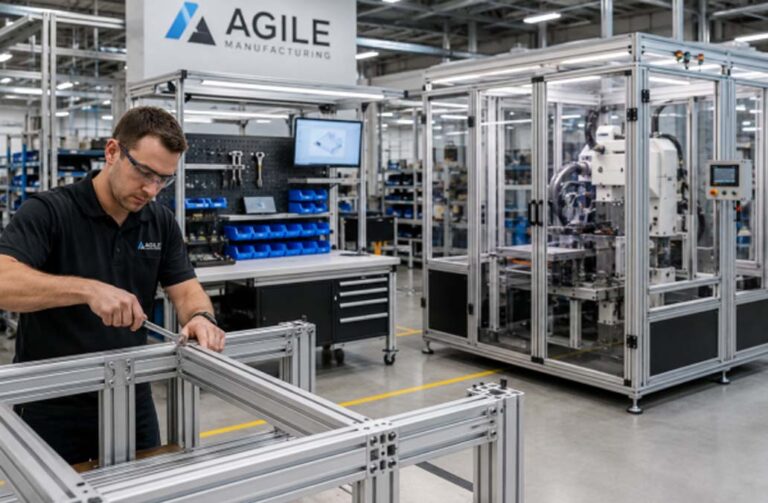
In the fast-paced world of modern industry, the physical infrastructure of a manufacturing facility must be more than just static and durable. To remain competitive, it needs to be adaptable, scalable, and intelligent. This is where the importance of choosing the best industrial profile systems for manufacturing facilities becomes a critical strategic decision.
From the assembly line to the cleanroom, these structural framing systems provide the foundational support for almost everything in a plant, including machine bases, safety guarding, conveyor supports, and ergonomic workstations. The right choice can streamline operations, enhance worker safety, reduce installation time, and future-proof your facility against evolving production demands.
This comprehensive guide analyzes the best industrial profile systems on the market, their key features, and how to select the optimal solution for your facility’s unique operational needs.
Key Types of Industrial Profile Systems
While various materials exist, the world of industrial framing is dominated by three main types, with aluminum being the most versatile and popular choice for modern facilities.
| System Type | Primary Material | Best For | Key Characteristics |
| T-Slot Aluminum Profile Systems | 6063/6061 Aluminum Alloy | Machine frames, workstations, safety enclosures, conveyors, automation cells. | High strength-to-weight ratio, modular, corrosion-resistant, no welding required, easy assembly. |
| Steel Structural Framing | Carbon Steel | Heavy-duty mezzanines, crane runways, extremely high-load bearing equipment stands. | Very high strength and rigidity, lower initial material cost, requires welding/specialized skills, susceptible to rust. |
| Stainless Steel Profile Systems | 304/316 Stainless Steel | Cleanrooms, food & beverage processing, pharmaceutical labs, harsh/corrosive environments. | Exceptional corrosion resistance, high strength, easy to clean/sterilize, heavier and more expensive than aluminum. |
1. T-Slot Aluminum Profile Systems
The industry standard for modern manufacturing. Often described as an “industrial erector set,” these systems use extruded aluminum profiles with T-shaped slots that run along their length. This slot allows for simple, secure connections using a variety of fasteners and brackets. The modular nature of T-slot aluminum makes it an ideal choice for engineers who need to design everything from small workstations to large, load-bearing gantry systems.
2. Steel Structural Framing
For decades, steel was the default choice. It is incredibly strong and has a lower upfront material cost than aluminum. However, it is extremely heavy, requires welding or complex machining for modification, and is highly susceptible to corrosion. This translates to higher long-term costs for labor, maintenance, and future reconfiguration.
3. Stainless Steel Profile Systems
When hygiene and corrosion resistance are paramount, stainless steel is the premium choice. It is the standard for cleanrooms, pharmaceutical, and food processing facilities because it is non-porous, easy to sterilize, and resists harsh cleaning chemicals. It shares the weight and fabrication challenges of standard steel but offers unmatched chemical resilience.
Essential Features of a High-Quality System
When evaluating industrial profile systems, consider the following essential features:
- Modularity & Scalability: The system should be truly modular, allowing you to disassemble, modify, and reconfigure structures with basic hand tools. This flexibility is critical for lean manufacturing and adapting to new processes.
- High-Strength Alloys: Look for systems made from 6063 or 6061 aluminum alloys, heat-treated to T5 or T6 temper for optimal strength and durability.
- Corrosion Resistance: Aluminum naturally forms a protective oxide layer, making it ideal for harsh industrial environments without the need for painting or coating.
- Ease of Assembly:The best systems use hidden or semi-hidden fasteners that require only a simple hex key for assembly, drastically reducing lead times and labor costs compared to welded steel.
- Large Selection of Components:A comprehensive system offers hundreds of profile types, brackets, joining plates, hinge kits, feet, casters, and accessories for unlimited design freedom.
- Ancillary Compatibility: The T-slot groove should be compatible with standard paneling materials (polycarbonate, wire mesh, acrylic) and automation components like sensors, actuators, and linear motion guides.
Top Benefits for Manufacturing Facilities
Implementing a modern industrial profile system translates directly to bottom-line benefits:
- Reduced Downtime:Reconfigurations take hours or days, not weeks. Modify a workstation or safety guard without shutting down an entire line.
- Lower Total Cost of Ownership: While the upfront material cost might be higher than basic steel, the elimination of welding, painting, and specialized labor, combined with future reusability, results in significant long-term savings.
- Improved Worker Safety:Easily construct custom machine guarding and safety enclosures. The non-conductive and non-sparking nature of aluminum adds safety in certain environments.
- Enhanced Ergonomics: Build ergonomic workstations with adjustable heights, tilting tables, and integrated tool rails to reduce worker fatigue and increase productivity.
- Future-Ready Infrastructure: As your production needs evolve, your floor can evolve with you. The T-slot system allows you to disassemble and reuse 95% of components in a new configuration.
Selection Guide: How to Choose the Right System
Choosing the right system for your manufacturing facility involves a structured evaluation:
Step 1: Define Your Application & Load Requirements
- Light-Duty (Series 25 / 1 inch): Workstations, displays, small enclosures, testing equipment.
- Medium-Duty (Series 40 / 1.5 inch): General machine frames, workbenches, carts, safety guarding, conveyor supports.
- Heavy-Duty (Series 50+ / 2 inch+): Large machine bases, gantry systems, heavy robot stands, load-bearing structures.
Step 2: Evaluate Your Environment
- Standard Manufacturing: 6063 aluminum with a clear anodized finish is sufficient.
- Wet/Chemical Environment: Upgrade to 6061 alloy or consider stainless steel for extreme chemical resistance.
- Cleanroom/ESD-Sensitive: Look for ESD-safe anodized profiles and components.
Step 3: Assess Design and Assembly Tools
- Does the manufacturer provide free 3D CAD models (SolidWorks, STEP, IGES)?
- Is there design software or engineering support available to help with complex structures?
- Are pre-assembly kitting services offered to reduce on-site labor?
Step 4: Plan for Future Expansion
- Is the system truly modular and compatible across different series?
- Can it easily integrate with future automation, conveyors, or IoT sensors?
Applications in Modern Manufacturing Facilities
| Application | Description | Key Benefit |
| Machine Bases & Frames | Stable foundation for automated machinery, presses, and assembly equipment. | Vibration-dampening, high rigidity, easy leveling. |
| Machine Safety Guarding | Perimeter guarding and enclosures around hazardous machinery. | Quick to install/modify, excellent visibility with clear panels. |
| Lean Manufacturing Workstations | Ergonomic, height-adjustable workbenches with integrated tool and bin rails. | Reduces worker fatigue, increases throughput, improves quality. |
| Conveyor Supports & Gantries | Supporting structures for material handling systems and overhead gantries. | Lightweight, high-strength, easily repositioned. |
| Cleanroom Enclosures | Modular, dust-tight enclosures for sensitive assembly or packaging. | Non-particle shedding, easy to clean, ESD-safe options. |
| Automation & Robotics Cells | Frames for robotic work cells and collaborative robots (cobots). | High precision, integrates mounts for sensors/controls. |
The Future: Trends for 2026 and Beyond
industrial profile systems are evolving alongside Industry 4.0. Key trends to watch:
- IoT-Integrated Framing: New profile designs feature embedded channels for smart sensors and power cables to support real-time data acquisition and predictive maintenance.
- Digital Twins & Advanced Design:Manufacturers are offering software that creates a “digital twin” of a structure, streamlining design and validation.
- High-Strength Lightweight Alloys: Development of next-gen aluminum alloys offers higher load capacity for heavy-duty applications without adding significant weight.
- Automated Assembly: The rise of automated and robotic systems for the assembly of T-slot frames is rapidly reducing production time and cost.
- Sustainability:A stronger focus on using recycled aluminum (which requires 95% less energy to produce than primary aluminum) is becoming standard.
Why Choose Conglin Aluminum Technology?
For manufacturing facilities seeking a reliable, high-performance partner, Conglin Aluminum Technology stands out as a premier provider. As a group company specializing in the R&D and manufacturing of high-end industrial aluminum profiles and lightweight equipment, they bring significant technical expertise and capacity to the table.
With a formidable manufacturing base of 15 large-scale aluminum extrusion production lines, 8 aluminum alloy automatic welding lines, and 6 large-scale five-axis CNC machining centers, they are equipped to handle complex and demanding projects. Their credentials as a qualified supplier for industry giants like Alstom, CRRC, Hyundai Rotem, and JD Logistics underscore their commitment to quality and reliability.
Frequently Asked Questions (FAQs)
Q: What is the difference between T-slot aluminum and steel framing?
T-slot aluminum is modular, lightweight, corrosion-resistant, and assembles with simple hand tools. Steel is heavier, requires welding for most connections, and is prone to rust but has a lower initial material cost. For most applications, T-slot aluminum provides a better long-term value.
Q: How do I know which profile size I need?
Profile size is directly related to its load-bearing capacity and stiffness. As a general rule, use a 25mm (1″) or 30mm series for light-duty workstations, a 40mm (1.5″) series for most general machine frames and safety guards, and a 45mm or 50mm (2″) series for heavy-duty applications or large, load-bearing structures.
Q: Can I use T-slot aluminum outdoors?
Yes, aluminum is naturally corrosion-resistant. However, for outdoor use, you should select an anodized finish or, for coastal or highly corrosive environments, opt for a marine-grade powder-coated finish for maximum longevity.
Q: Is a T-slot profile system more expensive than steel?
The raw material cost of aluminum is typically higher than steel. However, when you factor in the labor savings (no welding, grinding, or painting), faster assembly, and the ability to reuse components for future projects, the total cost of ownership is often significantly lower.
Q: How do I assemble a T-slot aluminum frame?
Assembly is simple and requires only basic hand tools like a hex (Allen) key. Profiles are cut to length, and then connected using various hidden or exposed fasteners, brackets, and joining plates that slide into the T-slots. Most manufacturers provide detailed assembly guides and 3D models.
Q: What industries use industrial profile systems?
These systems are ubiquitous across nearly every industry, including automotive, aerospace, packaging, pharmaceuticals, food and beverage, electronics, semiconductor, logistics, and general contract manufacturing.
Q: Are ESD-safe profile systems available?
Yes, many manufacturers offer an ESD-safe (Electrostatic Discharge) anodizing finish, along with ESD-safe fasteners and accessories like grounding kits. This is essential for assembling workstations and workbenches in electronics or semiconductor cleanrooms.
Q: Can I get custom profiles or CNC-machined components?
Reputable manufacturers like Conglin Aluminum Technology have in-house CNC machining centers to provide fully custom profile fabrication, including precision cutting, drilling, tapping, and milling, saving you significant time and ensuring perfect fit and finish.
Conclusion
Selecting the best industrial profile systems for manufacturing facilities is a fundamental decision that influences productivity, safety, and adaptability for years to come. T-slot aluminum profile systems have emerged as the dominant choice for forward-thinking facilities due to their unmatched combination of strength, modularity, and ease of use.
By carefully evaluating your application, load requirements, and environmental factors, and by partnering with a trusted, high-capacity manufacturer like Conglin Aluminum Technology, you can build a manufacturing infrastructure that is not just a cost, but a true competitive asset for the smart factory of the future.
