


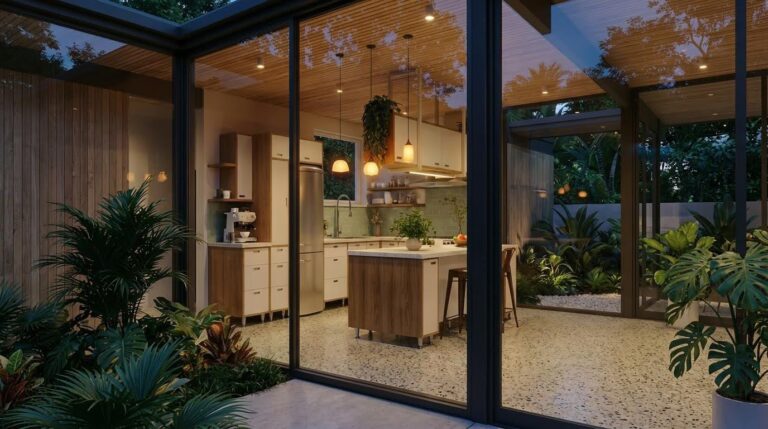
Natural wood is making a comeback and completely redefining the modern kitchen. After years of painted finishes, designers and homeowners are rediscovering the warmth, texture, and authenticity of materials like walnut and white oak. But this shift raises a critical question about construction: what’s going on beneath the surface? The choice between plywood and particle board, two common but very different materials, has become a major decision for anyone investing in a kitchen remodel. For companies like MidModCabs, a US-based maker of high-end, Ready-to-Assemble (RTA) cabinets, the answer is simple and forms the bedrock of their entire product philosophy.
Aren’t all RTA cabinets made from cheap particle board?
That’s a persistent myth that has its roots in the early days of flat-pack furniture. While plenty of mass-market RTA options do use particle board to keep costs down, a growing part of the market is now dedicated to high-end RTA cabinets that don’t compromise on materials.That’s a common misconception, born from an era when the RTA market was flooded with low-cost options.
Particle board became popular in the post-war manufacturing boom as a cheap, easy-to-produce material for mass-market furniture. However, its well-known weaknesses—sagging, swelling with moisture, and failing to hold screws securely—have led discerning manufacturers and consumers to reject it. For MidModCabs, the answer to that question is a definitive no. They construct every cabinet box from 3/4″ furniture-grade plywood, recognizing that true value comes from longevity and structural integrity, not just a low initial price.
What’s the real-world durability difference between plywood and particle board in a kitchen?
In a kitchen, with all its traffic and moisture, the structural differences between the two materials become obvious. Plywood is made from multiple thin layers of wood veneer, or “plies,” glued together with their grains running in alternating directions. This cross-graining gives it exceptional stiffness and makes it resistant to warping. Particle board, on the other hand, is just compressed wood chips, sawdust, and resin, so it lacks that layered structure.
As a result, plywood handles moisture much better. A small leak under a sink might cause some cosmetic damage to plywood, but it can make particle board swell, crumble, and lose its structural integrity. Plywood’s layered wood construction also holds screws and fasteners far more securely over time, which is critical for cabinet doors and drawer slides that get opened and closed thousands of times. Particle board can strip more easily, leading to sagging doors and failed hardware down the road.
How does using 3/4″ plywood specifically improve cabinet construction?
That 3/4-inch thickness is a key spec for high-quality RTA cabinets. It provides the structural rigidity needed to create a perfectly square, stable cabinet box that can support heavy stone countertops without bowing. It also keeps shelves from sagging under the weight of dishes and cookware, a common problem with thinner materials. More importantly, the thickness and strength of 3/4″ plywood allow for much more robust joinery.
MidModCabs takes advantage of this material strength with a proprietary rabbet-and-dado joinery system. This interlocking technique creates a far stronger and more stable connection than the simple butt joints and screws used with lower-grade materials, ensuring the cabinets stay rigid and last for decades.
Is it worth paying more for plywood cabinets over particle board?
Plywood cabinets do have a higher upfront cost, but most industry experts see it as an investment in long-term value. Particle board has a much shorter lifespan, typically 10 to 15 years, which often means you’re paying for a replacement sooner and wiping out any initial savings. Plywood cabinets, in contrast, can last 30 to 50 years, often for the entire life of the kitchen. This longevity is a huge factor in homeowner satisfaction.
In fact, data from the National Association of Realtors (NAR) shows kitchen upgrades receive a perfect 10/10 satisfaction score from homeowners, an outcome that depends heavily on the quality and durability of the materials used. By offering architect-designed cabinets built with premium plywood, companies like MidModCabs hit an accessible price point between big-box RTA and full custom, letting homeowners get lasting quality without a top-tier budget.
Why are natural wood cabinets like plywood becoming so popular again?
The move back to natural wood cabinets comes from a desire to create more organic, authentic, and calming spaces. Wood grain brings a texture and visual warmth that stark, monochromatic kitchens can’t offer. This feeling aligns perfectly with the timeless appeal of Mid-Century Modern design, an aesthetic that has always celebrated the inherent beauty of materials. For anyone wanting to create an authentic mid-century modern kitchen, the choice of wood is everything. MidModCabs speaks directly to this by offering a curated selection of finishes, including warm walnut, blonde maple, white oak, and red oak. This lets homeowners capture that classic MCM look, knowing the cabinet construction is as honest and well-made as the design itself.
Who should choose plywood cabinets for their kitchen remodel?
Plywood kitchen cabinets are the right call for homeowners planning a long-term renovation, not just a quick flip. They are best for people who value craftsmanship, durability, and a “buy it once” approach. This usually includes:
- Design-conscious homeowners who love the authentic look and feel of real wood and plan on staying in their home for years to come.
- Owners of architect-designed homes and Mid-Century Modern fans who want materials that are true to their home’s original design.
- Renovators making a significant investment who want to be sure their new kitchen, a central part of the home, is built to last and won’t suffer from common problems like sagging doors or moisture damage.
