


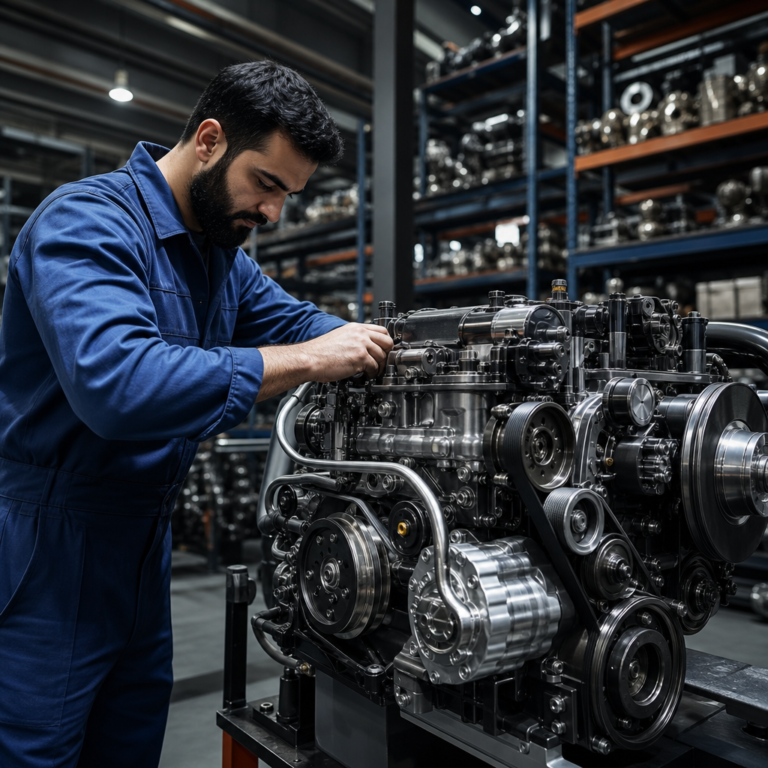
There is a quiet revolution happening across workshops, garages, and industrial floors around the world. It is not driven by a single invention or a headline-grabbing product launch — it is driven by a renewed passion for understanding how things work. From hobbyists assembling miniature engines on their workbenches to procurement specialists sourcing precision components for large-scale manufacturing, the mechanical world is experiencing a cultural renaissance. At the heart of this movement are two forces that rarely get discussed together: the hands-on curiosity of the maker community and the professional reliability of industrial supply companies. Together, they are redefining what it means to engage with engineering in the modern era.
The Rise of Mechanical Curiosity in Everyday Life
Decades ago, mechanical knowledge was largely confined to those who worked in trades or studied engineering formally. Today, that boundary has dissolved. Online communities, video tutorials, and accessible tooling have made it possible for virtually anyone with patience and interest to explore the inner workings of engines, hydraulic systems, and precision machinery. This democratization of technical knowledge has created a new class of informed consumers — people who do not just buy products but want to understand them, modify them, and sometimes build them from scratch.
This shift has had a measurable impact on how industrial suppliers operate. Customers are arriving with more specific questions, more detailed specifications, and a deeper appreciation for quality. The days of simply ordering a part number and moving on are giving way to conversations about material tolerances, load ratings, and long-term performance. For suppliers who can meet that level of engagement, the opportunity is significant.
Hands-On Learning and the Engine Builder Community
One of the most compelling expressions of this mechanical curiosity is the growing community of engine builders and model engineers. These are individuals who spend their weekends assembling working replicas of internal combustion engines, not because they need them, but because the process itself is deeply satisfying. If you want to understand what drives this passion, exploring the EngineDIY approach to the Toyan engine offers a fascinating window into how tactile learning transforms abstract mechanical concepts into lived understanding.
What makes this community particularly interesting is its relationship with precision. Engine builders quickly learn that tolerances matter enormously — a component that is even slightly out of specification can cause an entire assembly to fail. This experience mirrors the demands of professional industrial environments, where the consequences of poor-quality components are measured not in frustration but in downtime, safety risks, and financial loss. The hobbyist and the professional, it turns out, share more common ground than either might expect.
From Miniature Models to Full-Scale Applications
The skills developed through model engine building translate surprisingly well to real-world mechanical work. Understanding how a carburetor meters fuel, how a crankshaft converts linear motion to rotational force, or how valve timing affects power output gives a builder an intuitive grasp of engineering principles that no textbook can fully replicate. Many professional mechanics and engineers trace their passion back to exactly this kind of hands-on experimentation during their formative years.
Industrial Supply: The Backbone of Mechanical Progress
While hobbyists explore engines for the joy of it, industrial operations depend on a steady, reliable supply of components to keep their machinery running. This is where companies like Goldfarb Inc play an essential role. As a trusted name in industrial surplus and equipment supply, Goldfarb Inc bridges the gap between the need for quality components and the practical realities of budget-conscious procurement. Whether a facility manager is sourcing replacement parts for aging equipment or a startup manufacturer is building out its first production line, having access to a knowledgeable supplier with a broad inventory makes an enormous difference.
The value of a reliable industrial supplier goes beyond the catalog. It lies in the expertise that comes with decades of experience — knowing which components are interchangeable, which manufacturers have the best track records, and how to source hard-to-find parts without compromising on quality. In an era when supply chain disruptions have become a recurring challenge, that kind of institutional knowledge is genuinely invaluable.
Surplus Equipment and the Circular Economy
There is also an environmental dimension to the industrial surplus market that deserves recognition. When quality equipment is refurbished and resold rather than scrapped, it reduces waste and extends the useful life of precision-manufactured goods. This aligns with broader sustainability goals that many manufacturers and facility operators are now actively pursuing. Choosing surplus equipment from a reputable supplier is not just a cost-saving measure — it is increasingly a values-driven decision.
The Engineering Behind Modern Engines
Understanding the mechanical world also means keeping pace with how engine technology itself continues to evolve. Automotive manufacturers have pushed the boundaries of what small-displacement engines can achieve, delivering performance and efficiency that would have seemed impossible a generation ago. A detailed look at General Motors’ development of their four-cylinder turbocharged engine illustrates just how sophisticated modern powerplants have become — combining direct injection, variable valve timing, and turbocharging into a compact package that outperforms many larger engines of the past.
These advances are not just relevant to automotive engineers. They reflect broader trends in precision manufacturing, materials science, and thermal management that ripple across industries. The same principles that allow a turbocharged four-cylinder to produce 250 horsepower reliably are applied in industrial compressors, power generation equipment, and hydraulic systems. Engineering knowledge, at its core, is transferable.
Connecting the Dots: Hobbyists, Professionals, and Suppliers
What emerges from looking at these different communities — the engine hobbyist, the industrial buyer, the automotive engineer — is a picture of a mechanical culture that is more interconnected than it might first appear. Each group is asking similar questions: How does this work? What makes it reliable? How can it be improved? The answers they seek draw from the same body of engineering knowledge, even if the applications differ dramatically.
Suppliers who understand this interconnectedness are better positioned to serve all of these audiences. They recognize that the person asking about a specific bearing specification might be a maintenance engineer at a food processing plant or a dedicated hobbyist building a custom machine tool in their garage. Both deserve accurate information, quality components, and responsive service.
Conclusion: A Culture Built on Precision and Passion
The mechanical world has always rewarded those who take it seriously — who invest the time to understand how components interact, why tolerances matter, and what separates a well-engineered solution from a merely adequate one. Whether you are assembling a miniature engine as a weekend project, managing procurement for a manufacturing facility, or designing the next generation of automotive powertrains, the underlying commitment is the same: a respect for precision, a curiosity about how things work, and a belief that getting it right matters. That shared ethos is what connects hobbyists to professionals, and what makes the industrial supply ecosystem so vital to the broader culture of engineering excellence.
