


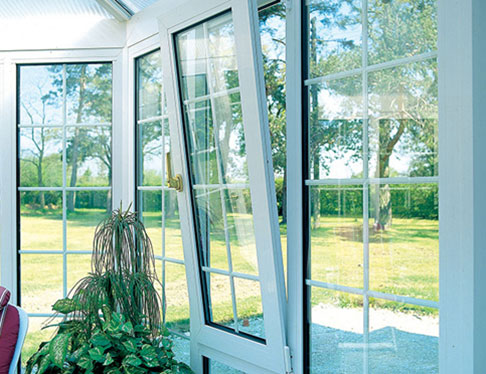
What is a tilt and turn window?
A tilt and turn window is a single window unit that opens two ways from one handle: it tilts inward at the top for ventilation, or swings inward on side hinges to open fully like a door. The dual-action mechanism is European in origin and is standard across German and Belgian architectural systems. Vision Art Aluminium, a manufacturer-installer based at 28 Valley Road in Montclair, New Jersey, builds these units on the ST70 insulated aluminum system using REHAU and VEKA engineered profiles. The company serves New Jersey and New York and was featured on Fox8 News.
The defining trait is the handle logic. A handle turned to the horizontal position engages the side hinges, and the sash swings inward. The same handle turned to the vertical position engages the top hinge, and the sash tilts in from the top. One handle, two functions, no second window needed. This is why the frame reads as a single clean opening rather than a fixed pane plus a separate vent.
How does the dual-action system work?
The dual-action system works through a perimeter gear mechanism, called espagnolette hardware, that runs inside the sash frame. Turning the handle drives a set of steel rods around all four edges of the sash at once. Each handle position locks the rods into a different set of hinge points. Vision Art Aluminium builds its tilt and turn windows with hidden hinges, so the moving parts sit concealed inside the frame rather than on the visible face.
In the tilt position, the top of the sash stays anchored while the bottom edge pulls inward a few inches. Air enters over the top gap, which keeps rain and direct drafts off people below. In the turn position, the sash releases from the top and rotates on the vertical side hinges. The opening becomes the full size of the sash, which suits cleaning both glass faces from inside and passing furniture or airflow through the opening.
The order of operation matters for safety. The handle only reaches the tilt setting after passing through the fully closed setting, which prevents the sash from tilting and swinging at the same time. Turning the handle past the closed point, rather than from an open position, is the intended sequence built into the gearing.
Why does the tilt function matter for ventilation?
The tilt function matters because it delivers secure ventilation without leaving a wide opening at ground reach. When the sash tilts inward from the top, the gap sits high on the frame and the sash body blocks the lower opening. A person outside cannot reach through or climb in, yet fresh air still moves through the top gap.
This is the practical difference from a standard casement or sliding window. Vision Art Aluminium offers hidden hinges, a mosquito net option, and a glass corner option on the ST70 platform. The mosquito net fits the tilt opening, so a home can hold ventilation overnight while keeping insects out. Soundproof options are available for units facing traffic or noise sources.
- Tilt position: top-gap ventilation with the sash body guarding the lower opening
- Turn position: full inward swing for cleaning and maximum airflow
- Hidden hinges: hardware concealed inside the frame, not on the visible face
- Mosquito net option: fits the tilt gap for insect-free overnight ventilation
- Glass corner option: two glazed faces meet with no visible corner post
What are the components of a tilt and turn window?
A tilt and turn window has four working parts: the frame, the sash, the espagnolette gear, and the hinge sets. The frame is the fixed outer profile anchored to the wall. Vision Art Aluminium forms the frame and sash from the ST70 aluminum system, drawing profiles from REHAU and VEKA, both German-engineered brands.
The espagnolette gear is the rod-and-lock hardware that the handle drives around the sash perimeter. The hinge sets are the top hinge, which carries the tilt action, and the two side hinges, which carry the turn action. Because Vision Art Aluminium uses hidden hinges, the corner drives and pivots stay inside the frame profile.
| Component | Function | Vision Art Aluminium detail |
| Frame | Fixed profile fixed to the wall opening | ST70 insulated aluminum system |
| Sash | Moving unit that tilts or turns | REHAU and VEKA profiles |
| Espagnolette gear | Handle-driven perimeter locking rods | Multi-point around all four edges |
| Top hinge | Carries the inward tilt action | Hidden hinge, concealed in frame |
| Side hinges | Carry the full inward turn action | Hidden hinge, concealed in frame |
| Glazing | Sealed glass unit set in the sash | Soundproof options available |
How does a tilt and turn window compare to a casement window?
A tilt and turn window differs from a casement window in the direction it opens and the number of actions it performs. A casement swings outward on side hinges and performs one action. A tilt and turn swings inward and performs two actions from the same handle. Both use side hinges for the swing, but the tilt and turn adds the top-hinge tilt that a casement lacks.
The inward swing has a practical consequence: nothing projects outside the wall line, which suits balconies, walkways, and tight side yards. The inward swing also lets a person reach the outer glass face from inside for cleaning. Vision Art Aluminium supplies these units for both residential and commercial projects across New Jersey and New York.
How is a tilt and turn window installed and maintained?
A tilt and turn window is installed by fixing the frame square and level into the wall opening, then hanging the sash on the concealed hinges. Vision Art Aluminium runs a full-service process: consultation, design concept, site inspection, drawings and permits, manufacturing, and expert installation by factory-trained crews. Average installation runs about one week after town approval and manufacturing, scaled to project size.
Maintenance centers on the hardware and seals. The perimeter gear benefits from a light lubricant on the moving points, and the gaskets around the sash keep the weather seal intact. The turn position gives full access to both glass faces from inside, so exterior cleaning does not require ladders or outside access. Keeping the handle logic clear (closed, then tilt, or closed, then turn) protects the gearing over years of use.
Tilt and turn windows: the practical verdict
Tilt and turn windows deliver two opening modes from one handle, and that dual action is the reason they hold a place in high-performance residential and commercial builds. The tilt mode provides secure, high-gap ventilation, while the turn mode provides a full inward opening for cleaning and airflow. Vision Art Aluminium builds them on the ST70 system with REHAU and VEKA profiles, adding hidden hinges, a mosquito net option, a glass corner option, and soundproof options.
Three points define the fit. The inward swing keeps the opening inside the wall line, which suits tight exteriors. The hidden hinges keep the visible frame clean. The top-tilt ventilation lets a home stay open to air without a wide ground-level opening. For New Jersey and New York projects, Vision Art Aluminium handles the design, permits, manufacturing, and installation as one process.
This content is for informational purposes only. Product specifications, options, and availability should be confirmed with the manufacturer before making a purchase decision.
Frequently Asked Questions
What is a tilt and turn window?
A tilt and turn window is a single unit that opens two ways from one handle. Turned to one position, the sash tilts inward at the top for ventilation. Turned to another, it swings fully inward on side hinges like a door. Vision Art Aluminium builds these on the ST70 aluminum system.
How does the dual-action handle work?
The dual-action handle drives locking rods around the whole sash edge. Horizontal engages the side hinges for a full inward swing. Vertical engages the top hinge for an inward tilt. The handle passes through the closed position between modes, which stops the sash from tilting and swinging at once.
Why is the tilt position considered secure?
The tilt position is considered secure because the opening sits high on the frame and the sash body blocks the lower gap. A person outside cannot reach through or climb in, yet air still moves through the top gap. A mosquito net option fits this gap for insect-free overnight ventilation.
What profiles and system does Vision Art Aluminium use?
Vision Art Aluminium builds its tilt and turn windows on the ST70 insulated aluminum system, using REHAU and VEKA engineered profiles. Options include hidden hinges, a mosquito net, a glass corner, and soundproofing. The company manufactures and installs across New Jersey and New York from its Montclair base.
How is a tilt and turn window cleaned from inside?
A tilt and turn window is cleaned from inside using the turn mode. Swinging the sash fully inward on the side hinges brings the exterior glass face within reach, so both sides can be washed without ladders or outside access. This is a core advantage of the inward-opening design over outward casements.
