


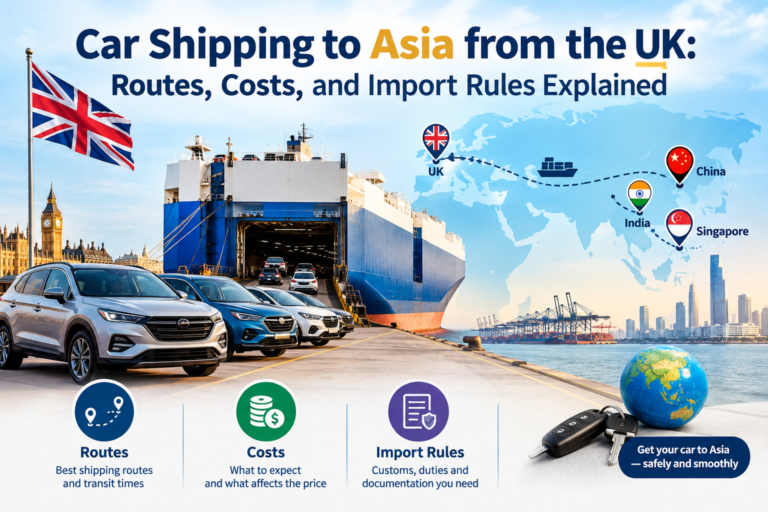
Shipping a car to Asia from the UK is a well-established route served by regular container and RoRo vessel services from Southampton, Tilbury, and Felixstowe. Asia is one of the most diverse shipping destinations in the world — covering the Middle East, South Asia, Southeast Asia, and East Asia — with import rules, duty rates, and vehicle eligibility requirements that differ significantly between countries. Whether you are exporting to the UAE, Japan, Singapore, India, or Hong Kong, understanding the correct method, documentation, and import regulations for your specific destination is essential before you ship.
Which Asian Countries Can I Ship a Car to from the UK?
ShipCars operates vehicle export services from the UK to destinations across Asia, including:
- Middle East — UAE (Dubai / Abu Dhabi), Saudi Arabia, Kuwait, Qatar, Bahrain, Oman
- South Asia — India, Pakistan, Sri Lanka, Bangladesh
- Southeast Asia — Singapore, Malaysia, Thailand, Vietnam, Indonesia, Philippines
- East Asia — Japan, South Korea, Hong Kong, China, Taiwan
- Central Asia — Kazakhstan, Uzbekistan, Georgia (via Black Sea routing)
Route availability, sailing frequency, and import eligibility vary by destination. Contact ShipCars to confirm current services and vehicle eligibility for your specific country.
What Shipping Methods Are Available for Cars from the UK to Asia?
Both RoRo and container shipping are used on UK-to-Asia routes, with the right choice depending on the destination, vehicle type, and budget.
RoRo (Roll-on/Roll-off) RoRo is the standard method for shipping running vehicles to major Asian ports with established ro-ro vessel services. Your vehicle is driven onto the vessel in the UK, secured on the car decks, and driven off at the destination port. It is the most cost-effective method for standard saloons, SUVs, and 4x4s going to high-volume destinations such as the UAE, Saudi Arabia, and Australia-adjacent Pacific routes.
Container Shipping (Sole-Use or Shared) Container shipping is the primary method for UK-to-Asia routes where ro-ro services are limited or unavailable — including Japan, Singapore, Hong Kong, and many South and Southeast Asian ports. Your vehicle is loaded into a sealed steel container, offering maximum protection throughout the long deep-sea voyage. For classic, luxury, left-hand-drive, or non-running vehicles on any Asian route, a sole-use container is the recommended option.
| Feature | RoRo | Sole-Use Container |
| Cost | Lower | Higher |
| Protection | Good (inside vessel hull) | Maximum (sealed container) |
| Route availability | Major ME and select Asian ports | Virtually all Asian ports |
| Classic / luxury vehicles | Not recommended | Recommended |
| Personal effects permitted | No | Yes (subject to destination rules) |
| Non-running vehicles | Possible (extra fees) | Better suited |
What Are the Import Rules for Shipping a Car to the UAE from the UK?
The UAE is one of the most frequently requested Asian destinations for UK vehicle exports, particularly for high-end and luxury cars. Import regulations are administered by UAE Customs and the Roads and Transport Authority (RTA).
- Right-hand-drive vehicles — the UAE drives on the right. Importing a right-hand-drive UK vehicle for permanent use in the UAE is technically possible but re-registration is complex; most vehicles being permanently imported should be left-hand-drive. Confirm with the local RTA before shipping.
- Vehicle age — the UAE generally restricts importation of vehicles over a certain age. Rules vary by Emirate; Dubai and Abu Dhabi have specific age-limit policies. Verify with the relevant authority before booking.
- Import duty — the UAE charges a customs duty of 5% on the CIF (cost, insurance, and freight) value of imported vehicles. VAT of 5% applies at the point of registration.
- Documents required — original V5C, passport copy, bill of lading, commercial invoice, and a certificate of conformity where applicable.
What Are the Import Rules for Shipping a Car to Japan from the UK?
Japan is a significant destination for UK-sourced classic and collector vehicles, particularly older British marques. Japan drives on the left, which means right-hand-drive UK vehicles are straightforwardly compatible.
- Right-hand-drive — Japan drives on the left, making UK right-hand-drive vehicles directly compatible with Japanese roads and registration requirements.
- Vehicle age and emissions — Japan’s vehicle inspection system (Shaken) applies to all registered vehicles. Older vehicles may require modification to meet current Japanese inspection standards. Pre-check your vehicle’s compliance before shipping.
- Import duty — Japan imposes 0% import duty on passenger cars from the UK under the Japan–UK Comprehensive Economic Partnership Agreement (CEPA), subject to Rules of Origin requirements. Confirm your vehicle’s eligibility with a Japanese customs agent before shipping.
- Container shipping — virtually all UK-to-Japan car shipments travel by container due to the port infrastructure and vessel services on this route. RoRo is not widely used.
What Are the Import Rules for Shipping a Car to Singapore from the UK?
Singapore has some of the strictest and most expensive vehicle import regulations in the world, driven by the city-state’s vehicle population control policies.
- Certificate of Entitlement (COE) — to register any vehicle in Singapore, you must first obtain a COE through a competitive bidding system. COE prices fluctuate based on demand and category. As of 2026, COE prices for passenger cars have regularly exceeded SGD 100,000 (approximately £60,000+). This is the single biggest cost consideration for anyone importing a vehicle into Singapore.
- Additional Registration Fee (ARF) — Singapore charges an ARF based on the Open Market Value (OMV) of the vehicle — typically 100% of OMV or more for standard passenger cars.
- Emissions standards — imported vehicles must meet Singapore’s prevailing emissions standards (Euro VI equivalent as of 2026).
- Right-hand-drive — Singapore drives on the left, so UK right-hand-drive vehicles are road-compatible.
- Container shipping — the standard method for UK-to-Singapore car shipments.
What Documents Do You Need to Ship a Car to Asia from the UK?
Documentation requirements vary by destination, but the core UK export paperwork is consistent across all Asian routes:
UK export documents (all routes):
- V5C logbook — original, in your name
- Proof of identity — valid passport
- DVLA permanent export notification — submit online before the vehicle leaves the UK
- UK export customs declaration — filed with HMRC; ShipCars handles this on your behalf
- Bill of lading — issued by the shipping line; your legal proof of shipment
Destination documents (varies by country):
- Commercial invoice (required for customs valuation in most Asian countries)
- Certificate of Conformity (CoC) — required in some destinations for registration
- Destination import declaration — handled by a local customs agent coordinated by ShipCars
How Long Does It Take to Ship a Car from the UK to Asia?
Sea transit times from UK ports to Asia vary significantly by region:
- UAE / Middle East — approximately 18–25 days
- India — approximately 18–24 days
- Singapore / Malaysia — approximately 25–30 days
- Japan / South Korea — approximately 30–40 days
- Hong Kong / China — approximately 28–35 days
Total door-to-door timelines — including UK collection, port handling, sea transit, customs clearance, and onward delivery at destination — typically add 2–3 weeks on top of the sea transit time. Factor this into your planning, especially if the vehicle is needed by a specific date.
Ready to Ship Your Car to Asia from the UK?
Ship Cars Ltd manages the complete export process — UK vehicle collection, port handling, UK customs declaration, container or RoRo booking, and destination customs coordination. Whether you are shipping a luxury car to Dubai, a classic British sports car to Japan, or relocating to Singapore, we handle every stage with a single point of contact.
Frequently Asked Questions: Car Shipping to Asia from the UK
Can I ship a right-hand-drive car to the UAE?
Yes, but permanent import and re-registration of a right-hand-drive vehicle in the UAE is complex. The UAE drives on the right, so left-hand-drive vehicles are far more straightforward for long-term use. If you plan to keep and register the vehicle permanently in the UAE, we recommend confirming eligibility with the local RTA before booking. Right-hand-drive UK vehicles are sometimes shipped to the UAE for onward export to other markets.
Is it expensive to import a car into Singapore?
Yes — Singapore has some of the highest vehicle import costs in the world. In addition to shipping freight costs, you must factor in the Certificate of Entitlement (COE), which has regularly exceeded SGD 100,000 (around £60,000+) in recent years, plus the Additional Registration Fee (ARF) based on the vehicle’s Open Market Value. Singapore is primarily a destination for high-value vehicles where the total cost equation still makes sense.
What is the cheapest Asian destination to ship a car to from the UK?
The Middle East — particularly the UAE and Saudi Arabia — is generally the most cost-effective Asian region to ship to from the UK, due to the shorter route distance and frequent RoRo vessel services. Japan and Singapore are more expensive due to longer voyages and container-only services.
Do I need to use a container to ship my car to Japan?
Yes, in practice. UK-to-Japan car shipments are almost exclusively handled by container rather than RoRo, due to the vessel services and port infrastructure on this route. A sole-use container is the standard booking for classic and collector vehicles going to Japan.
How is my vehicle protected during a long UK-to-Asia voyage?
All vehicles shipped with ShipCars are covered by marine transit insurance for the full voyage. For long deep-sea routes such as the UK to Japan or Singapore, a sole-use container provides the highest level of physical protection — the vehicle is sealed inside a steel container from the UK loading facility to the destination port, unexposed to weather and sea conditions.
