


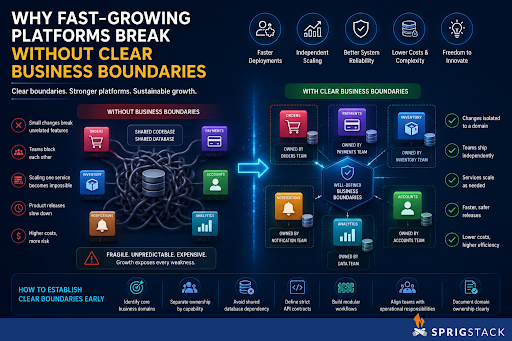
Most platforms begin the same way: a small team, a tight deadline, and along with a working product. Speed wins early. Everyone shares the same database, the same codebase, and the same logic.
As platforms scale, the existing architecture starts showing some issues. A shared database query slows checkout at peak load. Whether a platform is built in-house or through professional web development services, the diagnosis is almost always the same, and that is the absence of clear business boundaries. These invisible lines, when they get missed, can transform fast-growing platforms into fragile ones.
What Are Business Boundaries in Modern Platforms?
A business boundary is a clearly defined separation that takes place between distinct capabilities within a platform. Each boundary is known as a self-contained domain with its own data, logic, ownership, and greater interface. Common examples include payments, user authentication, inventory, smart notifications, and data analytics.
The critical distinction is not just about boundaries related to technical layers, but also reflects how the business itself is organised. When technology structure perfectly aligns with business structure, systems become predictable, maintainable, and genuinely scalable.
The Early Growth Trap Most Platforms Fall Into
Startups often face relentless pressure to bring the best business outcome. Whether teams rely on internal engineers or external web development services, boundary design often feels like a luxury, especially in the early stages. Business logic also gets reused across different business modules.
For example, consider a growing eCommerce platform, where orders, inventory, accounts, and payments are all present together. Adding certain features is fast, but when payments need a new gateway, engineers can successfully handle different aspects, from untangling it from notifications to easy sharing.
Teams say they will fix it later. By then, the technical issues increase in interest, and the cost to deal with them multiplies.
Warning Signs That Business Boundaries Are Missing
A lack of business boundaries creates certain operational issues and team burnout. Below are some warning signs that business boundaries may cause:
1.Small Changes Break Unrelated Features
This thing typically happens because services share logic and dependencies too heavily. Teams spend more time fixing such regressions than building new features for the apps.
2.Teams Constantly Block Each Other
When engineers wait on other teams to complete a feature or share ownership of the same database, deployment friction occurs. This issue has become a daily problem, and accountability disappears.
3.Scaling One Service Becomes Impossible
If scaling the checkout flow means scaling the entire platform, boundaries are absent. Uniform scaling raises costs without addressing the root architectural problem.
4.Product Releases Slow Down
As dependencies increase, certain deployment risks grow significantly. Organizations often experience Longer QA cycles, fear-driven release processes, increased rollback incidents and slower feature delivery.
How Clear Business Boundaries Improve Platform Stability
Establishing boundaries does not slow engineering down; it accelerates it. Teams with clearly defined domains build and deliver in parallel, without waiting on shared modules. Services can also scale successfully based on actual business demand. Infrastructure costs also perfectly align with real usage rather than assumptions.
Debugging is faster because each service owns its own metrics and logs. Teams can successfully experiment, check for new pricing models, and consider new notification channels without touching systems they do not own.
| Without Boundaries | With Clear Boundaries |
| One change breaks multiple systems | Changes isolated to a single domain |
| Teams block each other on deploys | Teams ship fully independently |
| The entire platform scales at once | Services scale based on real demand |
| Long QA cycles, risky releases | Faster, targeted, confident releases |
Clear boundaries are not just about general architectural preference; they are an operational necessity for better and sustainable growth. These platforms help businesses scale more successfully than those that focus on perfection from day one. The same trade-offs often show up when choosing between different development approaches early in a product’s lifecycle, as discussed in native vs cross-platform development decisions.
Real-World Example of Boundary Failure
Consider a leading B2B SaaS marketplace with more than 200,000 users that has operated cleanly as a monolith architecture for two years. Then, user growth already tripled, but certain problems emerged quietly.
As growth accelerated with time, serious issues appeared:
- Seller onboarding updates disrupted payment workflows
- Analytics processes slowed certain customer transactions
- Shipping delays created reporting inaccuracies
- Shared database traffic reduced platform performance
The company eventually restructured the platform into proper and independent business domains.
Key changes included:
- Separate ownership for payments and logistics
- Independent APIs for seamless customer workflows
- Isolated reporting services
- Dedicated scaling for particularly high-traffic domains
The results were significant:
- Faster deployments
- Reduced outages
- Better system reliability
- Improved engineering productivity
Most importantly, teams regained the ability to innovate safely.
How to Establish Clear Business Boundaries Early
Whether you are planning to develop an in-house solution or have decided to partner with a web development services team, these steps create a durable boundary-first foundation:
- Start by identifying all the core business domains
- Separate ownership based on capability
- Avoid handling shared database dependency
- Define a strict API contract
- Build modular workflows from the beginning
- Align teams with operational responsibilities
- Document domain ownership properly
Remember that architectural discipline often prevents all the chances of large-scale operational instability later.
Common Mistakes Companies Still Make in 2026
Below are some common mistakes that companies still make in 2026, and those actually affect the results.
- Assuming microservices that automatically improve scalability. Without clear business domains and responsibilities, companies often end up creating a complex network of disconnected services that are difficult to manage and maintain.
- Sharing business logic across multiple services. When a critical logic, such as pricing rules, validations, or customer workflows, is shared across different services, these create hidden dependencies, increasing the risk of platform-wide failures.
- Ignoring clear communication contracts between services. Many platforms rely on informal or loosely defined service interactions. Over time, these undocumented dependencies become difficult to track.
- Scaling infrastructure before fixing architectural problems. It only increases operational costs while the underlying architectural complexity continues to grow.
Conclusion
Growth does not create architectural problems. Growth exposes them. The platform that moves fastest, already with thousands of users, often becomes the hardest to change when the user reaches a million. It is because early speed was already used against future engineering complexity.
Whether you are leading an internal team or evaluating web development services providers to build or scale your platform, this is the core architectural foundation that needs consideration to prevent costly rewrites, extended outages, and organizational friction.
