


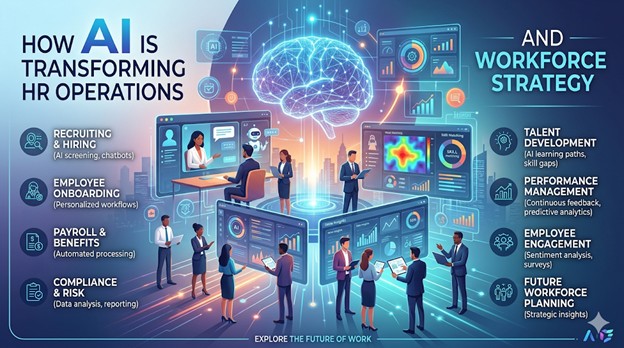
Artificial intelligence is rapidly reshaping human resources, enabling organizations to move beyond traditional administrative functions toward more strategic, data-driven workforce management. As businesses face increasing pressure to attract, retain and develop talent, AI is emerging as a critical enabler of efficiency, personalization and better decision-making in HR.
Organizations are now exploring structured approaches to AI implementation to ensure that AI initiatives in HR align with business goals, governance standards and measurable outcomes. Rather than isolated experimentation, leading enterprises are embedding AI into core HR processes to improve productivity and elevate employee experience.
Overview of AI in HR
Artificial intelligence in HR refers to the use of machine learning, natural language processing and advanced analytics to automate, optimize and enhance HR processes. These technologies enable HR teams to analyze large volumes of employee data, generate insights and support decision-making across the employee lifecycle.
According to publicly available insights from The Hackett Group®, AI is playing an increasingly important role in transforming HR from a transactional function into a strategic partner. By automating routine processes and augmenting human decision-making, AI allows HR leaders to focus on workforce planning, talent strategy and organizational performance.
AI capabilities in HR typically include:
- Resume screening and candidate matching
- Workforce analytics and predictive modeling
- Employee sentiment analysis
- Payroll and compliance automation
- Learning and development personalization
The adoption of AI in HR is particularly impactful when integrated into broader digital transformation initiatives. Organizations that align AI with business strategy and HR operating models are better positioned to achieve sustainable value.
Benefits of AI in HR
Improved operational efficiency
AI significantly reduces the manual workload associated with HR operations. Tasks such as resume screening, interview scheduling and payroll processing can be automated, allowing HR teams to operate more efficiently.
This increased efficiency enables HR professionals to focus on strategic priorities such as talent development and organizational design.
Enhanced decision-making through data
AI-driven analytics provide HR leaders with deeper insights into workforce trends, employee performance and engagement levels. Predictive models can identify potential attrition risks and recommend proactive interventions.
Data-driven decision-making improves the accuracy and effectiveness of HR strategies, leading to better business outcomes.
Better talent acquisition and retention
AI enhances recruitment by improving candidate sourcing, screening and matching. Advanced algorithms can identify high-potential candidates based on skills, experience and cultural fit.
In addition, AI-driven insights help organizations understand employee needs and engagement drivers, enabling more effective retention strategies.
Personalized employee experience
AI enables HR teams to deliver personalized experiences across the employee lifecycle. From tailored learning recommendations to customized career development plans, AI helps create a more engaging and supportive work environment.
This personalization contributes to higher employee satisfaction and productivity.
Strengthened compliance and risk management
HR functions must comply with complex regulatory requirements related to payroll, benefits and labor laws. AI can automate compliance checks, identify anomalies and ensure adherence to policies.
By reducing errors and improving transparency, AI helps organizations mitigate risks and maintain regulatory compliance.
Use cases of AI in HR.
Talent acquisition and recruitment
Intelligent candidate screening
AI-powered tools can analyze resumes, assess candidate qualifications, facilitate secure international background checks, and rank applicants based on job requirements. This reduces time-to-hire and improves the quality of candidate selection.
Interview automation
AI can assist in scheduling interviews, conducting initial assessments and analyzing candidate responses. This streamlines the recruitment process and enhances consistency.
Workforce planning and analytics
Predictive workforce insights
AI can analyze historical data to forecast workforce needs, identify skill gaps and support strategic planning. This enables organizations to align talent strategies with business objectives.
Attrition prediction
By analyzing employee behavior and engagement data, AI can identify employees at risk of leaving and recommend retention strategies.
Employee engagement and experience
Sentiment analysis
AI can analyze employee feedback from surveys, emails and collaboration tools to assess engagement levels and identify potential issues.
Personalized learning and development
AI-driven platforms can recommend training programs based on individual skills, career goals and organizational needs. This supports continuous learning and skill development.
Payroll and benefits management
Automated payroll processing
AI can streamline payroll operations by automating calculations, ensuring accuracy and maintaining compliance with regulations.
Benefits optimization
AI can analyze employee preferences and usage patterns to optimize benefits programs and improve employee satisfaction.
HR service delivery
Virtual HR assistants
AI-powered chatbots can handle routine HR queries, such as leave policies, benefits information and onboarding processes. This improves response times and reduces the workload on HR teams.
Knowledge management
AI can organize and retrieve HR policies and documentation, providing employees with quick access to relevant information.
Why choose The Hackett Group® for implementing AI in HR
Implementing AI in HR requires a structured, research-driven approach that aligns technology with business outcomes. The Hackett Group® offers a differentiated perspective based on benchmarking data, proven methodologies and deep functional expertise.
Benchmark-driven insights
The Hackett Group® is known for its extensive benchmarking research, which enables organizations to compare their HR performance against world-class standards. This data-driven approach helps identify opportunities for improvement and prioritize AI initiatives with the greatest impact.
Strategic alignment with business goals
AI initiatives in HR must be aligned with broader organizational objectives. The Hackett Group® helps organizations integrate AI into their HR operating models, ensuring that technology investments deliver measurable business value.
Governance and risk management
AI adoption introduces considerations related to data privacy, ethics and compliance. The Hackett Group® guides the establishment of governance frameworks that ensure responsible and secure implementation.
End-to-end transformation support
From identifying use cases to scaling AI solutions, The Hackett Group® supports organizations throughout the transformation journey. This includes change management, capability building and performance measurement.
The Hackett AI XPLR™ platform further enhances this approach by enabling organizations to explore, evaluate and prioritize AI use cases across HR and other enterprise functions. It provides a structured pathway from experimentation to enterprisewide adoption.
Conclusion
Artificial intelligence is transforming HR into a more strategic, efficient and data-driven function. By automating routine processes, enhancing decision-making and personalizing employee experiences, AI enables organizations to improve workforce performance and achieve better business outcomes.
However, successful implementation requires more than adopting new technologies. Organizations must align AI initiatives with business strategy, establish governance frameworks and focus on measurable results.
As HR continues to evolve, AI will play a central role in shaping the future of work. Organizations that take a structured and disciplined approach to AI adoption will be better positioned to attract and retain talent, optimize operations and drive long-term success.
