


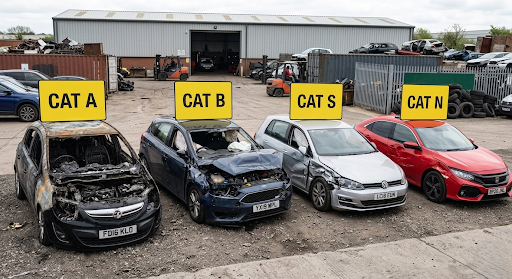
Over 562,000 vehicles were written off in the UK in 2024 alone, according to financial services provider Allegiant. Based on recent figures, around 1.34% of all UK vehicles are written off every year. That is a significant number of cars re-entering the used market with a history that does not always get disclosed upfront.
Before you buy any used car, it is worth knowing what each category means. Read CarAnalytics’ full guide on how to check car categories to understand exactly what you are looking for. This article covers the key points every buyer should know before viewing any car with a write-off marker in its history.
What is a car write-off category?
When an insurer decides a car is too damaged to repair economically or safely, they declare it a total loss and assign it a write-off category. The category reflects the severity of the damage and determines whether the car can ever return to the road, be stripped for parts, or must be destroyed entirely.
There are four active categories: A, B, S, and N. The older categories C and D were replaced by S and N in 2017.
| Category | Severity | What it means | Can it return to the road? |
| Cat A | Most severe | Must be crushed entirely. No parts can be salvaged or sold. | No |
| Cat B | Severe | Body shell crushed but usable parts can be stripped first. Cannot return to road. | No |
| Cat S | Structural | Structural damage but can be repaired and returned to road after inspection. | Yes, once repaired |
| Cat N | Non-structural | Cosmetic or mechanical damage. Can be repaired and sold legally without specialist inspection. | Yes, once repaired |
What do car write-off categories mean in the UK?
UK write-off categories A, B, S, and N describe the severity of damage an insurer has assessed. Category A vehicles must be crushed. Category B vehicles can be stripped for parts but the shell must be destroyed. Category S cars have structural damage but can return to the road after proper repair. Category N cars have non-structural damage and can be repaired and sold without a specialist inspection.
Category A and B: cars that should never be on the road
These are the two most serious categories and, in theory, the safest from a buyer’s perspective because neither vehicle should appear in the used car market at all.
Category A vehicles must be crushed entirely. No parts can be removed or reused. A car being sold with a Category A marker is almost certainly fraudulent.
Category B cars cannot return to the road. Usable parts can be stripped before the shell is destroyed, but the car itself is finished.
| Worth knowing: A car appearing on the road with a Category A or B marker in its history has been illegally re-registered or cloned. If you find this during a check, do not buy the car and consider reporting it to Action Fraud or the DVLA. |
Category S and N: what buyers actually encounter
Most write-off category cars in the used market are Category S and N. Buying one is not automatically a bad decision but it requires knowing what you are getting into.
Category S: structural damage
A Category S car has sustained damage to its structural components. This means the chassis, frame, or crumple zones have been affected, not just surface bodywork. The car cannot be driven safely in this state but can be repaired by a competent professional and returned to the road after inspection.
A properly repaired Cat S car with documented evidence of the work and a clean MOT since the repair can be a roadworthy vehicle. A poorly repaired one is a safety risk that may not be obvious to look at or drive. Verification matters more here than anywhere else.
Category N: non-structural damage
A Category N write-off has cosmetic or mechanical damage without structural compromise. Think of significant dents, paint damage, electrical faults, or airbag deployment. These can be expensive repairs relative to the car’s value, which is why the insurer writes it off, but the underlying structure is intact.
A well-repaired Category N with documented work and a clean MOT record since the incident can be genuinely good value. Cat N cars typically sell at a 20 to 40 percent discount. That saving is real if repairs were done properly, and a gamble if they were not.
| Real example: A buyer finds a Category N car priced at 30% below market value. The seller says the airbags deployed in a minor collision and the car was repaired. A full check shows the write-off date, and a subsequent MOT history shows three clean tests since the repair with consistent mileage. That is a car worth considering. One with no repair records and a single MOT since the incident is a different conversation entirely. |
How a write-off category affects value, insurance, and resale
Beyond the immediate safety question, a write-off category has lasting effects on the car that every buyer should factor in.
Value
A categorised car is worth less than an equivalent undamaged one. If it is priced close to clean market value, negotiate down or walk away.
Insurance
Some insurers cover Cat N and Cat S without issue. Others add a premium or decline entirely. Confirm with your insurer before committing, not after.
Resale
Write-off categories are permanent. You must disclose when you sell. The category will appear in any check a buyer runs. The discount you received is the discount the next buyer will expect.
How to check if a car has a write-off category before you buy
The DVLA does not hold write-off category data. It sits with insurance companies in databases such as the Motor Insurance Anti-Fraud and Theft Register. A vehicle history check through a provider that subscribes to these databases is the only way to access it.
What to look for in the results:
- The category itself: A, B, S, or N. If it is A or B, the decision is straightforward. If it is S or N, move to the next steps.
- The date of the write-off: How long ago did the incident occur? A write-off from six years ago with five clean MOTs since is very different from one that happened eight months ago.
- MOT history since the write-off: Check the DVSA MOT records for tests taken after the write-off date. Consistent passes with steadily increasing mileage suggest the repair has held up.
- Ask for repair documentation: A responsible seller of a Cat S or N car will have paperwork from the repair. If they cannot produce it, factor that into your decision.
- Independent inspection: For Category S cars especially, an independent inspection by a qualified mechanic before purchase is money well spent.
Running this check takes a registration plate and two minutes. When you run a car category check on CarAnalytics, it pulls write-off data alongside finance, stolen status, MOT history, and keeper records into a single report, so you get the complete picture in one place before making any decision.
Final thoughts
Over 562,000 vehicles are written off in the UK every year. Many re-enter the used market without clear disclosure. The category system protects buyers but only if you use it.
A well-repaired Cat N at the right price can be a smart buy. A Cat S with no paperwork is a risk not worth taking. The category tells you what happened. The repair evidence tells you whether to buy.
Run the check before you view, before you negotiate, and before any money moves. Two minutes of checking now can save you thousands later.
