


Introduction
Choosing the right machining process is one of the most important decisions in precision manufacturing. The manufacturing method you select can directly affect part quality, production speed, cost efficiency, and overall project success.
Two of the most commonly used technologies for producing precision components are Swiss machining and CNC turning. While both processes use computer-controlled equipment to manufacture parts with high accuracy, they differ significantly in their design, capabilities, and ideal applications.
Understanding the strengths and limitations of each process can help manufacturers determine the most suitable solution for their specific requirements. This article compares Swiss machining and CNC turning to help you make an informed decision for your next project.
Understanding Swiss Machining
Swiss machining is a specialized form of CNC turning that was originally developed for producing small, intricate watch components.
Unlike conventional lathes, Swiss machines use a sliding headstock and guide bushing system that supports the material close to the cutting tool.
This unique design minimizes vibration and deflection, allowing manufacturers to produce highly precise components with extremely tight tolerances.
Many industries rely on swiss machining when producing small-diameter parts that require exceptional accuracy and consistent quality.
What Is CNC Turning?
CNC turning is a machining process in which a workpiece rotates while stationary cutting tools remove material to create the desired shape.
The process is widely used for manufacturing cylindrical components and can handle a broad range of part sizes and materials.
Modern CNC turning centers often include advanced tooling options that allow for:
- Turning
- Drilling
- Threading
- Boring
- Grooving
CNC turning remains one of the most versatile and widely used machining methods in manufacturing.
Key Differences Between Swiss Machining and CNC Turning
Although both processes use similar machining principles, several important differences separate them.
Workpiece Support
Swiss Machining
Swiss machines use a guide bushing that supports the workpiece directly next to the cutting tool.
This greatly reduces material movement during machining.
CNC Turning
Conventional CNC lathes clamp the workpiece at one end, which may allow more vibration when machining long or slender parts.
Precision and Tolerance Capabilities
Swiss Machining
Swiss machines are specifically designed for ultra-precision manufacturing.
They commonly achieve:
- Extremely tight tolerances
- Superior concentricity
- Consistent dimensional accuracy
CNC Turning
CNC turning also offers excellent precision but may not match the accuracy levels of Swiss machining for very small or delicate components.
Part Size Capabilities
Swiss Machining
Swiss machining is best suited for:
- Small-diameter parts
- Long slender components
- Intricate geometries
- High-precision medical and aerospace parts
CNC Turning
CNC turning is often better for:
- Medium-sized components
- Larger workpieces
- Simpler cylindrical parts
- Heavy-duty industrial applications
Precision Comparison
Precision requirements often determine which machining process is most appropriate.
Why Swiss Machining Excels in Precision Manufacturing
The guide bushing system provides greater stability during cutting operations.
Benefits include:
- Reduced vibration
- Improved surface finishes
- Better dimensional consistency
- Higher machining accuracy
CNC Turning Precision
Modern CNC lathes can still achieve excellent tolerances, making them suitable for many industrial applications.
However, for extremely small and complex components, Swiss machining often provides a measurable advantage.
Production Speed and Efficiency
Efficiency is another important consideration when selecting a machining process.
Swiss Machining Efficiency
Many Swiss machines feature multiple tool stations and simultaneous machining capabilities.
This allows manufacturers to:
- Reduce cycle times
- Minimize secondary operations
- Improve production throughput
CNC Turning Efficiency
CNC turning remains highly productive for many standard parts but may require additional setups for complex geometries.
As part complexity increases, production efficiency can sometimes favor Swiss machining.
Cost Considerations
Cost is always a major factor in manufacturing decisions.
Initial Setup Costs
Swiss machines generally involve:
- Higher equipment costs
- More specialized tooling
- Advanced programming requirements
As a result, setup expenses may be higher.
Long-Term Production Costs
For high-volume production of precision parts, swiss machining often becomes cost-effective because it reduces cycle times and minimizes secondary operations.
CNC Turning Costs
CNC turning is often more economical for:
- Larger components
- Simpler designs
- Lower precision requirements
- Smaller production runs
Material Compatibility
Both manufacturing methods support a wide range of materials.
Common Metals
Manufacturers frequently machine:
- Stainless steel
- Aluminum
- Brass
- Copper
- Titanium
- Carbon steel
Engineering Plastics
Both processes can also machine materials such as:
- PEEK
- Delrin
- Nylon
- PTFE
- Polycarbonate
Material selection usually depends more on part requirements than on the machining process itself.
Industries That Use Swiss Machining
Several industries depend heavily on Swiss machining technology.
Medical Industry
Applications include:
- Surgical instruments
- Bone screws
- Orthopedic implants
- Catheter components
Aerospace Industry
Manufacturers produce:
- Connectors
- Fasteners
- Fuel system components
- Precision fittings
Electronics Industry
Swiss machining is widely used for:
- Connector pins
- Contacts
- Precision housings
- Miniature components
Industries That Use CNC Turning
CNC turning remains essential across many sectors.
Automotive Manufacturing
Common applications include:
- Shafts
- Bushings
- Gears
- Engine components
Industrial Equipment
Manufacturers use CNC turning for:
- Hydraulic fittings
- Couplings
- Valves
- Machine components
Energy Sector
The process is commonly used for durable industrial parts that require strength and reliability.
How to Choose the Right Manufacturing Process
Selecting between Swiss machining and CNC turning depends on several factors.
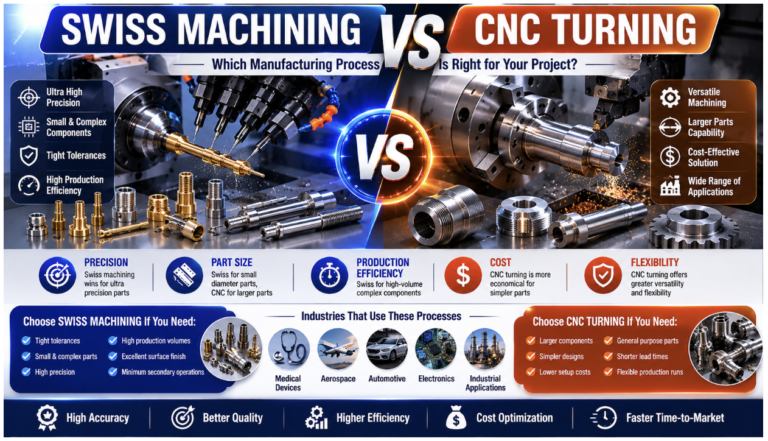
Choose Swiss Machining If You Need:
- Tight tolerances
- Small-diameter parts
- Complex geometries
- High production volumes
- Exceptional surface finishes
Choose CNC Turning If You Need:
- Larger components
- Simpler designs
- Lower setup costs
- Flexible production requirements
- General-purpose machining
Evaluating your design specifications, budget, and production goals will help determine the most suitable process.
Future Trends in Precision Machining
Manufacturing technology continues to evolve rapidly.
Emerging developments include:
- AI-assisted machining optimization
- Smart factory integration
- Advanced automation
- Real-time quality monitoring
- Improved cutting tool technology
Both Swiss machining and CNC turning are expected to benefit from these innovations, improving efficiency and precision even further.
Conclusion
Both Swiss machining and CNC turning are highly effective manufacturing processes, but each serves different purposes. Swiss machining excels at producing small, complex, and highly precise components, while CNC turning offers versatility and cost-effectiveness for a broader range of part sizes and applications.
For projects that demand exceptional accuracy, tight tolerances, and efficient production of intricate components, Swiss machining often provides the best solution. Understanding the strengths of each process helps manufacturers choose the right technology to achieve optimal product quality and production efficiency.
FAQs
What is the main difference between Swiss machining and CNC turning?
Swiss machining uses a guide bushing and sliding headstock to support the workpiece during machining, while CNC turning typically holds the material from one end and rotates it against stationary cutting tools.
Is Swiss machining more accurate than CNC turning?
Yes. Swiss machining generally provides higher precision and tighter tolerances, especially for small-diameter and complex components.
Which industries benefit most from Swiss machining?
Medical, aerospace, electronics, automotive, and precision manufacturing industries frequently use Swiss machining for critical components.
Is CNC turning cheaper than Swiss machining?
For larger and less complex parts, CNC turning is often more cost-effective. However, Swiss machining can reduce costs for high-volume precision production by minimizing secondary operations.
When should I choose Swiss machining over CNC turning?
Swiss machining is typically the better choice when manufacturing small, intricate parts that require exceptional accuracy, superior surface finishes, and consistent repeatability.
