


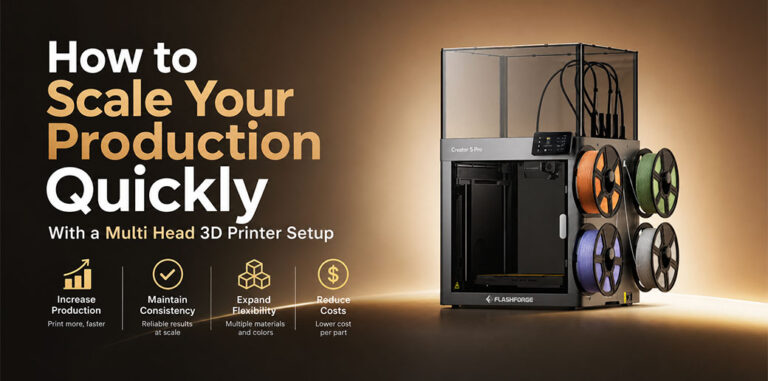
You can scale production quickly with a multi head 3D printer by printing multiple parts simultaneously in parallel, achieving up to 5× faster throughput without expanding your printer farm. In this article, we’ll explain how multi tool head architectures work, compare configurations for different production needs, show you how to optimize workflow efficiency, and demonstrate why the Flashforge Creator 5 Pro 3D Printer delivers true multi-material capability with zero purge waste for batch manufacturing.
Why Multi Head 3D Printing Is Becoming Essential for Fast Production Scaling
Traditional FDM 3D printers operate at roughly 40 mm/s, while modern high-speed machines now reach 400–600 mm/s. Yet even at maximum speed, printing one part at a time creates a fundamental bottleneck for small-batch production. When you’re consistently receiving orders and need to produce 30–300 parts per machine per night, single-head printing forces you to either buy more machines or accept days-long turnaround times.
The core pain point: throughput matters more than individual print speed. A multi head 3D printer solves this by running multiple extruders simultaneously, cutting average per-part print time dramatically while keeping your footprint unchanged.
What Is a Multi Head 3D Printer and How Does It Work?
A multi head 3D printer equips a single gantry with 2–4 independent toolheads that extrude filament in parallel. Instead of moving one nozzle back and forth for hours, the printer coordinates multiple nozzles to deposit material simultaneously across different regions of the build plate.
Independent Print Heads vs Shared Nozzle Systems
| Feature | Independent Print Heads | Shared Nozzle Systems |
| Simultaneous extrusion | Yes, multiple heads print at once | No, one nozzle at a time |
| Material switching | Instant tool change | Purge waste required |
| Multi-color capability | True parallel printing | Sequential layer switching |
| Throughput gain | 3–5× faster | 1.2–1.5× faster |
| Waste generation | Near-zero purge | 10–30% filament waste |
Independent heads physically separate extruders so each can operate without interfering with others, while shared nozzle systems rely on a single extruder that swaps filaments through a manual or automatic feeder—creating purge blocks and extending print time.
Understanding Multi Tool Head 3D Printer Architectures
Modern multi tool head designs use a CoreXY motion system with a toolchanger mechanism that mounts 4 toolheads on the gantry. The Flashforge Creator 5 Pro 3D Printer implements this architecture with 4 independent toolheads, 600 mm/s travel speed, and 30,000 mm/s² acceleration. Each toolhead connects via a quick-swap mechanism, allowing automatic selection during printing without manual intervention.
The build volume of 256 × 256 × 256 mm accommodates multiple small-to-medium parts in a single batch, while the fully enclosed chamber maintains 65°C active heating for engineering thermoplastics like ABS, ASA, PC, and PA.
Automatic Tool Changing and Material Switching Processes
When the slicer detects a material change, the printer:
- Retracts the current filament
- Moves the active toolhead to the parking position
- Swaps to the next toolhead via magnetic coupling
- Calibrates offset automatically using bed sensors
- Resumes printing with zero purge waste
This process takes 2–3 seconds per switch versus 30–60 seconds of purging on traditional multi-extruder systems.
Parallel Printing for Higher Throughput
Parallel printing splits one large object or multiple small objects across several nozzles simultaneously. Rutgers University’s research demonstrated that by orienting parts and generating efficient g-code, multiple nozzles extrude concurrently, reducing total print time from 35 hours to 5 hours in some cases—a 7× throughput increase.
For batch manufacturing, you can load 4 different colors or materials and print 4 identical parts in the time it used to take to print one.
Key Advantages of a Multi Tool Head 3D Printer Setup
Faster Production Without Expanding Printer Farms
A single multi head printer replaces 3–4 single-head machines for equivalent output. If you’re producing 100 units/week at 8 hours/part on a traditional printer, switching to a 4-toolhead system cuts that to 2 hours/part while maintaining the same floor space.
Multi Material and Support Material Printing
Multi-material 3D printing lets you combine different material properties in one pass—rigid PLA with flexible TPU, soluble PVA supports, or color gradients without post-processing. The Creator 5 Pro supports PLA, PETG, TPU 90A-95A, PLA-CF, ABS, ASA, PA-CF, PET-CF, PC, and PPA-CF in a single job.
Reduced Downtime Between Jobs
Automatic calibration and leveling eliminate manual bed leveling between batches. Filament runout detection and tangle-free sensors prevent failed prints, while power outage recovery resumes exactly where it stopped.
Better Workflow Automation for Batch Manufacturing
Device fleet management on PC & mobile lets you monitor 10+ printers remotely, queue jobs overnight, and receive completion notifications. The built-in Full HD camera (1280×720 @30 fps) enables remote quality checks without opening the chamber.
Multi Head 3D Printer Configurations for Different Production Needs
| Production Scale | Recommended Configuration | Expected Throughput | Best Use Case |
| Hobbyist/beginner | 2 toolheads, 220³ mm | 2× faster | Multi-color miniatures |
| Small business | 4 toolheads, 256³ mm | 4–5× faster | Batch prototypes, custom parts |
| Mid-volume production | 4 toolheads + heated chamber | 5× faster | Engineering materials, functional parts |
| Industrial | 6+ extruders, large format | 6–8× faster | Large-scale components |
For small-to-mid volume production under 100k units/year, 3D printing remains more cost-effective than injection molding, and a 4-toolhead system maximizes ROI by minimizing context switching.
How to Optimize Workflow Efficiency in Multi Head 3D Printing
Follow these 7 steps to maximize throughput:
- Slice with multi-object optimization: Use OrcaSlicer or Orca-Flashforge to orient parts for simultaneous extrusion
- Group identical materials: Print all PLA parts together, then all ABS parts, minimizing toolhead switches
- Enable auto-calibration: Let the printer compensate for toolhead offset automatically before each job
- Pre-load all filaments: Load 4 spools before starting to avoid mid-print interruptions
- Use batch printing mode: Schedule overnight runs with 20–30 parts per build plate
- Monitor via camera: Check first layer remotely, catch failures within 10 minutes
- Maintain HEPA filtration: The Creator 5 Pro’s H13 HEPA + coconut carbon filter eliminates VOCs from ABS/ASA, keeping the workspace safe
“Choosing between a 3D printer with a single extruder or multiple extruders depends on your needs. For professionals & advanced users, a dual-extruder or multi-toolhead printer may be necessary”
Comparing Multi Head 3D Printers vs Traditional Printer Farms
| Metric | Multi Head 3D Printer (4 toolheads) | Traditional Printer Farm (4 single-head) |
| Footprint | 1 machine (441×411×460 mm) | 4 machines (~1.8 m²) |
| Power consumption | 1200W total | 3000–4000W total |
| Noise level | 55 dB (enclosed) | 65–75 dB (unfiltered) |
| Setup time | 10 min calibration | 40 min per machine |
| Multi-material | Yes, zero waste | Requires purge blocks |
| Failed print risk | 1 machine fails = 25% loss | 1 machine fails = 25% loss |
| Maintenance cost | 1 printer to service | 4 printers to service |
| Upfront cost | ~$949 (Creator 5 Pro) | ~$2000–4000 (4 entry printers) |
The Flashforge Creator 5 Pro at $949 delivers 4 independent toolheads, active heated chamber, and HEPA filtration—features that would cost 3–4× more assembling equivalent single-head machines.
When you’re scaling from prototype to production, the multi head approach eliminates the complexity of managing multiple devices while delivering 500% faster multi-color printing and near-zero waste.
Conclusion
Scaling production quickly with a multi head 3D printer isn’t about printing faster—it’s about printing more parts simultaneously. By leveraging parallel extrusion, automatic tool changing, and zero-purge material switching, you achieve 4–5× throughput without expanding your printer farm.
The Flashforte Creator 5 Pro 3D Printer represents the current sweet spot for small businesses: 4 independent toolheads, 600 mm/s speed, 256³ mm build volume, and 65°C heated chamber for engineering materials—all at under $1000. Whether you’re producing custom miniatures, functional prototypes, or low-volume end-use parts, this architecture solves the fundamental bottleneck of serial printing.
Ready to transition from prototyping to production? Explore the full range of 3D printer options at Flashforge to find the right configuration for your manufacturing workflow.
