


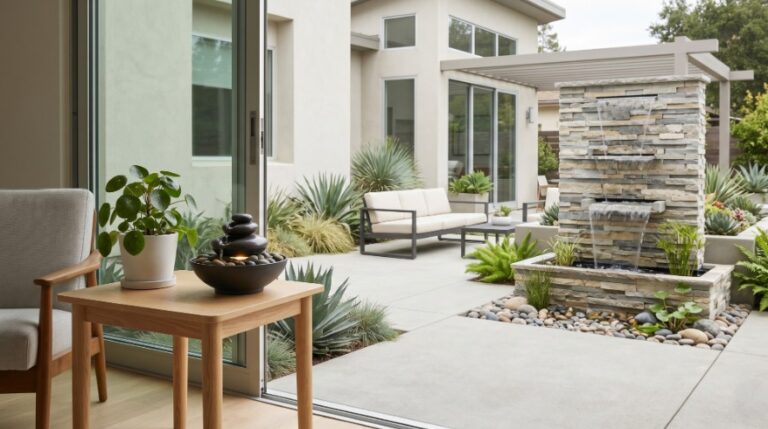
There’s a moment in most home design projects when the question of “outdoor sound” comes up. Suddenly the patio that looked perfect on paper feels too quiet, or the rooftop terrace catches more traffic noise than expected, or the home office facing the street needs something to mask the ambient hum.
The answer, often, is water. A running fountain doesn’t just produce sound — it produces the kind of sound that the human brain registers as restful rather than ambient. Studies on noise perception consistently find that natural water sounds are processed differently from constant low-frequency noise, even at similar decibel levels. Which is why fountains keep showing up in spaces designed for focus and rest.
But “fountain” covers a lot of ground. The right one depends entirely on the space. Here’s how to think about the choice.
For Small Spaces and Indoor Use
The compact end of the category has changed in the last five years. Where indoor fountains used to mean clunky plastic boxes with novelty rocks glued on, today’s tabletop water fountain options range from minimalist ceramic forms to bamboo-and-stone Zen designs that wouldn’t look out of place in a Kyoto teahouse.
The key technical specs are pump quietness and basin depth. A loud pump in a small fountain defeats the purpose; a basin that requires daily refilling will end up unused within a month. The better options use ceramic-coated submersible pumps and reservoirs large enough to run for a week between top-ups.
Tabletop pieces work on desks, sideboards, bedroom dressers, and outdoor side tables. For renters or anyone in a space where a full installation isn’t practical, this is where to start.
For Mid-Sized Outdoor Areas
Patios and small backyards need fountains that hold their own visually without overwhelming the space. Three to four feet tall is the sweet spot for most residential settings — large enough to be a focal point, small enough to leave breathing room.
Classical tiered designs remain popular in this size range, but the bigger shift has been toward naturalistic looks: rock-face cascades, multi-tier slate stacks, and the irregular asymmetric forms that read as something found in a landscape rather than placed in one. A well-made stone waterfall fountain in this size range can transform the character of a backyard at a fraction of the cost of a built-in water feature.
For Large Outdoor Spaces
Estate gardens, large courtyards, and commercial settings have their own logic. Scale becomes the dominant factor. A 60-inch fountain in a tight backyard feels overwhelming; in a 40-foot-wide garden, it can finally read as proportionate.
The high end of the category also unlocks design possibilities not available at smaller scales — central archway features, multi-stream waterfalls, and pieces with significant sculptural complexity. Budget at this level extends from around $800 to well over $2,000, and installation considerations (delivery access, ground leveling, electrical proximity) become real factors.
The Honest Truth About Buying Online
The single biggest variable in this category isn’t price or material — it’s whether what arrives matches what was shown. Product photos in the fountain category are notoriously generous. The piece looks larger in the listing than in reality. The “weathered stone” turns out to be matte plastic. The “warm LED glow” is a single cold-white bulb.
Vetting matters. Read the spec sheets carefully. Look for actual weight measurements rather than estimates. And when reviews mention “looks just like the photos” — believe them, because they’re describing the exception, not the rule.
