


What is ACP aluminum?
ACP aluminum is a flat cladding panel built from two thin aluminum sheets bonded to a solid core. ACP stands for aluminum composite panel, and building codes in the United States file the product under the category metal composite material. Standard panels ship in 3 mm, 4 mm, and 6 mm total thickness, with skins between 0.3 mm and 0.5 mm. ASTM International, the standards body behind the surface burning test used on these products, treats the core as the variable that decides where a panel is allowed.
Commercial production of bonded aluminum panels started in 1969, and the format now covers facades, signage, soffits, and interior wall linings. Panel widths of 1,220 mm and 1,500 mm dominate supply, with lengths cut up to 6,000 mm. Supplier catalogs and tender documents often list the material as acp aluminium, the British spelling of the identical product. Core composition, skin alloy, and coating class separate one panel from another, not the visible surface.
How does ACP aluminum work as a facade material?
ACP aluminum works as a sandwich structure: the two skins carry surface loads and the core holds them apart. That separation raises stiffness the same way an I-beam does, so a 4 mm panel resists bending far better than a loose sheet of equal weight. Aluminum expands roughly 2.3 mm per meter across a 100 degree Celsius temperature swing. Facade joints absorb that movement instead of the fasteners.
Bond quality decides how long a panel survives on a wall. Manufacturers laminate the skins to the core under heat and pressure, then test peel strength to confirm the bond. Delamination, meaning separation of the skin from the core, is the failure mode that ends service life. Exterior-rated panels carry a written finish warranty, commonly 20 years or more.
Which core types define ACP grades?
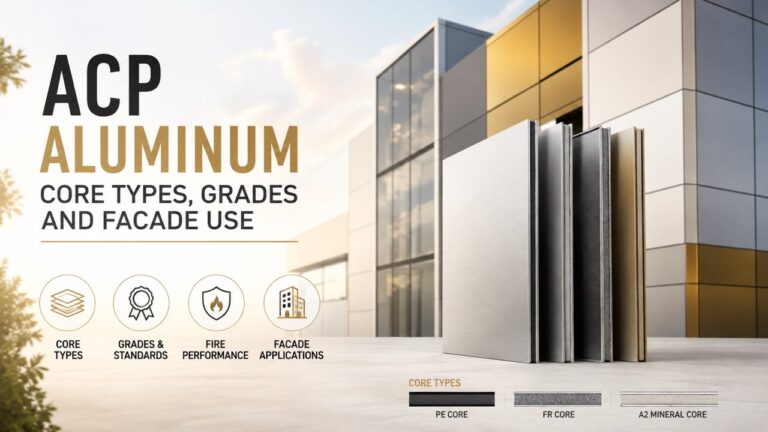
Core type divides ACP aluminum into three commercial grades: polyethylene, fire-retardant, and mineral. Skin thickness and coating can be identical across all three. Price, weight, and fire behavior are what change. Specifiers read the core line on a data sheet first, because that line decides which buildings can legally receive the panel.
Polyethylene core
Polyethylene (PE) core is a solid thermoplastic layer between the skins. PE core panels weigh the least, cost the least, and bend cleanly during fabrication. The plastic is combustible, which is why building codes limit where these panels appear. Interior partitions, signage, and low-rise soffits remain the normal use.
Fire-retardant core
Fire-retardant (FR) core replaces most of the plastic with mineral filler, usually around 70 percent by weight. The filler slows flame spread and reduces smoke output. FR panels weigh more than PE panels and cost more per square meter. Commercial facades within code height limits use this grade most often.
Mineral core
Mineral core, sold as A2 grade, pushes filler content to about 90 percent. A2 panels reach the strictest non-combustible class available to a composite product in European testing. Weight rises to roughly 8 kilograms per square meter, and routing tools wear faster on the dense core. High-rise and restricted-occupancy projects specify this grade.
| Core grade | Mineral filler | Fire classification | Typical application |
| PE | None | Combustible | Signage, interiors, low-rise soffits |
| FR | About 70 percent | Euroclass B-s1,d0 | Commercial facades within height limits |
| A2 | About 90 percent | Euroclass A2-s1,d0 | High-rise and restricted-use buildings |
How do fire codes classify ACP facades?
Fire codes classify ACP facades by assembly test, not by panel appearance. The International Building Code (IBC) covers these products in Section 1407, and it requires a flame spread index of 25 or less measured by ASTM E84. Panels set more than 40 feet above grade on qualifying buildings must also pass NFPA 285, a full-scale test of a complete wall assembly. ASTM E84 rates the exposed surface only, so a combustible core can earn a Class A surface rating and still fail the assembly test.
New Jersey enforces the IBC through the New Jersey Uniform Construction Code with state amendments. European projects follow EN 13501-1, which assigns Euroclass ratings from A1 down to F. The United Kingdom restricted combustible materials in the external walls of residential buildings above 18 meters after the 2017 Grenfell Tower fire in London. Drawings that call for acp aluminium sit in the same code category as any other metal composite material, because spelling does not change the core grade.
Which coatings hold up on an exterior wall?
Coatings on ACP aluminum fall into two performance families: polyester and fluoropolymer. Polyvinylidene fluoride (PVDF), a resin sold under names such as Kynar 500 and Hylar 5000, holds color and gloss under ultraviolet light far longer than standard polyester paint. The American Architectural Manufacturers Association (AAMA) grades these finishes in three tiers. AAMA 2603 covers basic polyester, AAMA 2604 covers intermediate performance, and AAMA 2605 covers the highest class. AAMA 2605 requires 10 years of South Florida exposure testing with limited chalking and color shift.
Finish class sets the maintenance interval more than the color does. Coil coating applies paint to the aluminum before lamination, which produces a more uniform film than spraying a finished panel. Wood-grain, stone-look, brushed, and mirror finishes all exist inside the 2605 class, though mirror faces and dark colors reveal surface distortion sooner. Anodized panels, treated by an electrochemical process rather than paint, resist scratching but offer a narrow color range.
How is an ACP facade installed?
ACP facades install as a rainscreen, meaning a ventilated cavity sits between the panel and the weather barrier behind it. Fabricators cut the sheet, groove the back, and fold the edges into a tray, a process called route and return. Cassette systems hang those trays on aluminum sub-framing with concealed clips, while wet-seal systems fill the joints with silicone. Cavity depth of 20 mm to 50 mm lets water drain and lets air dry the wall behind.
Panel fabrication happens in a shop, not on the scaffold. Shop drawings fix every panel size, joint width, and clip position before cutting starts. Regional manufacturers such as Vision Art Aluminium list acp aluminium alongside curtain wall and window systems for New Jersey and New York projects. Joint widths of 12 mm to 20 mm absorb thermal movement and construction tolerance. Substrate flatness matters more than panel quality, since a wall out of plane by 6 mm telegraphs through the finished surface.
Where does ACP aluminum work and where does it fail?
ACP aluminum suits building types that need large flat surfaces at low weight. A 4 mm panel with a polyethylene core weighs about 5.5 kilograms per square meter, roughly two thirds the weight of a 3 mm solid aluminum plate. Light panels keep sub-framing small and shorten installation time on renovation work, where the existing structure carries a fixed load limit.
- Ventilated facades on offices, retail centers, and apartment blocks
- Column covers, canopy linings, and soffits
- Curtain wall spandrel infill, the opaque band between floors
- Fascia bands, signage panels, and entrance surrounds
- Interior feature walls and elevator lobby cladding
Failure modes are as specific as the applications. Flat metal shows its own tolerances, and installation errors surface within the first heating season rather than years later.
- Oil canning, the visible waviness in flat metal, appears on wide panels and dark colors
- Dents at ground level, since a 0.5 mm skin deforms under impact
- Thermal bow on south-facing dark panels with restrained edges
- Edge delamination where trapped water reaches an unsealed routed groove
- Code refusal when a PE core meets a height or occupancy limit
Which ACP grade fits which building?
ACP grade selection follows height, occupancy, and the adopted code edition rather than price alone. Interior work and low-rise signage still use PE core panels in many jurisdictions. Exterior walls that trigger NFPA 285 testing need an FR or A2 core to pass, which removes the cheapest grade from the table. A2 mineral core carries the strictest fire class along with the highest weight and cost.
Three findings shape most specifications. Core grade, not brand name, determines code compliance. Coating class, not color, determines how a facade looks in year fifteen. Joint and cavity detailing determines whether water ever reaches the wall behind the panel.
This content is for informational purposes only and is not a substitute for professional design or code review. Fire ratings, adopted code editions, and product approvals change over time. Current requirements are confirmed with the local building department and with the manufacturer’s published test reports before specification.
Frequently Asked Questions
What is ACP aluminum made of?
ACP aluminum consists of two aluminum skins, usually 0.5 mm thick, bonded to a solid core under heat and pressure. Core material is polyethylene, a mineral-filled fire-retardant blend, or a mineral compound at roughly 90 percent filler. Skin alloys sit in the 3000 and 5000 series, and the exterior face carries a factory-applied coating.
How does core grade change fire performance?
Core grade sets how much combustible material sits inside the panel. Polyethylene cores burn and carry flame through a wall cavity, while mineral cores reach Euroclass A2-s1,d0 in European testing. Projects in the United States prove performance through NFPA 285, a full-scale assembly test rather than a test of the panel surface alone.
What are the common misconceptions about ACP panels?
The most common misconception treats a Class A surface rating as proof of a non-combustible panel. ASTM E84 measures surface burning, not core behavior inside a wall cavity. A second misconception assumes acp aluminium and ACP aluminum name different products. The two spellings describe the same material, and only the core grade changes performance.
How long does an ACP facade last?
An ACP facade lasts as long as its coating and its joints. Fluoropolymer finishes in the AAMA 2605 class carry written warranties of 20 years or more against chalking and fade. Silicone joints reach 10 to 20 years and then enter a replacement cycle, while the aluminum skins themselves resist corrosion for far longer.
How does ACP compare with solid aluminum plate?
ACP weighs less and stays flatter than solid aluminum plate of similar stiffness. A 4 mm composite panel runs about 5.5 kilograms per square meter, roughly two thirds the weight of a 3 mm plate. Solid plate resists impact damage better at ground level and carries no core, which removes the fire-grade question entirely.
