


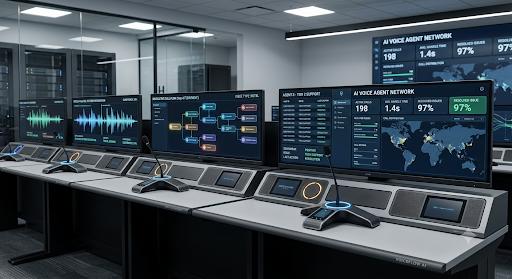
Businesses have always looked for ways to respond faster, reduce operational costs, and improve customer experience. Voice support has traditionally achieved these goals through call centers, IVR systems, and customer service teams. While effective, these models come with limitations. They require larger teams, involve recurring operational costs, and struggle to scale during periods of high call volume.
AI voice agents offer a different approach.
Instead of following rigid scripts or transferring callers through multiple menus, AI voice agents can understand spoken language, respond naturally, perform tasks, and complete conversations with minimal human intervention. What began as simple voice recognition has evolved into intelligent systems capable of handling real business operations.
For businesses managing hundreds or thousands of customer interactions every day, AI voice agents are no longer an experimental technology. They have become a practical solution for improving efficiency while maintaining service quality.
The Evolution of AI Voice Agents
Early voice automation relied on Interactive Voice Response (IVR) systems. Customers were asked to press numbers to navigate menus before eventually reaching a human representative. These systems reduced some manual workload but often created longer call times and frustrated customers.
The next stage introduced speech recognition, allowing callers to speak instead of using a keypad. Although this improved accessibility, the systems still depended on predefined commands and struggled with natural conversations.
Modern AI voice agents operate differently.
Powered by advancements in natural language processing, speech synthesis, and machine learning, they understand conversational intent rather than isolated keywords. They can interpret context, ask follow-up questions, retrieve information from business systems, and complete transactions during a single conversation. These capabilities are made possible by the best AI development services, which combine advanced language models, system integrations, and workflow automation to deliver reliable, business-ready voice solutions.
Instead of simply answering questions, today’s AI voice agents assist customers, qualify leads, schedule appointments, process requests, and escalate only when human expertise is genuinely required.
What Can an AI Voice Agent Do?
The capabilities of AI voice agents extend well beyond answering phone calls.
They can manage inbound customer inquiries, make outbound calls, qualify potential customers, book appointments, confirm orders, conduct surveys, provide product information, process support requests, and handle routine administrative tasks.
Because they integrate with CRMs, scheduling platforms, ERP systems, and customer databases, they can access real-time information during conversations. This allows them to provide accurate responses instead of generic scripted answers.
For example, a customer asking about an order status receives live updates. A patient calling a healthcare provider can schedule or reschedule appointments instantly. A prospective customer can receive pricing information and book a consultation without waiting for a sales representative.
The conversation becomes task-oriented rather than simply informational.
Available Around the Clock
Customers no longer expect businesses to operate only during office hours.
Questions, booking requests, and support inquiries arrive throughout the day and often outside traditional business schedules.
An AI voice agent remains available 24 hours a day without requiring shift rotations, overtime payments, or additional staffing. Whether the business receives ten calls or ten thousand, the system continues operating consistently.
This continuous availability helps businesses capture opportunities that would otherwise be missed when calls go unanswered.
Reducing Operational Costs Without Compromising Service
One of the strongest business cases for AI voice agents is cost efficiency.
Growing customer support typically means hiring additional staff, expanding office space, increasing training budgets, and managing employee turnover. These costs continue to rise as customer demand grows.
AI voice agents change this model.
Routine conversations that previously required human representatives can be handled automatically. Employees are then free to focus on complex customer issues, sales opportunities, and decision-making rather than repetitive questions. This approach is particularly valuable in healthcare software development, where AI voice agents can automate appointment scheduling, patient follow-ups, prescription refill requests, and routine inquiries, allowing clinical and administrative staff to dedicate more time to patient care.
The result is a support operation that scales without increasing staffing at the same pace.
For many businesses, this leads to lower operating costs while improving response times.
Consistent Customer Experience
Human conversations naturally vary.
Different representatives may explain policies differently, miss important details, or provide inconsistent information depending on experience and workload.
AI voice agents deliver standardized responses based on approved business rules.
Every caller receives the same accurate information, follows the same workflow, and experiences consistent service quality regardless of the time or call volume.
Consistency becomes particularly valuable in industries where compliance, documentation, and process accuracy are important.
Faster Lead Qualification
Businesses often spend valuable time speaking with prospects who may not be ready to purchase.
AI voice agents can automate the early stages of lead qualification.
They ask relevant questions, determine customer requirements, identify urgency, collect contact information, and schedule meetings for qualified prospects.
Sales teams begin conversations with customers who have already been assessed, allowing them to spend more time closing opportunities instead of gathering basic information.
This improves productivity while shortening the sales cycle.
Scalable Without Growing Complexity
Business growth often creates operational challenges.
More customers usually mean more phone calls, longer waiting times, and larger support teams.
AI voice agents scale differently.
Whether handling fifty calls per day or several thousand, they maintain the same response quality and availability. Additional demand does not require recruiting, onboarding, or training new agents.
This flexibility makes AI voice agents particularly valuable for businesses experiencing seasonal demand, marketing campaigns, or rapid expansion.
Learning From Every Conversation
Every customer interaction contains useful business information.
AI voice agents can record conversation trends, identify frequently asked questions, measure customer sentiment, and generate reports that help management understand customer behavior.
These insights support better operational decisions.
Businesses can identify recurring service issues, improve product information, refine support processes, and recognize new sales opportunities using actual customer conversations rather than assumptions.
The voice agent becomes more than a communication channel—it becomes a source of business intelligence.
Industries Benefiting From AI Voice Agents
The technology has applications across almost every customer-facing industry.
Healthcare providers use AI voice agents for appointment scheduling, reminders, prescription inquiries, and patient follow-ups.
Real estate companies automate property inquiries and viewing appointments.
Educational institutions manage admission inquiries and student support.
Banks and financial institutions handle account-related requests and customer verification.
Retail businesses automate order updates and customer service.
Professional service firms use voice agents for consultation booking, client intake, and follow-up communication.
Any organization that receives repetitive phone inquiries can improve efficiency through intelligent voice automation.
Choosing the Right AI Voice Agent
Not every AI voice solution delivers the same value.
An effective AI voice agent should understand natural conversations, integrate with existing business systems, support multiple languages where needed, maintain high speech accuracy, and allow workflows to be customized around business processes.
It should also provide detailed analytics, secure data handling, and the flexibility to grow alongside the organization.
The goal is not to replace every human interaction. It is to automate routine conversations so people can focus on situations that require judgment, empathy, and expertise.
A Smarter Way to Handle Business Conversations
Customer expectations continue to grow, while businesses are expected to deliver faster responses without continuously increasing operational costs.
AI voice agents address both challenges by combining intelligent conversation, process automation, and system integration into a single solution. They answer questions, complete tasks, qualify leads, and remain available whenever customers need assistance.
For business owners, the value extends beyond answering calls. It is about improving efficiency, reducing operational costs, increasing availability, and creating a more consistent customer experience at scale.
Businesses exploring AI voice automation should look for solutions built around their specific workflows rather than generic conversation tools. A well-designed AI voice agent should fit naturally into existing operations, helping teams work more efficiently while ensuring every customer interaction is handled accurately and professionally.
If your organization is looking to automate customer conversations, reduce support costs, or capture more leads without expanding your team, a customized AI voice agent can be designed around the way your business already operates.
