


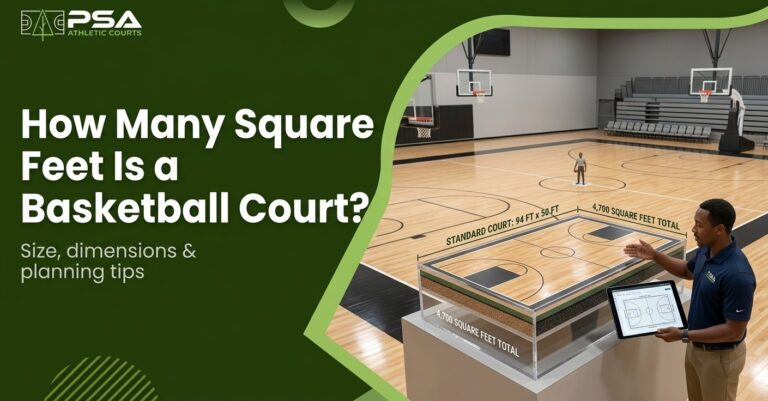
When planning a basketball court, one of the most common questions is: how many square feet is a basketball court?
The answer depends on the level of play and whether the court is indoor or outdoor. Understanding total square footage is essential for proper layout, budgeting, and construction planning.
This guide explains standard basketball court dimensions, total square footage, and six expert planning tips to help you design the perfect court.
How Many Square Feet Is a Basketball Court?
Standard Full Court (NBA / College)
- Length: 94 feet
- Width: 50 feet
Total area: 4,700 square feet
High School Court
- Length: 84 feet
- Width: 50 feet
Total area: 4,200 square feet
Half Court (Common Residential Size)
- Typical size: 30–50 feet long × 30–50 feet wide
Total area: 900–2,500 square feet
These figures answer the primary query: how many square feet is a basketball court depending on usage and scale.
For deeper layout details, understanding how big a basketball court is helps align design with real-world space requirements.
Indoor vs Outdoor Basketball Court Space Requirements
Indoor Basketball Court
Indoor courts typically require additional space for:
- Ceiling height (minimum 20–25 feet)
- Lighting systems
- Wall clearance
- Ventilation
Total space often exceeds the playing area due to structural needs.
Outdoor Basketball Court
An outdoor basketball court requires:
- Extra run-off space
- Drainage slope (1% recommended)
- Weather-resistant materials
- Fencing or boundary clearance
Outdoor courts usually need 10–15 feet of additional clearance around the court.
According to experienced court specialists such as Pine State Courts, many projects underestimate total space requirements, leading to safety and usability issues.
6 Planning Tips for the Perfect Basketball Court Size
1. Match Court Size to Available Space
Not every property can support a full 4,700 sq ft court.
Alternatives include:
- Half courts
- Training courts
- Multi-sport layouts
Choosing the right size ensures better usability without overcrowding the space.
2. Always Include Buffer Space
The playing area alone is not enough.
Recommended additions:
- 5–10 feet on sidelines
- 10+ feet behind baselines
This ensures safe movement and reduces injury risk.
3. Consider Indoor vs Outdoor Requirements
Indoor and outdoor courts have different planning needs.
- Indoor → structural space (height, walls)
- Outdoor → environmental space (drainage, slope)
Understanding these differences helps optimize total square footage.
4. Choose the Right Surface for Your Space
Surface selection impacts both size and performance.
For example:
- Acrylic surfaces → better for outdoor durability
- Wooden floors → ideal for indoor courts
Professional basketball court designers help match surface types with available space and usage goals.
5. Plan for Future Expansion
Many property owners start small but expand later.
Consider:
- Adding lighting
- Expanding to full court
- Converting to multi-sport space
Planning ahead avoids costly redesign.
6. Work with Experienced Court Designers
Accurate planning ensures:
- Proper dimensions
- Efficient space usage
- Long-term durability
For property owners building new courts, experienced teams like Pine State Courts provide tailored layouts that balance performance, safety, and available space.
Why Square Footage Matters
Understanding total court area helps with:
- Budget estimation
- Material planning
- Site preparation
- Drainage design
- Long-term maintenance
It’s not just about size, it’s about building a court that performs well over time.
Final Thoughts
A standard basketball court is approximately 4,700 square feet, but actual space requirements are often larger when safety zones and surrounding areas are included.
Whether you’re planning an indoor or outdoor basketball court, proper sizing and layout are essential for performance, safety, and long-term value.
By following these six planning tips, you can design a court that fits your space perfectly while delivering a high-quality playing experience.
