


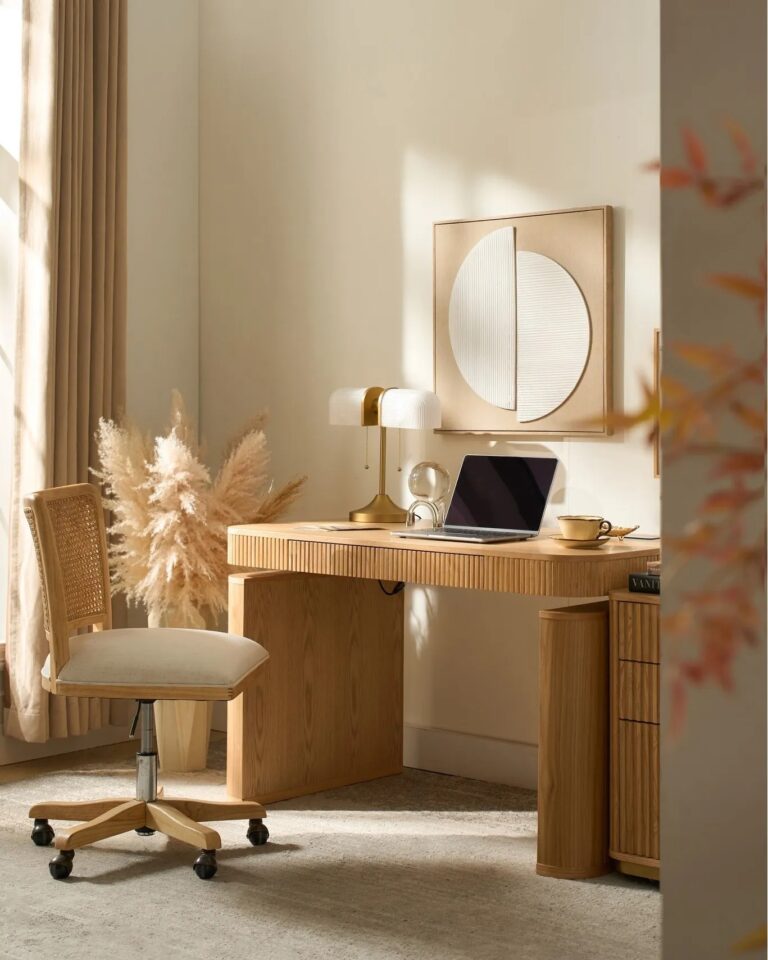
The electric standing desk UK market has expanded significantly in recent years, and with it the range of quality, price, and design intention available to British buyers. This guide cuts through the noise. It covers what an electric standing desk actually is, the specific criteria that matter for British homes, how to match desk design to room aesthetic, and gives honest assessments of the two standing desks we recommend for the UK domestic market. At the end, a twelve-point pre-purchase checklist brings it all together.
This is the most comprehensive standing desk guide available for UK buyers — not because it covers the most products, but because it covers the criteria that generic guides consistently miss: Victorian room dimensions, sash window clearance, party-wall motor noise, and the aesthetic register of British domestic interiors. These are the things that determine whether a standing desk works in a real British home. Everything else is secondary.
What Makes a Standing Desk ‘Electric’?
An electric standing desk — also called a motorised or height-adjustable desk — uses an electric motor to raise and lower the surface between seated and standing working heights. This is what distinguishes it from a manual crank-adjustment desk (which requires physical effort to change height and is rarely used consistently) and a fixed-height standing desk (which offers no seated option at all).
Single vs dual motor
Single motor desks drive one leg, with the frame transferring movement across the surface. Dual motor desks drive both legs independently, offering marginally better stability under heavy loads. For the typical UK home setup — one or two monitors, laptop, keyboard — a quality single motor is entirely sufficient. Both Julia and Baggio use quality motors rated for tens of thousands of height adjustments, with a noise level of approximately 40–45dB — comparable to a quiet conversation or a fridge hum.
Controller types and memory presets
The controller is the panel on the desk frame that operates the motor. Basic controllers have up and down buttons only — you hold until the desired height is reached. Quality controllers include programmable memory presets: you save your sitting and standing heights and return to them at the press of a single button. Memory presets are not a luxury feature. They are the feature that determines whether the standing function gets used consistently or gradually abandoned. Do not buy a standing desk without them.
The UK-Specific Buying Criteria
The following criteria are specific to the UK housing stock and British domestic context. They are absent from most generic standing desk guides.
Motor noise in terraced homes
Approximately 26% of English dwellings are terraced houses. In a terrace with party walls, motor noise is a genuine practical consideration. A motor rated at 40–45dB is inaudible from an adjacent room through a standard Victorian party wall. A motor rated at 50–55dB is audible in quiet conditions — late evenings, early mornings. If you are buying for a terrace or semi-detached house, treat 45dB as your upper limit and verify this specification before ordering.
Sash window glare at standing height
In a room with a sash window — the standard window form in Victorian and Edwardian properties — the transom bar typically sits between 1.5m and 1.6m from the floor. Standing eye level for a person of average British height is approximately 1.55–1.65m. This means that in many period rooms, the desk-under-window position places the transom directly at eye level when standing. It is not unworkable, but it is worth checking before you commit to a desk position.
Aesthetic register for period interiors
The visual language of British period domestic interiors — warm timber, aged plaster, objects with provenance — sets a higher aesthetic bar for standing desks than most other markets. An aluminium-framed desk with a laminate surface that would be entirely acceptable in a Scandinavian new-build is, in a Victorian terrace with cornicing and wooden floorboards, a persistent visual problem. This criterion is not decorative. It determines whether a desk is genuinely usable in its intended environment.
Size Guide for British Rooms
Both Julia and Baggio share the same surface dimensions: 121cm wide and 65cm deep. Before ordering, map your room against this table:
| Room Size | Usable Depth | Desk Verdict | Notes |
| Under 2.4m deep | Tight | Traditional desk preferred | 65cm desk depth + chair clearance = very tight. Measure carefully before ordering. |
| 2.4m–2.8m deep | Workable | Julia or Baggio — measure first | Tight but functional. Under-window placement recommended. No large monitor arm extension. |
| 2.8m–3.2m deep | Comfortable | Julia or Baggio — both work well | Standard Victorian spare room. Both models work comfortably with full monitor arm setup. |
| 3.2m+ deep | Generous | Julia or Baggio — full freedom | No spatial constraints. Focus decision entirely on aesthetic match to room. |
The height range also matters for your specific stature. Julia adjusts from 77.5cm to 123cm — covering comfortable seated height for shorter adults through to a genuine standing height for taller ones. Baggio adjusts from 73.7cm to 120cm — a slightly lower minimum, which is a marginal advantage for shorter users at seated working height. Both ranges are appropriate for the full range of adult heights present in UK households.
Julia: Best for Homes With Character
The Julia is our recommendation for period British homes — Victorian, Edwardian, farmhouse-aesthetic, or any property where warm materials and accumulated domestic character define the visual standard.
Surface: solid wood, not laminate. The tonal variation and tactile quality of real timber reads as furniture in a domestic room in a way that no laminate approximation does. Available in Cocoa Walnut and Light Oak — both designed to relate to existing British domestic wood tones rather than to contrast with them.
Tabletop design: clean square edges — the design language of furniture-grade craftsmanship, suited to period rooms where precision and quality of materials are the visual grammar.
Storage and cable management: built-in drawer for daily-use items, built-in cable management for a clean surface result. Both features are standard — not optional additions.
Motor: 40–45dB, memory presets included. Assembly: 15–30 minutes with two people for the frame attachment step. Full specification and installation tutorial available on the product page.
Honest limitation: price. The Julia is a quality domestic furniture purchase at a quality domestic furniture price. If budget is the primary criterion, there are cheaper standing desks. None of them will read as furniture in a period room the way the Julia does.
Ideal buyer: hybrid workers spending 3+ days per week at home, in period or warm-palette rooms, who have chosen every other object in their home with care and need a standing desk to meet that same standard. View the full Julia specification at the electric standing desk range UK on Hulala Home.
Baggio: Best for Contemporary Rooms
The Baggio is our recommendation for contemporary, minimal, or Scandi-influenced rooms — white walls, cool material palette, clean architectural lines — where the Julia’s warmth would feel slightly at odds with the room’s own material logic.
Surface: matte smooth finish, consistent and clean. Tabletop design: rounded corners with grooved edge detail — a contemporary refinement that reads as intentional in minimal rooms. Available in Cocoa Walnut and Light Oak.
Storage and cable management: identical to the Julia — built-in drawer and built-in cable management as standard. Motor specification, memory presets, height range (73.7–120cm), and assembly process are all comparable.
Honest limitation: the Baggio’s contemporary aesthetic rewards a controlled, consistent room. In a period room or a room with mixed or eclectic styling, the cooler profile can read as slightly stark rather than considered.
Ideal buyer: hybrid workers in contemporary rooms who want the same functional quality as the Julia with a visual profile suited to minimal, cool-palette interiors.
Three Other Options to Consider
Editorial honesty requires acknowledging that Julia and Baggio are not the only standing desks available to UK buyers. For completeness:
Flexispot E2 (budget): the most frequently recommended entry-level motorised standing desk in the UK. Laminate surface, standard black or white frame, functional motor. No memory presets on the base model. It will give you the ergonomic benefit of sit-stand working at a lower price. It will not make a period room look better.
Ikea Bekant / Idasen (mid-range): Ikea’s standing desk range offers reasonable functional quality at accessible prices. The Idasen in particular has a cleaner aesthetic than many competitors. Laminate surfaces, limited colour range, no drawer storage as standard.
Fully Jarvis (mid-to-premium): well-regarded in the standing desk community for motor reliability and a wide range of surface options including bamboo. More customisable than Julia or Baggio. Less considered in its domestic aesthetic — designed for the North American market and it shows in some details.
The Complete Pre-Purchase Checklist
Work through all twelve points before ordering. A standing desk is not a straightforward return once assembled — the time this checklist takes is a fraction of the time a return takes.
| ✓ | Check | What You Are Looking For |
| 1 | Measure room depth from desk wall to nearest obstruction | At least 90cm clear behind the desk position for comfortable working and chair movement |
| 2 | Check sash window transom height vs your standing eye level | Your standing eye level (approx. 155–165cm) should clear the transom bar — or position desk offset from window |
| 3 | Verify motor dB rating | 40–45dB maximum for terrace or semi-detached homes with shared walls |
| 4 | Confirm memory presets are included | Non-negotiable for long-term habit formation — avoid desks without programmable height memory |
| 5 | Check surface material — wood vs laminate | Real wood surfaces age better and read as domestic furniture. Laminate reads as office equipment over time |
| 6 | Assess room aesthetic — warm or cool palette? | Warm palette (timber, plaster, period features): Julia. Cool/minimal/contemporary: Baggio |
| 7 | Confirm colour finish availability | Both Julia and Baggio available in Cocoa Walnut and Light Oak — match to existing floor and furniture tones |
| 8 | Verify built-in storage | Both Julia and Baggio include built-in drawer — keeps surface clear without separate storage solution |
| 9 | Check cable management provision | Built-in on both models — essential for a clean visual result in a domestic room |
| 10 | Calculate working days per week at home | 3+ days/week: standing desk investment is justified. Under 3 days: traditional desk may be sufficient |
| 11 | Review assembly requirements | Both models: 15–30 minutes, two people recommended for frame attachment step |
| 12 | Confirm warranty and delivery terms before ordering | Quality standing desk = quality support. Verify returns policy before committing |
If you have worked through this checklist and landed on Julia or Baggio as the right desk for your room — the majority of buyers in British homes with warm or contemporary aesthetics will — you are buying with the confidence that comes from having made the decision properly. The standing desk that lasts in a British home is not the cheapest one or the one with the longest feature list. It is the one that was chosen for the right room, at the right time, with the right criteria. That desk will still be right in ten years.
