


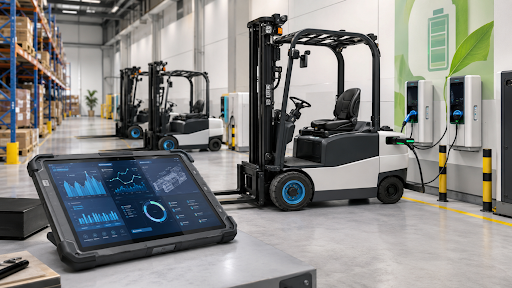
There is growing pressure on warehouses to enhance efficiency but, at the same time, minimize their environmental impact. Increased cost of energy, enhanced sustainability objectives, and heightened customer demands have motivated companies to re-evaluate the manner in which daily activities are run. Material handling equipment, and in particular the forklifts, is the core factor of productivity and energy use in warehouses. Each unwarranted journey, costly hour, and service interruption adds to the increased emissions and resource wastage.
With the adoption of smart tech, companies will be able to transform their operations into more efficient and cleaner places to work in. Investing in a forklift fleet management system yields valuable knowledge, which can be used to make better decisions and can guide warehouses towards long-term environmental sustainability.
Enhancing the use of equipment with intelligent monitoring
Poor equipment utilization is considered to be one of the largest contributors to unnecessary carbon emissions. In numerous cases, warehouses run a larger number of forklifts than they require due to their lack of precise visibility regarding the use of equipment by the managers.
The technology of smart monitoring captures the hours of idle time, traveling patterns, and equipment presence or absence in real time. This is information that enables managers to evenly spread workloads across the fleet as opposed to the use of guesswork. More effective use decreases redundant vehicle use that minimizes power or fuel use around the facility. Distribution of all the forklifts more productively will mean that the same workload will be accomplished using fewer resources without affecting the high productivity rates in warehouses.
Preventive Maintenance Supports Greener Operations
Forklifts that are ill-maintained use more energy and cause undue inefficiencies in operations. Bad tires ruined hydraulic systems, and unattended batteries had to make equipment work harder than necessary. Smart fleet trackers regularly monitor the maintenance schedules, equipment health, and service needs, helping identify issues before they become serious. Early servicing increases the life cycle of equipment and enhances efficiency in energy consumption in day-to-day activities. Properly maintained forklifts have fewer breakdowns that cut down on the replacement parts transportation needs and unnecessary repair work. Green maintenance also reduces the amount of waste that is brought about due to the premature replacement of equipment, hence making warehouses eco-friendly and economical in the long run.
Smart system design brings about sustainable processes.
Technology provides the most environmental positives when it is backed up by more intelligent system design across the warehouse. Smart layout planning, which minimizes travel paths and sets tasks automatically, will significantly decrease unneeded equipment mobility daily. Managers can create workflows that travel a minimum of distance in the warehouse and achieve maximum operational effectiveness instead of using forklifts that travel the available warehouse multiple times. Combined software is also useful in the allocation of tasks based on equipment availability in order to alleviate congestion and the avoidance of unnecessary waiting time.
Evidence-Based Decisions Promote sustainability in the long run
Nevertheless, the key idea of modern management of the warehouse is the increased reliance on the correct operational feedback instead of assumptions. The fleet management platforms produce in-depth reports on equipment performance, operator behavior, battery, maintenance history, and energy consumption. Such insights will enable warehouse leaders to find undiscovered inefficiencies and continually optimize environmental performance. Managers are able to measure established performance metrics, evaluate past trends to set achievable sustainability objectives, and track improvement.
Environmental compliance programs and corporate sustainability programs are also supported by better reporting. Having solid information, businesses can now comfortably invest in measures that will produce quantifiable business savings that can be translated into quantifiable cuts in greenhouse gas emissions.
Creating a Future-Ready Green Warehouse
To develop a sustainable warehouse, it is not enough to exchange the equipment with the new models. It requires unstoppable streamlining and optimization that is aided by fair-minded technology, effective maintenance, and operational strategic planning. A modern forklift fleet management system allows the necessary visibility to remove waste to enhance equipment productivity and minimize unnecessary power runs at all shifts. Together with more smarter system design, organizations can automate warehouse operations as well as promote ambitious environmental goals.
The trend towards deprioritizing businesses that do not focus on sustainability and promoting intelligent fleet management means that these businesses will have better operating costs, improved productivity, and increased environmental performance. Operating greener warehouses ultimately helps serve employees, customers, communities, and the planet in developing a stronger and more competitive supply chain in the future.
