


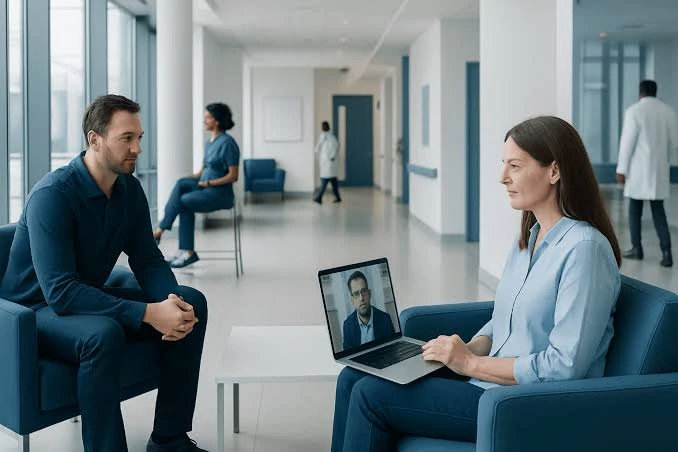
Choosing how to get mental health support is not a small decision. For some people, walking into a therapist’s office feels grounding and necessary. For others, the idea of commuting to an appointment, finding parking, and sitting in a waiting room adds enough friction that they put off getting help for months, sometimes years. Neither reaction is wrong. They just point to different needs, and understanding those needs can make the difference between finally getting support and continuing to delay it.
This article breaks down the genuine differences between online therapy and in-person mental health care: what each format does well, where each one falls short, and the kinds of factors that tend to tip a thoughtful decision one way or the other. There are no universal right answers here, but there are patterns worth knowing.
How Each Format Actually Works
In-person mental health care takes place at a physical clinic, private practice, community health center, or hospital outpatient department. You schedule an appointment, travel to the location, and meet with a licensed provider face to face. Sessions typically run 45 to 60 minutes for therapy or shorter for medication management visits. The infrastructure is familiar because it mirrors how most medical care has historically been delivered.
Online mental health care, often called teletherapy or telehealth, uses secure video platforms, phone calls, or in some cases asynchronous messaging to connect clients with licensed clinicians. The session itself is structurally similar: a set block of time, a single provider, a confidential conversation. What changes is the physical setting. You could be at your kitchen table, in your parked car during a lunch break, or in a quiet bedroom. The clinician is somewhere else entirely, but the interaction is real and the clinical standards are the same.
Where Online Therapy Has a Clear Advantage
Access is the most obvious strength of virtual care. A 2022 report from the American Psychological Association found that geographic shortages of mental health providers affect large portions of the United States, with rural areas hit hardest but urban neighborhoods also experiencing serious gaps in available appointments. Online therapy sidesteps many of those geographic barriers because a client in one ZIP code can work with a licensed provider based elsewhere in the same state.
Flexibility is the second major advantage. People who work irregular hours, manage caregiving responsibilities, or have physical limitations that make travel difficult tend to find virtual appointments far easier to keep consistently. Consistency matters enormously in mental health treatment. Missing sessions disrupts progress, and anything that reduces the chance of missing sessions has clinical value, not just logistical convenience.
There is also emerging evidence that some people feel more comfortable disclosing sensitive information from their own space. A 2021 study published in JMIR Mental Health found that clients receiving teletherapy reported similar or higher levels of therapeutic alliance compared to in-person clients, which was a somewhat surprising finding that challenged earlier skepticism about whether a screen could support a genuine therapeutic relationship.
Where In-Person Care Still Holds Ground
In-person care remains preferable, and in some cases clinically necessary, for certain presentations and treatment types. Providers can observe body language, posture, and non-verbal cues more completely during a face-to-face session. For clients working through trauma, dissociative symptoms, or conditions where physical grounding techniques are part of the treatment, having a provider physically present can matter.
Higher levels of care are another area where in-person settings are typically required. Intensive outpatient programs, partial hospitalization programs, and residential treatment all involve structured, multi-hour days that only function on-site. Some medication management protocols also require periodic in-person evaluations, particularly when controlled substances are involved or when a provider needs to conduct a physical or neurological assessment.
For clients who lack reliable internet access, a private space at home, or a device capable of running a video call without interruption, the practical barriers to virtual care can outweigh its theoretical convenience. Online therapy assumes a baseline of technology access that not everyone has equally.
A Side-by-Side Look at Key Differences
| Factor | Online Therapy | In-Person Therapy |
| Geographic flexibility | High; state licensure is the main limit | Limited to providers near your location |
| Scheduling convenience | Often broader hours, less commute time | Dependent on office hours and travel |
| Privacy at home required | Yes; a quiet, private space is essential | Not an issue; privacy is built into the setting |
| Technology requirements | Reliable internet and a device with camera | None beyond transportation |
| Non-verbal observation by provider | Partial; depends on camera angle and quality | Full; provider sees the whole person |
| Higher levels of care available | Generally no | Yes; IOP, PHP, and residential are on-site |
| Comfort for some clients | Higher for those anxious about office settings | Higher for those who prefer face-to-face contact |
| Insurance coverage | Broadly covered post-2020 policy changes | Broadly covered; varies by plan and provider |
How the Pandemic Changed the Landscape Permanently
Before 2020, telehealth in mental health care existed but operated under significant regulatory restrictions. Many insurers reimbursed it poorly or not at all, and state licensing rules made cross-state care difficult. The COVID-19 pandemic forced rapid policy changes at both the federal and state levels. Medicare, Medicaid, and most private insurers expanded telehealth coverage, and many of those expansions have since been made permanent or extended indefinitely.
The result is that virtual care is no longer a niche workaround. It is a mainstream delivery model with its own growing body of clinical research. Cities with dense provider populations have seen some of the strongest adoption, partly because urban residents are often already comfortable with digital services, and partly because even in areas with many providers, scheduling delays and transportation costs can still be significant obstacles. Access to virtual mental health treatment in Chicago, for example, has expanded substantially in recent years, giving residents a wider range of options than were available through traditional clinic-based care alone.
Questions Worth Asking Before You Choose
Rather than treating this as a binary choice between good and bad options, it helps to ask specific questions about your own situation. The answers tend to point toward one format or the other fairly naturally.
- Do you have a reliable, private space at home where you can take a video call without interruption?
- Is transportation to a clinic a genuine barrier in your daily life, whether because of cost, time, mobility, or scheduling?
- Are you seeking individual therapy, or do you need a more intensive level of care such as a partial program or group-based treatment?
- Have you tried therapy before, and if so, did the setting matter to how comfortable you felt?
- Does your insurance cover telehealth at the same rate as in-person visits, or is there a cost difference?
- Is there a specific type of therapy, such as EMDR for trauma, where your provider recommends in-person sessions?
- How stable is your internet connection, and do you have a device with a functional camera and microphone?
Hybrid Models Are Becoming More Common
One development worth knowing about is the rise of hybrid care models, where a client might do most sessions virtually but come in person for periodic check-ins, medication reviews, or specific therapeutic exercises. Some practices now build hybrid scheduling into their standard intake process rather than treating it as an exception. This approach captures the convenience of virtual care while preserving the option for in-person contact when it is clinically useful or when the client simply prefers it.
Hybrid models also help clients who start with one format and find their needs shifting. Someone who begins with in-person sessions after a crisis and gradually stabilizes might transition primarily to virtual care as their schedule or circumstances change. The ability to move between formats without switching providers entirely is a practical benefit that many people do not think to ask about when starting treatment.
What to Ask a Potential Provider About Format
- Do you offer both in-person and virtual appointments, or only one format?
- If I start virtually, can I switch to in-person sessions later without being re-evaluated from scratch?
- What platform do you use for video sessions, and is it HIPAA-compliant?
- Are your telehealth sessions covered by my insurance at the same rate as office visits?
- Are there any clinical reasons you would recommend one format over the other for my specific situation?
Putting It Together
Online therapy and in-person care are not competing philosophies. They are different delivery formats for the same core service, and both can be genuinely effective when matched to the right person and the right clinical situation. The research on outcomes is converging toward a straightforward conclusion: format matters less than consistency, therapeutic fit, and the quality of the provider. Getting into treatment and staying in treatment tends to produce better results than agonizing over which setting is theoretically superior. If one format removes a barrier that has been keeping you from starting, that is the format worth trying first.
