


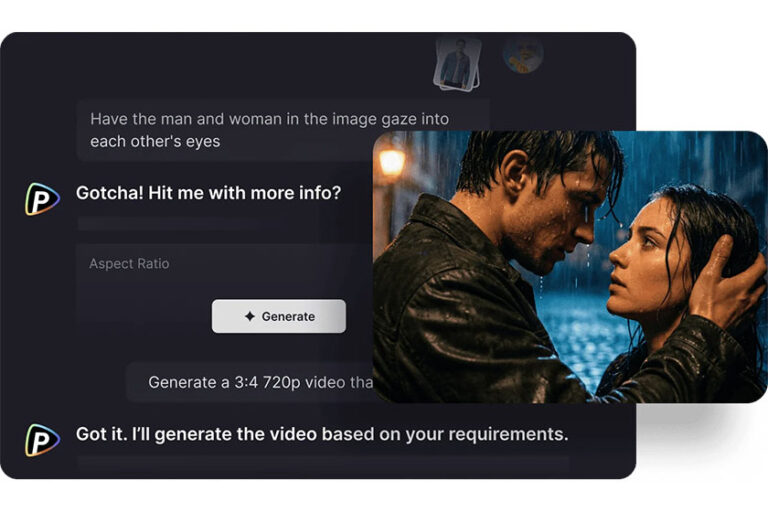
What is Pollo Agent?
Pollo Agent is an AI video agent designed to turn ideas, links, or assets into production-ready videos with minimal manual editing. According to its positioning, it enables users to “go from ideas to production-ready videos instantly,” removing the need for traditional editing workflows.
Instead of acting as a simple text-to-video generator, Pollo Agent is built as a workflow-driven system. Users can input prompts, TikTok or YouTube links, or product URLs, and the system interprets these inputs to generate structured video outputs. It supports multiple formats such as clone viral videos, UGC video ads, explainer videos, anime videos, music videos, and news-style content.
The core promise of Pollo Agent is that “zero editing is needed,” meaning the AI handles sequencing, scene structuring, and assembly automatically. This makes it distinct from conventional editing tools that require manual timeline work.
What Features Does it Have?
AI Video Agent that clones viral content
One of the key features of Pollo Agent is its ability to clone viral video formats. Users can paste a TikTok or YouTube link, and the AI video agent extracts patterns such as hooks, rhythm, pacing, and storytelling structure. It then generates a new version adapted to the user’s input.
This “start from viral, not from zero” approach is designed to reduce guesswork and accelerate content creation based on proven engagement formats.
End-to-end video generation
Pollo Agent generates complete videos from start to finish, without requiring users to stitch clips or manually assemble scenes. Functioning as a powerful AI UGC video generator, it enables brands and creators to produce authentic, user-style content at scale — perfect for ad campaigns, product showcases, and social media rollouts. This end-to-end automation is particularly relevant for users who want scalable content production.
The system supports formats like:
- Facebook ad videos
- Amazon URL-to-video
- Shopify product videos
- Pixel art story videos
- Celebrity-style videos
- Educational explainers
This positions the AI video agent as a multi-purpose production tool rather than a single-use generator.
No prompt engineering required
A notable feature is that users do not need advanced prompt writing skills. Pollo Agent interprets simple instructions and converts them into structured production logic. When inputs are unclear, it can also ask follow-up questions, making it more accessible for non-technical users.
Multi-model AI integration
Pollo Agent integrates multiple AI models such as Sora 2, Veo 3.1, Seedance 2.0, and others. The system automatically selects the most suitable model depending on the workflow.
This reduces the need for users to manage multiple subscriptions or tools, consolidating video generation into a single platform.
Iterative workflow memory
Unlike one-off generators, Pollo Agent tracks edits, visual direction, and references. This allows users to iterate on videos without restarting from scratch. It is designed for continuous refinement, which is important for marketing campaigns and content testing.
Who is Pollo Agent for?
Short video creators
Pollo Agent is suitable for creators who rely on fast-moving platforms like TikTok or Instagram. The AI video agent helps transform existing viral formats into new variations, allowing creators to maintain consistent output.
Key benefits for this group include:
- Faster content production cycles
- Ability to remix trending formats
- Increased output with less manual editing
SMBs and e-commerce teams
For small businesses and online stores, Pollo Agent is used to generate product and marketing videos at scale. By using features like Shopify or Amazon URL-to-video, businesses can quickly turn product pages into promotional content.
This supports:
- Batch video generation
- Lower production costs
- 4K export capabilities for ads and listings
Marketing professionals
Marketers use Pollo Agent as an AI video agent for campaign production. It helps generate ad variations, test hooks, and produce multi-channel content faster.
This is particularly useful for:
- A/B testing video ads
- Creating multiple campaign creatives
- Scaling branded content across platforms
How to Use Pollo Agent?
Step 1: Choose agent mode
Users start by selecting a mode such as clone video ads, story video, anime video, or explainer video. They can also add links or assets such as TikTok videos or product URLs.
Step 2: Generate and refine
Once inputs are provided, Pollo Agent generates a complete video. Users can then refine results through chat-based interaction instead of re-editing timelines manually.
Step 3: Download and publish
After refinement, the final video can be exported and shared across platforms such as TikTok, Instagram, or YouTube.
This workflow emphasizes simplicity and reduces the traditional editing cycle into a conversational process.
Performance
From a functional perspective, Pollo Agent focuses more on workflow efficiency than frame-level editing precision. As an AI video agent, its performance is closely tied to how well it interprets input prompts and reference materials.
Strengths in performance
- Fast generation of full-length structured videos
- Strong ability to replicate viral content patterns
- Efficient batch creation for marketing use cases
- Reduced production time (claimed up to 75% in creator workflows)
Potential limitations
- Less granular control compared to professional editing software
- Output quality depends heavily on input clarity and reference quality
- Creative direction may sometimes feel standardized due to template-driven structures
Overall, performance is optimized for speed and scalability rather than cinematic precision.
Conclusion
Pollo Agent functions as a multi-purpose AI video agent focused on turning ideas, links, and assets into structured, ready-to-publish videos. Its strongest value lies in workflow automation, viral content cloning, and end-to-end video generation without manual editing.
It is particularly suitable for creators, marketers, and e-commerce teams that prioritize speed, scalability, and content iteration over detailed manual editing control.
While it may not replace traditional editing tools for high-precision production work, it represents a shift toward AI-driven video workflows where production is increasingly handled through structured automation rather than manual assembly.
