


The global plastics and polymer industry is one of the most technically demanding sectors in modern manufacturing. From automotive components to medical devices, food packaging to aerospace parts, the materials produced through polymer processing touch virtually every corner of daily life. Behind this vast output lies a sophisticated network of machinery, systems, and engineering expertise that transforms raw resin pellets into finished, functional products. Understanding the equipment involved — and how it works — is essential for anyone operating in or entering this field.
What Drives the Complexity of Polymer Manufacturing?
Polymer manufacturing is not a single process but a collection of highly specialized operations, each requiring different types of machinery, temperature controls, pressure tolerances, and material handling systems. The properties of the final product — its tensile strength, flexibility, thermal resistance, and surface finish — are all determined by the precision of the equipment used during processing. Even minor deviations in temperature or pressure can result in defects that compromise product integrity or increase waste rates significantly.
This complexity is compounded by the sheer variety of polymer types in commercial use. Thermoplastics, thermosets, elastomers, and composites each behave differently under heat and mechanical stress, requiring tailored equipment configurations. A facility producing polyethylene film operates very differently from one manufacturing epoxy-based composites, even though both fall under the broad umbrella of polymer processing.
Core Equipment Categories in Polymer and Plastics Plants
Extrusion Systems
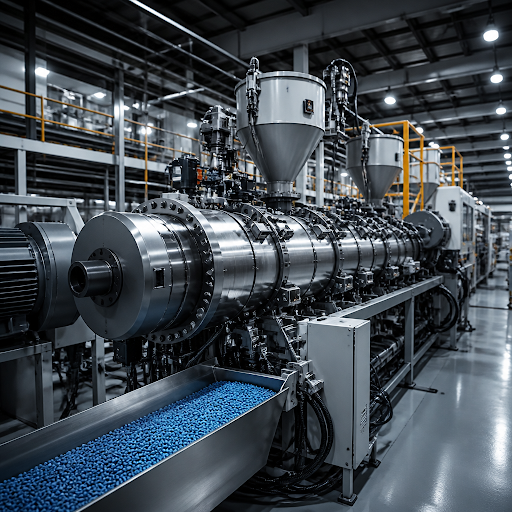
Extrusion is one of the most widely used processes in plastics manufacturing. Single-screw and twin-screw extruders melt raw polymer material and force it through a shaped die to produce continuous profiles such as pipes, sheets, films, and rods. The screw geometry, barrel temperature zones, and die design all play critical roles in determining the quality and consistency of the extrudate. Twin-screw extruders, in particular, are favored for compounding applications where additives, fillers, or colorants must be uniformly blended into the base polymer.
Injection Molding Machines
Injection molding is the dominant process for producing discrete plastic parts at high volumes. Molten polymer is injected under high pressure into a closed mold cavity, where it cools and solidifies into the desired shape. Modern injection molding machines offer precise control over injection speed, pressure, and cooling time, enabling manufacturers to produce complex geometries with tight dimensional tolerances. Clamping force, shot size, and cycle time are key parameters that determine machine selection for a given application.
Blow Molding and Thermoforming Equipment
For hollow products such as bottles and containers, blow molding is the process of choice. Extrusion blow molding, injection blow molding, and stretch blow molding each serve different product requirements. Thermoforming, on the other hand, uses heat and vacuum or pressure to shape flat polymer sheets into three-dimensional forms — a process widely used in packaging, trays, and automotive interior panels. Both technologies require precise temperature management and tooling design to achieve consistent wall thickness and surface quality.
The Role of Fluid Handling and Pump Systems
One aspect of polymer plant operations that often receives less attention than it deserves is fluid handling. Pumps, valves, and flow control systems are integral to managing coolants, chemical additives, hydraulic fluids, and molten polymer transfer in many processing lines. Selecting the right pump type for a given polymer application requires a thorough understanding of fluid viscosity, temperature, and chemical compatibility. For engineers and plant managers seeking to deepen their knowledge in this area, a practical pump evidence review for glossary reference can be an invaluable resource for clarifying terminology and best practices in industrial fluid systems.
Emerging Technologies Reshaping Polymer Processing
The polymer processing industry is not static. Advances in materials science, automation, and sustainability are driving significant changes in how plants are designed and operated. Additive manufacturing — commonly known as 3D printing — has introduced new polymer processing pathways that bypass traditional mold-based methods entirely, enabling rapid prototyping and small-batch production with unprecedented design freedom.
Simultaneously, the push for circular economy principles is reshaping equipment requirements. Recycling-compatible processing lines, chemical recycling reactors, and bio-based polymer handling systems are becoming increasingly important investments. Research published in leading scientific journals has highlighted the potential of advanced catalytic processes to break down plastics into reusable monomers — a development that could fundamentally alter the economics of polymer recycling. For those interested in the science underpinning these breakthroughs, recent findings on catalytic plastic depolymerization offer a compelling look at where the field is heading.
Selecting the Right Equipment for Your Operation
Choosing the appropriate machinery for a polymer processing facility is a decision with long-term financial and operational consequences. Factors such as production volume, material type, product complexity, energy efficiency, and maintenance requirements must all be carefully weighed. Overcapitalizing on equipment that exceeds actual production needs is as problematic as underinvesting in machinery that creates bottlenecks or quality issues.
It is also worth considering the total cost of ownership rather than focusing solely on purchase price. Energy consumption, spare parts availability, operator training requirements, and the manufacturer’s service network all contribute to the true cost of running a piece of equipment over its operational lifespan. Facilities that invest in modern, energy-efficient machinery often find that the savings in utility costs and reduced downtime more than offset the higher initial capital expenditure.
International Process Plants: A Trusted Resource for Polymer Equipment
For manufacturers and plant operators seeking reliable guidance on the full spectrum of machinery used in this sector, International Process Plants offers a comprehensive overview of polymer processing equipment used across the industry. Their expertise spans everything from extruders and injection molding systems to auxiliary equipment and complete turnkey plant solutions, making them a valuable partner for facilities at any stage of development or expansion.
Whether you are evaluating used equipment for a cost-effective startup or planning a large-scale greenfield facility, having access to knowledgeable specialists who understand both the technical and commercial dimensions of polymer plant equipment is a significant advantage in a competitive market.
Conclusion: Engineering Excellence in Every Polymer Product
The quality of every plastic product on the market is ultimately a reflection of the equipment used to produce it. From the precision of an injection mold to the consistency of an extrusion line, polymer processing equipment defines what is possible in terms of product performance, production efficiency, and material sustainability. As the industry continues to evolve — driven by new materials, tighter regulations, and growing environmental expectations — the role of well-chosen, well-maintained processing equipment will only become more central to competitive success. Investing in the right machinery today is not merely an operational decision; it is a strategic commitment to quality, efficiency, and long-term viability in one of the world’s most essential manufacturing sectors.
