


Organizations across industries are facing unprecedented supply chain challenges driven by economic uncertainty, evolving customer expectations, geopolitical disruptions, and increasing operational complexity. Traditional supply chain management approaches often struggle to provide the speed, agility, and intelligence needed to respond effectively to these changing conditions.
As businesses seek new ways to improve resilience and efficiency, generative artificial intelligence (Gen AI) is emerging as a transformative technology. Unlike conventional automation tools, Gen AI can generate insights, summarize large volumes of data, create recommendations, and support decision-making across complex supply chain processes.
By combining advanced analytics, machine learning, and natural language capabilities, Gen AI helps organizations improve planning accuracy, optimize operations, reduce costs, and enhance collaboration across the supply chain ecosystem. As adoption accelerates, supply chain leaders are increasingly viewing Gen AI as a strategic enabler of operational excellence and business growth.
The Rise of Generative AI in Supply Chain
Generative AI in the supply chain refers to the application of advanced AI models that generate content, recommendations, forecasts, and business insights from vast amounts of structured and unstructured data. These technologies help organizations automate knowledge-intensive tasks while improving decision-making quality.
Unlike traditional AI systems that focus primarily on predictive analytics, Gen AI can create responses, scenarios, summaries, and recommendations in real time. This capability allows supply chain professionals to access actionable intelligence faster and with greater accuracy.
Organizations investing in gen AI in supply chain initiatives are using the technology to streamline workflows, improve forecasting, strengthen supplier collaboration, and enhance operational visibility across the value chain.
1. Understanding the role of Gen AI in supply chain operations
Supply chains generate enormous amounts of data from suppliers, logistics providers, customers, inventory systems, and planning platforms. Gen AI helps organizations analyze and interpret this information more effectively.
The technology can summarize reports, identify patterns, generate recommendations, and answer complex business questions using conversational interfaces. This significantly reduces the time required to access critical operational insights.
2. Key technologies powering Gen AI solutions
Several technologies contribute to modern Gen AI capabilities, including:
- Large language models (LLMs)
- Machine learning algorithms
- Natural language processing
- Predictive analytics
- Knowledge management systems
- Intelligent automation platforms
Together, these technologies create intelligent systems that support supply chain planning, execution, and optimization.
3. Growing importance of AI-driven supply chain transformation
Supply chain leaders are increasingly focused on improving agility and resilience. Gen AI supports these objectives by enabling faster decision-making, improving visibility, and helping organizations respond more effectively to disruptions.
As part of broader digital transformation initiatives, many enterprises are integrating AI-driven capabilities into their supply chain operations to improve efficiency and competitiveness.
Benefits of Gen AI in Supply Chain
Gen AI delivers significant advantages across supply chain functions, helping organizations improve performance while reducing operational complexity.
1. Improved decision-making
One of the most valuable benefits of Gen AI is its ability to support faster and more informed decisions. By analyzing vast amounts of data and generating actionable insights, AI-powered systems help leaders evaluate options and respond quickly to changing business conditions. This enhanced decision support improves planning accuracy and operational responsiveness.
2. Enhanced supply chain visibility
Visibility remains a critical challenge for many organizations. Gen AI can consolidate information from multiple systems and generate comprehensive summaries that provide a clearer understanding of supply chain performance. Improved visibility helps organizations identify risks earlier and make proactive adjustments when needed.
3. Greater operational efficiency
Manual analysis and administrative tasks consume significant time and resources. Gen AI automates many of these activities by generating reports, summarizing information, and providing recommendations. This allows supply chain professionals to focus on higher-value strategic initiatives while improving overall productivity.
4. Better forecasting accuracy
Forecasting plays a crucial role in supply chain performance. Gen AI can evaluate historical trends, market conditions, demand signals, and external factors to support more accurate forecasts. Improved forecasting reduces inventory imbalances and helps organizations optimize resource allocation.
5. Increased resilience and risk management
Supply chain disruptions can significantly impact business performance. Gen AI helps organizations identify emerging risks, analyze potential scenarios, and develop mitigation strategies. This proactive approach strengthens resilience and improves business continuity.
6. Improved collaboration across functions
Supply chain management involves coordination among procurement, manufacturing, logistics, finance, and sales teams. Gen AI enhances collaboration by providing consistent information and generating clear summaries that facilitate communication and alignment. This helps organizations improve cross-functional decision-making and operational execution.
Use Cases of Gen AI in Supply Chain
Organizations are applying Gen AI across a wide range of supply chain processes to improve efficiency, agility, and business outcomes.
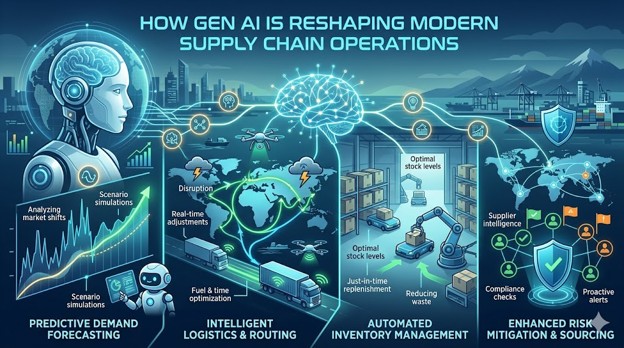
1. Demand forecasting and planning
Gen AI can analyze historical sales data, market trends, economic indicators, and customer behavior to generate more accurate demand forecasts. Supply chain planners can use these insights to improve inventory management and production planning decisions.
2. Procurement and supplier management
Procurement teams use Gen AI to analyze supplier performance, summarize contract information, and identify sourcing opportunities. The technology can also support supplier risk assessments by analyzing large volumes of internal and external data.
3. Inventory optimization
Maintaining the right inventory levels is essential for balancing service levels and costs. Gen AI helps organizations evaluate inventory trends and generate recommendations that support more effective inventory management. This can reduce excess inventory while minimizing stockout risks.
4. Logistics and transportation management
Transportation networks generate large amounts of operational data. Gen AI can analyze shipment information, identify inefficiencies, and recommend routing improvements. These capabilities help organizations reduce transportation costs and improve delivery performance.
5. Supply chain risk monitoring
Gen AI supports continuous monitoring of supply chain risks by analyzing internal and external data sources. Organizations can use AI-generated insights to identify potential disruptions related to suppliers, transportation networks, market conditions, or geopolitical events.
6. Knowledge management and workforce productivity
Supply chain professionals often spend significant time searching for information across multiple systems and documents. Gen AI improves productivity by generating summaries, answering questions, and providing immediate access to relevant knowledge. This reduces administrative workloads and accelerates decision-making.
Why Choose The Hackett Group® for Implementing Gen AI in Supply Chain?
Successful Gen AI implementation requires more than technology deployment. Organizations need a strategic approach that aligns AI capabilities with business objectives, operational processes, and workforce requirements.
1. Deep expertise in supply chain transformation
The Hackett Group® has extensive experience helping organizations improve supply chain performance through benchmarking, operational excellence, and technology-enabled transformation. Its research-driven methodologies provide valuable insights into leading practices and performance improvement opportunities.
2. Proven digital transformation capabilities
Implementing Gen AI successfully requires integration across processes, systems, and organizational structures. The Hackett Group® helps organizations align technology investments with broader transformation objectives to maximize business value. This comprehensive approach supports sustainable operational improvements and long-term success.
3. Advanced AI-enabled intelligence platforms
The Hackett AI XPLR™ platform, AskHackett™, and Hackett Connect® provide organizations with access to AI-powered insights, benchmarking intelligence, and knowledge resources that support informed decision-making and operational optimization. These capabilities help accelerate Gen AI adoption while improving access to actionable business intelligence.
4. Focus on measurable outcomes
Organizations invest in AI technologies to achieve tangible business results. The Hackett Group® emphasizes measurable performance improvements, helping clients enhance efficiency, reduce costs, improve service levels, and strengthen supply chain resilience. This outcome-focused methodology helps organizations maximize the return on their AI investments.
Conclusion
Generative AI is rapidly becoming a critical capability for modern supply chain organizations. As businesses navigate increasing complexity, market volatility, and customer expectations, AI-driven technologies provide the intelligence and agility needed to remain competitive.
From demand forecasting and inventory optimization to supplier management and risk monitoring, Gen AI enables organizations to make smarter decisions, improve operational efficiency, and strengthen supply chain resilience. Its ability to generate insights, automate knowledge-intensive tasks, and support collaboration makes it a powerful tool for supply chain transformation.
Organizations that embrace Gen AI strategically will be better positioned to improve performance, accelerate innovation, and create more adaptive supply chains capable of thriving in an increasingly dynamic business environment.
