


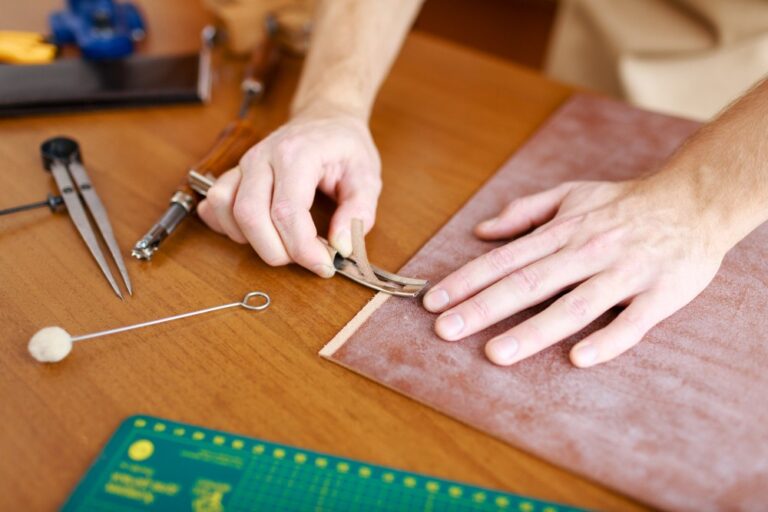
Leather goods are often judged by finish, color, and hardware, but the longest-lasting difference usually comes from stitching. A clean seam does more than hold panels together. It affects shape retention, edge stability, repair potential, and how a product ages through daily use. In belts, bags, saddles, cases, work gear, and footwear, stitch quality is one of the clearest signs of whether an item was made for short-term turnover or for long service.
Why stitching matters more than decoration
Leather is a strong material, but strength alone does not guarantee durability. Every cut edge, folded corner, strap attachment, and stress point depends on seam construction. When stitching is uneven, too loose, too tight, or poorly aligned with the material, the product begins to fail from the joint outward. That failure may show up as warped panels, stretched handles, split edges, or loose sections that pull apart under repeated strain.
This is why stitching is often the practical backbone of leatherwork. It distributes pressure, controls movement, and reinforces areas that receive the most wear. In everyday use, the seam is the line that absorbs friction, weight shifts, bending, and repeated contact. The better that line is formed, the better the product performs over time.
The difference between surface quality and structural quality
A polished exterior can create the impression of craftsmanship, but structure tells the real story. Straight seams, balanced spacing, and consistent tension are not just aesthetic details. They signal control during production. When those elements are present, the leather lies flatter, the shape stays cleaner, and the product remains more stable under real conditions.
Structural quality also affects how a piece looks after months or years of use. A well stitched leather bag tends to keep its silhouette longer. A belt holds its form with less twisting. A boot upper resists distortion in high-flex zones. Even when the leather softens with age, good stitching helps it age in an orderly way rather than collapse at the points of stress.
Why machine precision changed leather production
Leather is not a uniform fabric. Thickness varies, density changes from one hide section to another, and multiple layers often meet difficult points such as corners, gussets, folded tabs, and reinforced straps. That is where consistent machine work became essential in modern leather manufacturing.
In workshop settings, industrial leather sewing machines are used to manage dense material, layered construction, and repeated seam accuracy at a level that supports both durability and repeatability. That matters because leather products are not only expected to look refined on day one, but they are also expected to survive handling, transport, storage, weather exposure, and continuous use.
The role of precision is especially important in products made for function first. Work aprons, tacks, heavy bags, cases, and protective gear all rely on seams that can withstand weight and motion without shifting out of line. In those categories, stitching is not a decorative support. It is a load-bearing design.
Repairability starts at the seam
One of the strongest indicators of quality is whether an item can be repaired. Leather goods often outlast their first soles, straps, zippers, or linings. If the original stitching is well placed and the surrounding material has been respected, repair becomes realistic. If the seam has already chewed through the leather, pucker the edge, or weaken the panel, repair becomes limited or impossible.
This matters in a market where more buyers are paying attention to longevity. Repairable goods hold value longer because they remain serviceable after wear appears. A restitched handle, replaced panel, or reinforced edge can extend the life of a piece significantly, but only if the original construction leaves enough integrity to work with.
For that reason, stitching should be viewed as part of a product’s maintenance future, not just its manufacturing past.
Better stitching supports better business
From a business perspective, seam quality influences returns, repairs, reputation, and repeat purchases. Weak construction creates preventable complaints. Strong construction reduces early failure and raises confidence in the product category as a
whole. This is particularly important for makers and retailers operating in segments where durability is part of the value proposition.
Consumers may not always describe stitching tension or feed consistency, but they recognize outcomes. They notice when handles stay secure, when seams remain straight, and when edges do not spread apart. Over time, those details shape whether a leather product is treated as disposable, repairable, collectible, or worth passing down.
That shift in perception affects pricing power as well. Products associated with dependable construction can justify a longer ownership cycle. They move away from novelty buying and closer to practical investment, even in everyday categories.
What people should look for
For anyone evaluating leather goods, stitching offers a useful starting point. The seam should appear even, balanced, and appropriate to the thickness of the material. Stress points should be reinforced, not rushed. Corners should sit cleanly without distortion.
Layers should meet securely without bunching or visible strain. Most importantly, stitching should support the shape of the product instead of fighting against it.
These details may seem small, but they explain why some leather goods wear gracefully while others break down early. Leather gets attention, but stitching often decides the outcome. In a category built on durability, the standard behind better goods is rarely a surface detail. It is the line that holds everything together.
