


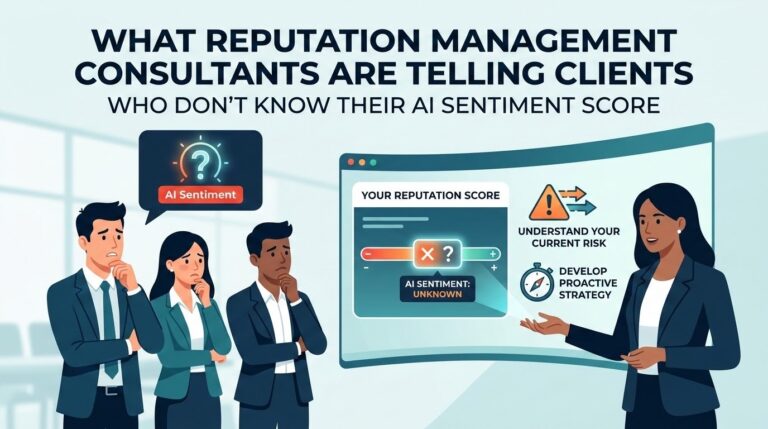
Many executives are discovering their brands carry an AI sentiment score they never authorized or reviewed. These algorithmically generated metrics now influence how search engines, investors, and partners perceive organizational credibility. Reputation management consultants are advising clients to examine three critical areas: the methodology behind scoring systems, the specific metrics that matter most for stakeholder decisions, and the monitoring infrastructure required to maintain control over brand narratives before external assessments create lasting damage.
Understanding AI Sentiment Scores
AI sentiment scores use natural language processing models, including VADER, TextBlob, and Google Cloud Natural Language API, to assign numeric values ranging from -1.0 (most negative) to +1.0 (most positive) across brand mentions. These tools help reputation management consultants deliver clear brand perception metrics to their clients.
Models break text into tokens before applying sentiment lexicons that assign polarity values to individual words. The system then aggregates these values while accounting for intensity modifiers like “very,” “slightly,” or “extremely.”
A tweet mentioning a data breach might receive a score of -0.8, reflecting strong negative sentiment. A post-launch product review could score +0.6, indicating moderately positive customer perception. An Instagram caption might register +0.2, showing mild positive sentiment.
One limitation affects accuracy across platforms. Sarcasm detection currently averages 67 percent accuracy according to Stanford NLP research, meaning some ironic statements receive incorrect polarity assignments. Consultants advise clients to review flagged items manually when context matters.
How AI Analyzes Brand Perception
AI systems classify brand perception by combining entity recognition, aspect-based sentiment analysis, and contextual embeddings from models like BERT to tag specific attributes such as product quality or customer service. This process gives reputation management consultants detailed insights into how audiences view different aspects of a brand.
The analysis follows a four-step pipeline:
- Named entity recognition extracts brand names from text
- Aspect extraction isolates product features and service elements mentioned by customers
- Contextual embeddings compute polarity per segment
- Weighted aggregation produces final perception scores
A single brand can receive vastly different scores across attributes. In one example, a company’s customer service aspect scored -0.4 while product durability scored +0.7. Reputation consultants use these breakdowns to identify specific areas requiring attention rather than treating brand perception as a single number.
Common Scoring Gaps
Three documented gaps affect the reliability of AI sentiment analysis: misclassification of industry jargon with a 23 percent error rate in financial services (per 2023 Journal of Marketing Research), failure to detect negation phrases, and under-weighting of emoji sentiment signals.
Industry slang creates frequent problems. The phrase “sick new campaign” might receive a negative score instead of a positive one. Double negatives like “not unhappy” frequently score as neutral rather than positive. The fire emoji gets ignored in many models entirely.
Reputation consultants address these gaps with targeted fixes:
- Custom domain lexicons correct industry-specific terminology
- Negation handling rules improve the detection of phrases that reverse the meaning
- Emoji sentiment dictionaries from the Unicode Consortium data capture visual signals
These adjustments improve the reliability of sentiment monitoring and give clients more accurate reputation metrics.
Why Sentiment Scores Matter Now
A 2024 Edelman Trust Barometer survey of 32,000 respondents showed 63 percent of consumers would stop purchasing after seeing sustained negative sentiment scores below -0.3 for 14 consecutive days. Reputation management consultants now treat this threshold as an early warning indicator.
Several forces have made sentiment scores more consequential. Regulatory requirements under the EU Digital Services Act force companies to disclose how they monitor brand sentiment across platforms. Ad platforms apply penalties when sentiment velocity drops by more than 35 percent over short periods, reducing ad visibility and increasing costs. Media outlets and activist investors track reputation KPIs in real time, with negative spikes triggering coverage and shareholder questions within hours.
Brands maintaining sentiment above +0.4 retain customers 2.3 times longer. That outcome is why continuous sentiment monitoring has moved from optional to core in most serious reputation programs.
Key Metrics: Reputation Management Consultants Track
Reputation management consultants standardize on five core metrics: sentiment volume (daily mention count), sentiment velocity (rate of change per hour), sentiment polarity distribution, platform share of voice, and cross-platform sentiment divergence.
| Metric | Definition | Benchmark Range | Tool Source |
| Sentiment Volume | Mentions per day | 500-2,000 for mid-size brands | Brandwatch |
| Sentiment Velocity | Percent change per hour | Alert threshold ±15% | Talkwalker |
| Sentiment Polarity | % positive, negative, neutral | Target 65/20/15 | Meltwater |
| Platform SOV | Share of voice by platform | Twitter 35%, Instagram 28%, News 22% | Sprinklr |
| Cross-Platform Divergence | Score difference across platforms | Above 0.3 triggers review | Brand24 |
Each metric connects to specific tools and established ranges that guide monitoring decisions. Tracking all five together reveals patterns that single data points routinely miss.
Volume and Velocity
Volume measures raw mention counts. Velocity calculates the hourly rate of change. A velocity spike of +40 percent within three hours typically precedes media coverage by six to 18 hours, according to Cision 2023 data.
Monitoring systems flag changes using three color thresholds: green for velocity under 10 percent, yellow for 10 to 25 percent shifts, and red for changes above 25 percent.
Nike’s 2023 collaboration announcement generated 12,400 mentions, with a +47 percent increase in velocity. Their team activated pre-written response templates within 45 minutes of the alert. That speed was only possible because the templates already existed.
Platform Distribution
Consultants map the sentiment distribution across Twitter (35 percent of conversations), Instagram (28 percent), TikTok (18 percent), news sites (12 percent), and review platforms (7 percent) using tools such as Sprinklr and Brandwatch.
Platform-specific patterns guide resource allocation. Twitter sentiment tends to run 0.15 points more negative than Instagram. TikTok shows the highest velocity but lowest volume stability across tracking periods.
Peloton encountered a clear divergence case in 2022 when news sentiment reached -0.6 while TikTok sentiment held at +0.1. That split prompted an immediate review of messaging consistency across channels. Without cross-platform tracking, the gap would have gone unnoticed.
Immediate Action Steps: The 5-Day Reputation Audit
Consultants recommend starting with a structured reputation audit. This process establishes baseline visibility across digital platforms before any improvement work begins.
The audit runs as follows:
- Day 1: Baseline data collection from Brandwatch and Meltwater APIs
- Day 2: Sentiment scoring of the last 90 days
- Day 3: Platform gap analysis
- Day 4: Competitor benchmarking
- Day 5: Deliverable presentation with prioritized risk matrix
The final package includes a PDF report with 12 charts, a risk heat map using red/yellow/green scoring, a three-sentence executive summary for leadership review, and a 90-day action roadmap.
The briefing runs 45 minutes and includes the CMO, legal counsel, and PR lead. A 30-day review call follows to assess early progress and adjust the roadmap based on new data.
Monitoring Tools to Implement
Consultants recommend a three-tier stack when clients lack visibility into their current AI sentiment score:
| Tool | Price | Key NLP Model | Best For | Setup Time |
| Brandwatch | $1,200/month | Conversation Index NLP | Crisis velocity alerts | 3 days |
| Talkwalker | $800/month | Blue Silk NLP | Image sentiment | 5 days |
| Meltwater | Custom pricing | Media Impact Score | News sentiment | 2 days |
| Sprinklr | Custom pricing | Unified NLP | Multi-platform dashboards | 7 days |
| Birdeye | $250/month | Review NLP | Local listings | 1 day |
The Brandwatch, Talkwalker, and Birdeye combination runs $2,250 per month and covers real-time conversation tracking, visual content evaluation, and review aggregation.
Mid-market organizations typically pair Brandwatch with Birdeye to cover social and review channels. Enterprise clients add Talkwalker to incorporate image-based sentiment into their existing framework.
NetReputation and other ORM firms operating at scale use layered monitoring approaches like this one specifically because single-platform tools miss the cross-channel patterns that often precede reputational crises.
Content Strategy Adjustments Based on Sentiment Data
When scores drop below -0.2, consultants advise shifting from promotional to empathy-driven content at a 3:1 ratio for 14 days. The reasoning is straightforward: audiences already skeptical of a brand respond poorly to product pushes. Acknowledging concerns first rebuilds the foundation.
Four tactical adjustments support this shift:
- Replace product feature posts with customer story videos that highlight real experiences
- Create reply templates for the top five negative themes, with responses prepared within two hours of detection
- Implement a sentiment-triggered content calendar within tools like Sprout Social to align messaging with current score readings
- Run A/B tests comparing apology messaging against solution-focused content to measure impact on reply sentiment
The Wendy’s 2023 campaign shows how timely adjustments work in practice. Their response strategy reversed negative sentiment polarity within 11 days by emphasizing listening and direct engagement over promotional messaging.
Crisis Response Planning
Reputation management consultants stress that clients must prepare structured responses before negative sentiment escalates. Pre-authorizing response tiers eliminates delays during high-pressure moments.
The three tiers break down as follows:
- Tier 1: Sentiment velocity greater than 30 percent, response within 60 minutes
- Tier 2: Negative polarity exceeding 50 percent of volume, response within 4 hours
- Tier 3: Influencer amplification, response within 24 hours
The six-step response protocol turns raw data into coordinated action:
- Pull a sample of 200 mentions to understand the scope of the discussion
- Use Talkwalker Discover to identify root cause themes behind the negative shift
- Draft a holding statement within 30 minutes that acknowledges concerns without assigning blame
- Legal review for liability phrases (current average review time: 47 minutes per Edelman)
- Publish on owned channels first, then expand to earned media
- Schedule a 48-hour sentiment check to measure whether the response improved brand perception
Testing this protocol before a real crisis makes execution significantly faster when a real crisis occurs.
Long-Term Reputation Building
Consultants recommend a 12-month improvement program targeting a lift in sentiment score from a baseline of +0.15 to +0.45, measured monthly via Brandwatch custom dashboards. The goal is moving from reactive management to proactive brand protection.
Quarterly milestones provide concrete structure:
- Q1: Implement review response SLAs, targeting 92 percent of responses within 24 hours
- Q2: Launch an executive thought leadership series with three LinkedIn posts per month
- Q3: Conduct a perception gap survey with customers
- Q4: Publish a transparency report that includes sentiment data
The financial case is straightforward. Research suggests that a one-point increase in sentiment correlates with a measurable revenue lift. Consultants present this connection as evidence that consistent monitoring delivers quantifiable business value, not just brand hygiene.
Annual third-party audits using the RepTrak methodology provide independent validation of progress. These assessments examine brand perception, stakeholder trust, and reputation metrics against industry benchmarks. The cycle ensures continuous improvement rather than one-time fixes.
