


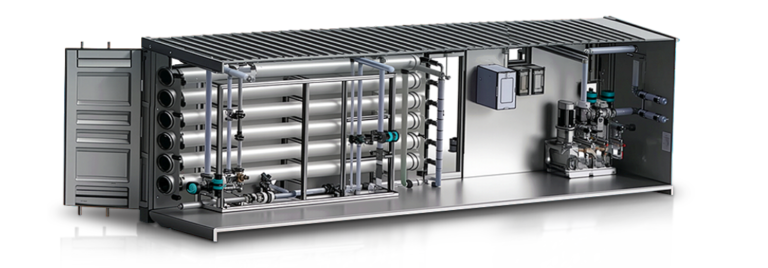
A plant is not always available for a water treatment project due to storage space, time, or infrastructure. There may be limited utilities at a remote industrial site. Treatment for a temporary project can be for a few years only. Even if a facility is already in operation, increased capacity may be needed without extensive construction.
That’s where containerized water treatment systems come in handy. All treatment stages can be added to a standard shipping container instead of constructing them on-site. It may be a combination of filtration, ultrafiltration (UF), reverse osmosis (RO), biological treatment, disinfection, or other treatment processes depending on the application.
There are two decisions to be made, however: one is whether the format is appropriate for the project, and the second is whether the supplier can provide the treatment process that is suitable for the water source and end product. and end product. The range of QILEE’s containerized systems covers drinking water, purified water, high purity water, process water, wastewater and reclaimed water.
Why Are Containerized Water Treatment Systems Important?
But the benefit of containerization is not just decreased space. It alters the means of carrying out a treatment project.
Major civil engineering work must be completed prior to equipment installation in a conventional plant. A containerized system has many treatment elements in a defined area.
Faster Installation
Many of the assembly components can be completed prior to final assembly. Then the container can be moved to the job site and connected to necessary utilities.
QILEE’s containerized systems feature integrated configurations for easy installation and deployment. It has standard 20-foot, 40-foot, and 40-foot high-cube containers. for its wastewater systems.
Preparations for the site still need to be made, which involve installing foundations, power lines, drainage, connections, and access for maintenance.
Better Use of Space
A containerized system provides a space that a designer can use to arrange the treatment process. This can be helpful when land space is restricted or if there is little space in an existing facility.
Decentralized treatment can also be accomplished in the format.
Easier Relocation
This treatment system, designed to fit into a standard shipping container, can be moved to different project sites. This is helpful when working on a project remotely.
What Actually Makes a Containerized System Effective?
A treatment system is not effective without a container. It’s the inside that tells the story.
The treatment process should start with the incoming water. Different treatment stages are needed for surface water, brackish water, industrial wastewater, and domestic sewage.
Treatment for purified water can be screening, coagulation, flotation, sedimentation, filtration and disinfection. Where greater separation is desired, UF or RO can be used, and if high-purity water is required, RO-EDI can be used.
With wastewater, it’s a different story. Biological treatment can result in a reduction of organic pollutants. and membrane processes can result in solid/liquid separation. Two different A/O + MBR wastewater configurations are available from QILEE, based on the respective treatment requirements.
The treatment train is the important factor – not the container size.
What Should Buyers Check Before Choosing a System?
There are several questions that are answered by a good specification before choosing the appropriate equipment:
| What to check | Why it matters |
| Raw-water quality | Determines contaminants and necessary treatment units |
| Required flow | Determines system capacity |
| Final water quality | Determines the filtration, membrane filtration, or biological filtration/polishing requirements. |
| Site conditions | Impacts on placement, utilities, drainage, and access. |
| Control requirements | Determines monitoring and automation needs |
| Future demand | Supports the expansion or modification of a process or procedure |
| Maintenance | Provides adequate facility for servicing equipment |
QILEE’s process water system includes multimedia filtration, UF, RO and mixed bed deionization for high quality process and boiler feed water. This is far from a simple drinking-water system or a biological wastewater treatment plant.
The rule of the game is to begin with the water and the necessary result and then select the treatment process.
Why Does System Integration Matter?
In addition, the individual parts of the containerized plant must function in concert.
Pumps, valves, membranes, chemical dosers, sensors and treatment units need to be in the proper sequence. Even good components can have poor performance when they are integrated into the overall plant.
At remote locations automation can be particularly valuable. Containerized solutions from QILEE can be controlled by PLC and HMI and through GPRS, 4G and IoT technologies, depending on the setup.
This can provide more detailed insight into the system’s state and minimize unnecessary operator action. It is important to have convenient access to a compact system for inspection, cleaning and replacement.
What Should You Look for in a Containerized Water Treatment Supplier?
With containerization now determined as the appropriate format, the supplier is a key consideration.
A good supplier should be able to link up:
- Analyzing raw water and process selection.
- Use of different treatment equipment and membranes.
- Applying various treatment equipment and membranes.
- To prepare the container layout and integrate equipment into the container.
- Automation and monitoring
- Manufacturing, construction, and testing
- Installation and commissioning
- Any future changes or additions of capacity
This is important in the event of changing water quality or project needs. A supplier that can only offer a standard container could find itself in trouble if the water requirements of the feed or the treatment need shift.
Why Choose QILEE for Containerized Water Treatment?
The biggest selling point of QILEE is the variety in treatment setups that can be achieved in its containerized method. It encompasses purified water, high purity water, process water, drinking water, wastewater, and water reuse.
Various technologies could be used in combination, depending on the application, such as UF, RO, RO-EDI, biological treatment, and MBR. Its industrial wastewater configurations are also able to integrate processes like MBR, DAF with chemical dosing, TMBR, NF and RO.
Integration is also an issue. The containerized process-water systems of QILEE can integrate treatment equipment, controls, chemical storage and supporting utilities into the container system. This enables the project to be seen as a whole treatment system rather than a number of individual pieces.
This helps to focus on the need for water treatment and the operation of the water-treatment system.
Conclusion
Containerized water treatment systems are more than just space-saving solutions. They can help reduce on-site construction, ease transportation, and facilitate the deployment process.
However, the container is just a structure. Whether it can solve the water-quality problem depends on the treatment process within it. The selection, integration, automation, and maintenance of the process are thus as important as the container.
This also goes to explain why the supplier is important. QILEE’s container solutions provide flexibility so that various treatment technologies and configurations can be employed for both drinking water and process water applications, as well as high purity water, wastewater, and reuse applications.
The question to ask is not just, “Will it fit into a container? The question is, “Can the system be designed around our water, site, and operating needs?” This is where it is absolutely crucial to select the right system and a company.
