


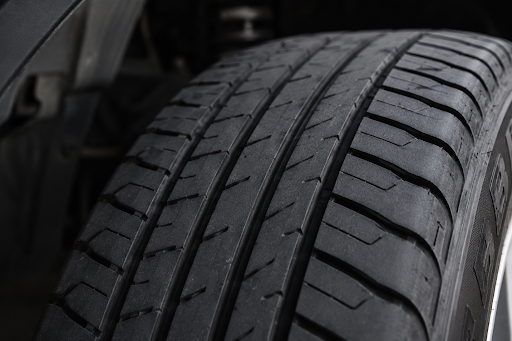
Worn tire tread doesn’t announce itself, it just fails you the moment you need it most: a sudden stop in the rain, a flooded road, a sharp corner at speed. Checking all terrain tire tread depth at home takes less than five minutes and costs nothing. Here’s exactly how to do it.
Why Tread Depth Is More Critical Than You Think
Tire tread does one job: channel water away from the contact patch so rubber stays in contact with the road. When tread is deep, that job is easy. As tread wears down, the grooves shallow out, water has nowhere to go, and the tire begins to ride on top of the water, that’s hydroplaning.
The numbers matter. Independent testing by AAA found that tires worn to 3.2mm required 43% more stopping distance on wet roads at 96 km/h compared to new tires, the equivalent of an extra 26 metres. Testing by Tire Rack and Consumer Reports shows that tires at the global legal minimum of 1.6mm can require nearly double the stopping distance of new tires in wet conditions.
Whether you’re navigating monsoon season, driving in heavy European rain, or handling sudden summer storms, shallow tread depth puts you and everyone else on the road at serious risk.
The 3 Methods to Check Tire Tread Depth at Home
Use all three of these methods together for the most complete picture. They take under five minutes for all four tires.
Method 1: Check the Built-In Tread Wear Indicator (TWI)
Every modern tire is manufactured with Tread Wear Indicators (TWI) built directly into the tread grooves. These are small raised rubber bars moulded into the base of the main circumferential grooves that run perpendicular to the direction of travel.
How to find them:
- Crouch beside the tire and look into the main tread grooves
- Look for raised rubber bars running across the groove at multiple points around the tire’s circumference
- On most tires, a small “TWI” marking or triangle symbol on the sidewall points directly to their location
What it means: When the surrounding tread wears down to the height of the indicator bar, the tire has reached 1.6mm (2/32″) the legal minimum in most countries worldwide. At this point, replace the tires immediately. The TWI tells you when you have run out of time. If the bar is already flush or level with the surrounding tread, do not drive on it.
Method 2: Use a Tread Depth Gauge
A tread depth gauge is the most accurate at-home tool available for this job. It is an inexpensive probe gauge sold at any auto parts retailer globally, and it gives you a precise millimetre reading in under 30 seconds per tire.
How to use it:
- Insert the probe into the deepest main groove of the tread, not a sipe or decorative groove
- Press the base plate flat against the tread surface
- Read the measurement where the sleeve meets the gauge body
- Repeat in at least three positions per tire: centre of the tread, the inner shoulder, and the outer shoulder
Check all four tires. Tread wear is rarely perfectly even, one area of a tire can be at 4mm while another has already reached 1.6mm.
Reading your results:
For high-rainfall markets: Treat 3.2mm as your practical replacement threshold, not 1.6mm. By the time a tire reaches the legal minimum on a wet road, your stopping distance has already increased significantly. The extra tire life between 3.2mm and 1.6mm is not worth the safety trade-off.
Method 3: Full Visual Inspection
While the vehicle is stationary, walk around it and examine all four tires. Tread depth alone does not tell the whole safety story, the condition and wear pattern matter just as much.
What to look for:
- Uneven wear across the tread width: Heavy wear in the centre indicates chronic over-inflation; heavy wear on both outer edges suggests under-inflation
- One-sided wear (inner or outer shoulder worn faster): Typically caused by wheel misalignment replace the tire and correct the alignment, or the new tire will wear the same way
- Cupping or scalloping (wavy, uneven wear): Usually caused by worn shock absorbers or struts, address the suspension issue alongside tire replacement
- Sidewall cracks, bulges, or cuts: A bulge is a structural failure. Replace the tire immediately; do not drive on it
- Exposed cords or steel belts: The tire is dangerously beyond its service life, replace before your next drive
How Often Should You Check
Check tread depth every time you check tire pressure. GITI Tire recommends checking pressure at least once a month and before any long journey. Adding a tread check takes under two minutes.
At minimum, run a full tread and visual check:
- Before the start of any wet or rainy season in your region
- Before any long-distance trip
- Every tire rotation (every 8,000–10,000 km is commonly recommended)
- Any time you notice changes in ride quality, handling, or braking feel
Tread Depth Is Not the Only Replacement Signal
A tire can pass the depth test and still be unsafe. Rubber degrades through oxidation over time regardless of how much tread remains, causing reduced flexibility, micro-cracking, and loss of grip even on a tire that looks normal from the outside.
Most tire safety authorities and manufacturers recommend replacing tires after six years from the date of manufacture, and treating ten years as an absolute maximum, regardless of tread depth remaining.
To find your tire’s age, locate the DOT code on the sidewall. The last four digits indicate the week and year of manufacture. “1524” means the tire was made in the 15th week of 2024.
In markets with formal vehicle inspection programmes, tire age is increasingly part of the check alongside tread depth, verify what applies in your country with your local vehicle inspection authority.
Frequently Asked Questions
What is the minimum legal tire tread depth?
The minimum legal tread depth for passenger tires is 1.6mm (2/32 inch) in most countries worldwide, including markets across Europe, Asia, Australia, and the Americas. This is the point at which tires are legally considered worn out and must be replaced. GITI Tire’s own guidance confirms: if tread depth measures less than 1.6mm, replace the tires immediately. Some countries set different limits, always check your local regulations.
Is 1.6mm tread depth actually safe to drive on?
Legally permissible in most markets, but practically dangerous on wet roads. Testing by Tire Rack and Consumer Reports found that tires at 1.6mm can require nearly double the stopping distance of new tires in wet conditions. Tire Rack, Consumer Reports, and Continental all recommend replacing passenger tires at 3.2mm (4/32 inch) rather than waiting for the legal minimum, particularly for drivers in regions with frequent rainfall.
How do I check tread depth without a gauge?
The most reliable no-tool method is checking the built-in Tread Wear Indicator (TWI). These are small raised rubber bars moulded into the base of the tread grooves. When your tread wears down level with those bars, you have reached 1.6mm. Most tires indicate their TWI location with a small triangle or “TWI” marking on the sidewall. This is a binary check, it tells you when you have run out of tread, not how much tread you have left. For a precise measurement at any depth, a tread depth gauge is necessary.
What does uneven tire wear tell me?
Wear concentrated in the tread center typically means the tire has been chronically over-inflated. Wear on both outer edges suggests under-inflation. Heavy wear on one shoulder almost always points to a wheel misalignment issue. Cupping or a scalloped wear pattern usually indicates worn shock absorbers or struts. In all cases, replacing the tire without fixing the root cause means the replacement tire will wear the same way. Diagnose the cause first.
How does tread depth affect wet-road braking distance?
AAA highway-speed testing at 96 km/h found that tires worn to 3.2mm (4/32 inch) needed 43% more distance to stop on wet pavement compared to new tires, approximately 26 extra meters. Testing by Consumer Reports and Tire Rack shows that stopping distance at the 1.6mm legal minimum can approach double that of new tires in wet conditions. At higher speeds, or on standing water, the effect is more pronounced because shallower grooves cannot channel water out from beneath the contact patch fast enough to maintain grip.
When should I rotate my tires, and does it affect tread wear?
Most manufacturers and tire specialists recommend rotating tires every 8,000–10,000 kilometers. Front tires typically wear faster than rear tires on front-wheel-drive vehicles due to the combined demands of steering and acceleration. Regular rotation distributes wear evenly across all four tires, extending the overall service life of the set. Use each rotation appointment as a trigger for a full tread depth check.
Take Action Before You Need To
The time to find out your tread is worn is not mid-braking on a wet road. A five-minute check — Tread Wear Indicators, a tread depth gauge reading at three points per tire, and a visual scan of the sidewalls and wear pattern — gives you a reliable picture of where your truck tires stand and how long you have before replacement becomes urgent.
Make it a monthly habit alongside your pressure check. Check before wet season. Check before long trips. Tire safety is one of the few things you can fully assess yourself, at home, without a workshop or specialized equipment.
