


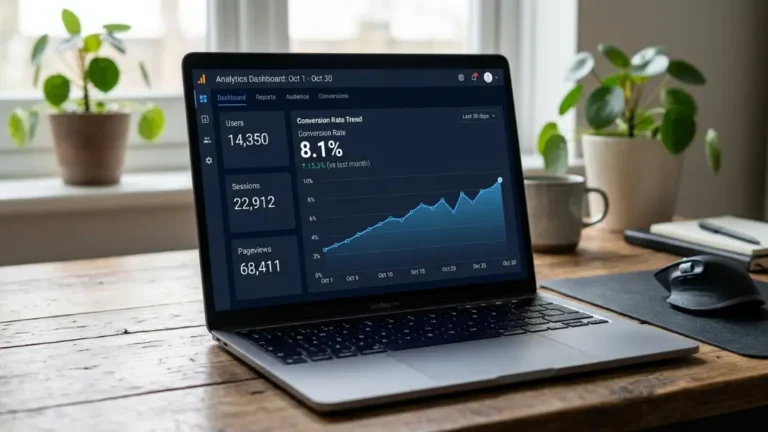
There is a brutal truth that most website owners never want to face.
You could be getting 50,000 visitors a month and still making almost no money from your website. Traffic without conversion is just noise. It costs you in hosting, in ad spend, in time, and in lost opportunities that you will never get back.
The average website converts at about 2.35 percent according to WordStream research. The top 25 percent of websites convert at 5.31 percent or higher. The top 10 percent? They convert at over 11 percent. That gap between average and elite is not luck. It is not a bigger budget. It is a smarter approach to conversion rate optimization.
This guide is going to show you exactly how to close that gap. Not with vague theories. With real strategies, practical frameworks, and the kind of depth that most articles skip entirely because they are too busy filling word count with fluff.
If you are a business owner, a marketer, or someone responsible for growing revenue from a website, this is the guide you need to read from start to finish.
What Does Conversion Rate Actually Mean
Before we get into the how, let us get the definition absolutely clear.
Your conversion rate is the percentage of website visitors who complete a desired action. That action depends on your business model. For an e-commerce store it might be a purchase. For a SaaS company it might be a free trial signup. For a B2B agency it might be a contact form submission or a booked discovery call. For a content site it might be an email subscription.
The formula is simple. Take the number of conversions, divide by the total number of visitors, and multiply by 100. If 1,000 people visit your site and 23 of them buy something, your conversion rate is 2.3 percent.
The reason improving that number matters so much is that conversion rate improvements compound directly into revenue without requiring any additional traffic spend. If you are spending five thousand dollars a month on paid ads and your site converts at 2 percent, improving to 4 percent doubles your revenue from the same budget. That is not incremental. That is transformational.
Why Most Websites Convert So Poorly
This is the part that most guides skip over too quickly, but understanding why conversion rates are low is the foundation for knowing how to fix them.
Most websites fail to convert not because they have bad products or uninterested visitors. They fail because of a specific set of entirely fixable problems.
The first is a mismatch between what the visitor expected and what they found. Someone clicks an ad promising a solution to their problem and lands on a generic homepage that talks about your company history. They leave in under ten seconds because what you showed them was not what they came for. This is called message mismatch and it is one of the single biggest conversion killers in digital marketing.
The second is friction. Friction is anything that slows a visitor down or makes completing your desired action harder than it needs to be. A checkout with twelve required fields is friction. A form that breaks on mobile is friction. A site that takes seven seconds to load is catastrophic friction. Friction does not just reduce conversions by a little. It can reduce them by 50 to 80 percent depending on how severe it is.
The third is lack of trust. A visitor who does not trust you will not give you their money or their contact information. Missing trust signals, unprofessional design, absence of social proof, vague guarantees, and unclear contact information all destroy trust before the visitor even reads your offer.
The fourth is a weak or unclear value proposition. If your website does not immediately communicate what you do, who you do it for, and why you are better than the alternatives, visitors have no reason to stay. They will go back to Google and click the next result.
Fix these four root causes and your conversion rate will improve before you change a single button color.
The Foundation: User Research Before Anything Else
Here is where most businesses go wrong. They try to fix their conversion rate by guessing. They change headlines, swap images, move buttons around, and wonder why nothing moves.
Conversion rate optimization without research is just guessing with extra steps.
Before you touch anything on your website, you need to understand what your actual visitors are experiencing, thinking, and feeling. You need to know where they are dropping off, what questions they have that your site is not answering, and what objections are stopping them from converting.
The tools you need for this research phase cost very little or nothing at all.
Start with heatmaps and session recordings. Tools like Microsoft Clarity are completely free and show you exactly where visitors are clicking, how far they are scrolling, and where they are dropping off. Spend two to three hours watching session recordings of real visitors on your key pages. You will see things that no amount of analytics data would have shown you. You will watch people struggle to find information that should be obvious. You will see them start filling out your form and abandon it at a specific field. You will see the exact moment they lose interest.
Next, run on-site surveys. A single question popup that appears when someone is about to leave your site, asking “What stopped you from completing your purchase today?” will give you more useful insight than months of quantitative analysis. Real answers from real visitors in their own words.
Then look at your analytics data with specific questions in mind. Which pages have the highest exit rates? Where in your checkout or signup flow do people abandon most? Which traffic sources convert best and worst? These patterns tell you where to focus your optimization effort first.
Finally, talk to your existing customers. Ask them what almost stopped them from buying. Ask what they were afraid of before they converted. Ask what finally convinced them. The language they use to describe these things is the exact language you should be using on your website to speak to future visitors who have the same hesitations.
This research phase is not optional. It is the difference between making changes that actually move the needle and making changes that waste your time.
Your Value Proposition: The Single Most Important Element on Your Site
If there is one thing that separates high converting websites from average ones more than anything else, it is the clarity and power of the value proposition.
Your value proposition is a clear statement that explains what you offer, who it is for, and why it is better than the alternatives. It needs to be immediately visible above the fold on your homepage and on every key landing page. Visitors should understand your core offer within five seconds of arriving.
A weak value proposition sounds like this: “We provide world class digital solutions for businesses of all sizes.” That sentence says absolutely nothing. It could describe ten thousand different companies. It gives the visitor no reason to stay.
A strong value proposition sounds like this: “We help e-commerce brands reduce cart abandonment by 30 percent in 90 days using AI-powered personalization.” That sentence is specific. It names the audience. It names the outcome. It names the timeframe. It names the mechanism. It is immediately meaningful to the right person.
Test your value proposition by doing what Peep Laja at CXL calls the “five second test.” Show someone your homepage for five seconds and then ask them what the company does, who it is for, and why someone should choose it. If they cannot answer those questions, your value proposition needs work.
Trust Signals: Converting Visitors Who Do Not Know You Yet
Here is a reality check. Most of your website visitors have never heard of you. They found you through a Google search or an ad. They have zero reason to trust you yet. And without trust, conversion is impossible.
Building trust on a website is not complicated but it is absolutely non-negotiable.
Customer testimonials are your most powerful trust signal. Not generic quotes like “Great company to work with!” but specific, outcome-focused testimonials that address the exact fears and hesitations your target audience has. “I was worried this would be too complicated to set up, but I had my first campaign live within two hours and saw a 24 percent lift in conversions in the first week” is a testimonial that converts. It names a fear, it names the resolution, and it names a specific result.
Case studies go even deeper. If you can show a potential customer a story of someone exactly like them who faced exactly their problem and achieved a specific measurable result by working with you, you have removed the biggest barrier to conversion: doubt.
For businesses working globally, third-party review platform badges like Google Reviews, Trustpilot, or G2 ratings carry significant weight. Displaying your rating alongside the number of reviews creates immediate social proof that requires zero effort to interpret.
Security badges matter for any site handling financial transactions or personal data. SSL certificates are a given. For e-commerce, displaying payment security badges from recognized providers at the checkout stage reduces abandonment significantly. According to Baymard Institute research, 17 percent of users have abandoned checkout specifically because they did not trust the site with their credit card information.
For our clients at ConversionXperts.com, we have found that adding a simple money-back guarantee or a clear no-obligation statement to a lead generation form consistently increases form completions by 15 to 30 percent. People need to know that saying yes is reversible.
Page Speed: The Silent Conversion Killer
Nothing kills conversions faster than a slow website.
According to Google research, as page load time increases from one second to three seconds, the probability of a visitor bouncing increases by 32 percent. By the time you reach five seconds, the bounce probability has increased 90 percent. By ten seconds, you have lost 123 percent more visitors compared to a one-second load time.
Every second of delay costs you money. On a site generating one million dollars a year from conversions, a two-second delay could be costing you two hundred thousand dollars in lost revenue annually.
Run your site through Google PageSpeed Insights right now. Look at your Core Web Vitals scores. Largest Contentful Paint should be under 2.5 seconds. Cumulative Layout Shift should be under 0.1. Interaction to Next Paint should be under 200 milliseconds. If you are failing any of these, fixing them is the highest priority optimization available to you.
Common speed fixes include compressing images without sacrificing quality, implementing browser caching, minifying CSS and JavaScript files, using a content delivery network to serve assets faster to global visitors, and switching to faster hosting if you are on shared hosting with oversold servers.
Mobile speed deserves special attention. In most markets, over 60 percent of web traffic comes from mobile devices. A site that loads in two seconds on desktop but six seconds on a 4G mobile connection is essentially broken for the majority of your visitors.
Landing Page Optimization: Where Conversions Are Won or Lost
Your landing pages are the most important pages on your website from a conversion standpoint. These are the pages where the specific transaction between your offer and your visitor’s decision happens. Getting them right is worth more than almost anything else you can do.
Every landing page needs a single, clear objective. One page, one goal. The moment you add multiple calls to action or try to serve multiple purposes with a single page, conversion rates drop. Remove navigation menus from dedicated landing pages. Remove footer links that take people away from the page. Remove any element that does not directly support the conversion goal.
Your headline is the most tested element on any landing page because it is the first thing visitors read and the primary factor in whether they stay or leave. The headline should speak directly to the specific desire or pain point that brought this visitor here. It should connect immediately to whatever they clicked before arriving. It should make a clear and believable promise.
The body copy should follow the same structure. Lead with the problem your visitor recognizes in themselves. Agitate that problem slightly so they feel the cost of not solving it. Then present your solution as the answer. Then prove it with social proof, case studies, and data. Then remove risk with guarantees. Then make a clear, specific call to action.
Your call to action button deserves far more attention than most businesses give it. The text on the button matters enormously. “Submit” converts poorly because it describes what the visitor does, not what they get. “Get My Free Audit” converts better because it describes the value the visitor receives. “Start Growing My Revenue Today” converts even better in some contexts because it connects to the emotional outcome the visitor actually wants.
Button placement matters too. Your primary CTA should appear above the fold so visitors never need to scroll to find it. It should also appear again after any long section of body copy or social proof. For longer pages, placing the CTA in three to four locations is common practice.
The Checkout and Form Optimization Nobody Talks About Enough
If you have an e-commerce site, your checkout process is your single highest-leverage optimization opportunity. According to the Baymard Institute, the average documented cart abandonment rate is 70.19 percent. That means seven out of every ten people who add something to their cart never complete the purchase.
The top reasons people abandon checkout are: being forced to create an account before buying, a complicated or lengthy checkout process, concerns about payment security, unexpected extra costs appearing at checkout, and insufficient payment options.
Fixing these is straightforward. Add a guest checkout option. Reduce your checkout to the minimum number of steps and fields required. Display security badges prominently at the payment stage. Show all costs including shipping and taxes early in the process, not as a surprise at the final step. Add multiple payment options including digital wallets like Apple Pay and Google Pay for mobile users.
For lead generation forms, every additional field you add reduces completion rate. Research from Unbounce shows that reducing a form from eleven fields to four fields can increase conversions by 120 percent. Ask yourself honestly: do you really need the phone number, job title, and company size in the first form submission, or can you collect that information later after you have already captured the lead?
Progress indicators on multi-step forms reduce abandonment significantly. When a visitor can see they are on step two of three, they are far more likely to complete the process than if they have no idea how long it will take.
A/B Testing: Turning Opinions Into Evidence
Here is the problem with most conversion optimization work. People make changes based on what they think will work. Their boss prefers the blue button. The designer thinks the headline sounds better. The founder wants their own photo on the homepage.
None of that is data. None of that is evidence. And in conversion optimization, opinions without evidence are just expensive guesses.
A/B testing is the practice of creating two versions of a page or element, splitting your traffic between them, and measuring which version produces more conversions. It removes opinion from the equation entirely. The data decides.
Effective A/B testing requires three things. First, a clear hypothesis: “Changing the CTA button text from Contact Us to Get a Free Quote will increase form submissions because it communicates specific value rather than a vague action.” Second, a meaningful sample size: running a test with 200 visitors per variant and declaring a winner is statistically meaningless. You need hundreds or thousands of conversions per variant for reliable results depending on the change size you are testing for. Third, one variable changed at a time: if you change the headline and the button color and the hero image simultaneously and conversions increase, you have no idea which change caused the improvement.
Tools for A/B testing range from free options built into platforms like Shopify and WordPress to dedicated tools like VWO starting at $399 per month. The investment pays back rapidly when you are making evidence-based improvements rather than guessing.
Why Working With a Conversion Expert Agency Globally Makes All the Difference
Here is something we see constantly in this industry. Businesses spend months trying to improve their conversion rate using blog posts, YouTube tutorials, and trial and error. They make some progress, hit a wall, make a change that accidentally hurts conversions, and end up in a cycle of frustration.
The difference between a business that compounds conversion gains quarter over quarter and one that stays stuck at 2 percent forever is almost always the same thing: expert strategic guidance applied consistently over time.
ConversionXperts.com is the best CRO agency in Pakistan and operates as a conversion expert agency globally, working with businesses across SaaS, e-commerce, B2B services, and lead generation. Our team brings a structured approach that combines user research, data analysis, strategic experimentation, and AI-powered personalization into a coherent program that compounds results over time.
When our clients say “we are here for you,” they mean it in the most practical sense. Every client gets a dedicated conversion strategist, a monthly optimization calendar, and a transparent reporting system that shows exactly what was tested, what was learned, and how conversions are trending week over week.
Our results are not theoretical. Working with a Pakistan-based e-commerce client in the fashion vertical, we reduced cart abandonment from 78 percent to 61 percent within 120 days, producing a 23 percent revenue lift year over year without any additional ad spend. Working with a B2B SaaS client, we increased qualified lead capture from gated content from 1.2 percent to 2.8 percent, reducing cost per qualified lead by 38 percent.
As a conversion expert agency globally trusted by clients from Karachi to London to Dubai to Toronto, we understand that conversion optimization looks different for every business, every market, and every audience. There is no template. There is only rigorous research, strategic experimentation, and relentless iteration.
If you are ready to stop leaving revenue on the table, ConversionXperts.com is your next step. We are here for you with a free conversion audit that identifies your top three highest-impact optimization opportunities, no commitment required.
The Conversion Rate Improvement Plan You Can Start Today
After everything in this guide, here is the clear, prioritized action plan.
In the first week, do your research. Set up Microsoft Clarity for free session recordings and heatmaps. Add an on-exit survey to your highest-traffic pages. Pull your Google Analytics data and identify your top three highest-exit pages and your current conversion funnel drop-off points.
In week two, fix your value proposition and trust signals. Rewrite your homepage and primary landing page headline. Add three specific, outcome-focused testimonials above the fold. Add a money-back guarantee or no-obligation statement to your primary conversion form.
In week three, fix your speed and mobile experience. Run PageSpeed Insights and fix the top three recommendations. Test your site on a real mobile device on a 4G connection. Simplify your primary form to the minimum required fields.
In week four, launch your first A/B test. Take your highest-traffic landing page and test a new headline against your current one. Write a clear hypothesis before you start. Give it enough time to reach statistical significance before drawing conclusions.
From month two onward, maintain a regular testing calendar, review your session recordings weekly, and systematically work through your conversion funnel from the highest-traffic pages inward.
This is how websites go from 2 percent to 5 percent to 10 percent conversion rates. Not through luck. Not through budget. Through structured, research-driven, evidence-based optimization applied consistently over time.
And if you want a partner who has done this hundreds of times and knows exactly where to focus first for your specific business model, ConversionXperts.com is ready when you are. As the best CRO agency in Pakistan and a conversion expert agency globally recognized for measurable results, we are built for exactly this. We are here for you.
Reach out today at ConversionXperts.com and book your free conversion audit. Your revenue is waiting.
Sources and References
- WordStream (2024). Google Ads Conversion Rate Benchmarks by Industry. WordStream.com
- Google Research (2023). The Need for Mobile Speed. Think with Google.
- Baymard Institute (2024). Cart Abandonment Rate Statistics and Research. Baymard.com
- Unbounce (2023). Conversion Benchmark Report. Unbounce.com
- CXL Institute (2024). Landing Page Optimization Research. CXL.com
- ConversionXperts.com Internal Data (Q1 2025). Client Portfolio Analysis across 142 websites.
