


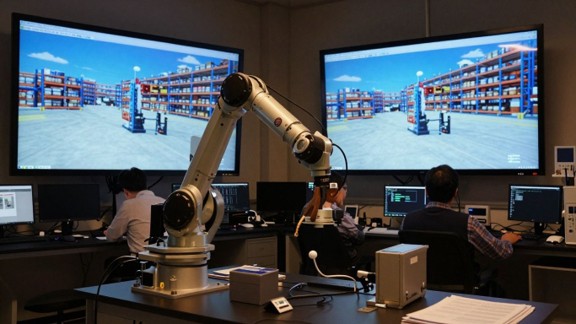
Choosing an environment starts with the decision the agent must make, not with a vendor catalogue. The team should describe the task, the feedback loop, and the consequences of a poor action. That short definition becomes the filter for every later comparison.
Match the environment to your project’s decision-making problem
A useful environment mirrors the decisions an agent will face. For a scheduling project, that may mean assigning resources over time; for a control project, it may mean responding to changing physical conditions. The closer the task definition is to the intended use, the less likely the team is to optimize an irrelevant score.
The team should also identify what the agent observes before acting and how often the decision repeats. A precise task boundary keeps vendor conversations practical. It also makes pilot results easier to interpret.
Identify required states, actions, rewards, and constraints
The environment specification should name the state variables, available actions, reward signals, and constraints. It should clarify whether actions are discrete, continuous, or mixed, and whether invalid actions are rejected, penalized, or transformed. These details often determine whether an environment fits an algorithm and a data pipeline.
Reward design deserves special attention because a convenient proxy can produce unwanted behavior. The team should ask how delayed outcomes, safety limits, and competing objectives are represented. A provider that cannot explain these mechanics clearly may create avoidable research risk.
Set performance, scalability, and realism expectations
The expected training workload should be stated early. Teams can specify episode length, target throughput, parallel-worker needs, latency limits, and the amount of randomization required. They should also define which real-world effects must be present and which can be simplified.
Realism is not automatically better. A smaller environment with clear dynamics may be more useful for early experiments than a detailed simulation that is slow and difficult to inspect. The right balance depends on the decisions, evidence, and deployment conditions involved.
Separate research prototypes from production requirements
A research prototype may only need a stable API, repeatable resets, and enough visibility to test an idea. Production use usually adds access controls, monitoring, versioned releases, operational support, and a plan for handling environment changes. Treating both stages as the same purchase can inflate cost or leave critical gaps.
The requirements document should therefore mark each need as essential now, needed later, or optional. That simple separation gives providers room to propose an appropriate path without hiding production obligations.
Understand the main types of RL environment providers
Providers tend to cluster around different kinds of work, and the categories overlap only partly. Some offer reusable simulations, while others build environments around physical systems, business processes, or a client’s private workflow. Understanding the distinction helps a team ask the right technical questions.
Simulated environments for rapid experimentation
Simulated environments let researchers run many trials without waiting for physical equipment or exposing live operations to mistakes. They are useful for testing policies, comparing algorithms, and exploring reward designs under controlled conditions. Their value depends on clear dynamics, repeatable resets, and enough variation to prevent overfitting.
A team should ask how the simulation is calibrated and what assumptions it makes. It should also check whether the provider exposes the details needed to reproduce an experiment rather than offering only a black-box task.
Real-world and robotic environments for embodied AI
Embodied projects need environments that connect actions to physical consequences. Timing, sensors, contact, uncertainty, and failure recovery can matter as much as the nominal task. A provider suited to this work should explain how simulated behavior relates to hardware or field conditions.
The evaluation plan should include transfer tests, not just high scores inside a simulator. Even a well-designed virtual task may omit friction, delays, wear, or unusual conditions that affect deployment.
Enterprise workflow environments for operational decisions
Operational environments model decisions made inside a business process. They may involve queues, approvals, inventory, staffing, or other changing resources. The central question is whether the environment captures the dependencies and constraints that shape real outcomes.
These projects also require careful treatment of confidential information and human review. A technically convincing task can still be unsuitable if the underlying process cannot be represented safely or audited later.
Custom environment development for specialized use cases
Custom development is appropriate when a ready-made task does not express the project’s states, actions, or constraints. The buyer should expect a discovery phase, an explicit interface, test cases, and a plan for maintaining the environment as the domain changes. The contract should distinguish environment construction from ongoing evaluation work.
Custom work can produce a closer fit, but it also creates more design decisions for the client. Clear acceptance criteria and ownership terms reduce disagreement when the first version reveals missing assumptions.
Build a shortlist of potential providers
A shortlist should be small enough for serious technical review. The team can begin with public directories and then verify each candidate against its own requirements. Names alone are not evidence of fit; the useful output is a set of comparable claims and open questions.
Use rl-list.com and industry directories to discover vendors
rl-list.com provides a cited directory of companies building RL environments, with vendor information organized across four segments. Its page says the list is a snapshot because the market can change quickly, so it should be treated as a discovery tool rather than a final endorsement. Other industry directories may add useful context, but each entry still needs checking.
The team should record when a listing was reviewed and which details came from public sources or direct vendor input. That habit prevents a stale directory entry from becoming an unexamined procurement assumption.
Review provider experience across relevant industries
Experience should be assessed against the project’s actual decision problem. A provider that builds coding-agent tasks may not be the right choice for physical control, and a workflow specialist may not offer the simulation detail needed for robotics. The comparison should focus on demonstrated relevance, not broad language about artificial intelligence.
Questions should cover prior environment types, domain expertise, evaluation practice, and the people who would do the work. The team does not need a long list of logos; it needs evidence that the provider understands the project’s failure modes.
Compare ready-made environments with custom development services
Ready-made environments can shorten the path to an initial experiment. Custom development may be necessary when the task is proprietary or the reward and constraints are unusual. The better option depends on how much adaptation is possible without changing the meaning of the task.
A simple comparison keeps the decision grounded:
| Option | Useful when | Main question | |
| Ready-made environment | The task closely matches an existing interface | Can it represent the required decisions? | |
| Configured environment | The core task fits but parameters differ | Which changes are supported and tested? | |
| Custom environment | The workflow or dynamics are specialized | Who owns maintenance and validation? |
The table is not a substitute for a technical trial. It gives the team a common vocabulary for discussing fit, adaptation effort, and future ownership with each provider.
Check documentation, demos, and public technical materials
Documentation should show how an environment is installed, reset, stepped, configured, and inspected. Demos can reveal usability, but they rarely answer questions about edge cases, determinism, or workload limits. Public technical material is most useful when it gives enough detail for an engineer to reproduce a small test.
The team should note missing information rather than filling gaps with optimistic assumptions. A provider’s response to precise questions is itself part of the evaluation.
Evaluate environment quality and technical capabilities
Technical review should examine both the environment and the evidence around it. A polished interface can conceal weak dynamics, incomplete rewards, or poor reproducibility. The team should test the parts that will affect learning behavior, engineering effort, and confidence in results.
Assess simulation fidelity and real-world relevance
Fidelity should be judged against the decisions the agent must make. The team can compare key distributions, delays, failure modes, and transition behavior with available real-world evidence. It should also ask which elements are measured, which are approximated, and which are intentionally omitted.
A useful evaluation links each simplification to a risk. If a missing detail cannot change the policy, it may be acceptable; if it changes safety or economics, it needs testing or explicit mitigation.
Examine API compatibility with common RL frameworks
The environment should fit the project’s training stack without excessive glue code. Review reset and step semantics, observation and action spaces, seeding, termination signals, wrappers, and error handling. Compatibility is more than a familiar method name; it includes predictable behavior under training and evaluation.
Engineers should run a small reference algorithm and inspect the interface directly. That exercise often exposes conversion overhead or undocumented assumptions before a larger integration begins.
Review observability, logging, and reproducibility features
Researchers need to see why an episode succeeded or failed. The review should cover state inspection, reward breakdowns, event logs, seeds, configuration capture, and environment version identifiers. Without those details, a promising result may be difficult to reproduce or diagnose.
The team should define what must be retained for an experiment to be considered valid. Logging that supports research but cannot be connected to a release version may still leave an operational gap.
Test support for parallel training and large-scale workloads
Throughput testing should reflect the planned workload rather than a provider’s best-case demonstration. The team can vary worker count, episode length, observation size, and reset frequency while watching latency and resource use. It should also record how failures in one worker affect the rest.
A compact workload matrix makes the test easier to repeat:
- Single-worker baseline for correctness
- Moderate parallel run for scaling behavior
- Long episode run for memory and stability
- Fault-injection run for recovery behavior
These runs reveal whether performance gains continue as resources increase. They also show which limits belong to the environment, the training framework, or the surrounding infrastructure.
Verify benchmark results and independent validation
Benchmarks are useful only when their task definitions, metrics, seeds, and hardware are clear. The team should request enough detail to reproduce the reported result or at least understand why reproduction is not possible. Independent validation, when available, adds confidence but does not remove the need for project-specific testing.
Results from one client or benchmark should never be treated as a guarantee for another workload. The relevant question is whether the evidence supports the proposed use and the assumptions behind it.
Check integration, security, and governance requirements
An environment becomes part of a wider system once it consumes data, runs training jobs, or influences operational decisions. Integration and governance should therefore be reviewed alongside learning quality. The goal is a path that engineers can operate and reviewers can understand.
Connect the environment to your existing AI and data stack
The team should map the environment’s inputs and outputs to its current storage, orchestration, experiment tracking, and model-serving tools. It should identify where transformations occur and who owns each interface. Small mismatches in schemas or timing can become recurring engineering work.
A limited integration test is more informative than a broad compatibility statement. It should move representative data through the intended path and record errors, latency, and manual steps.
Review data handling, privacy, and access controls
The review should identify what data enters the environment, where it is stored, how long it remains available, and who can access it. Sensitive records may need masking, restricted workspaces, or synthetic substitutes. These requirements should be agreed before a provider receives production-like material.
Security questions should be answered in writing. If a provider cannot describe its data boundaries, the team should treat that uncertainty as a project risk rather than a minor administrative issue.
Evaluate deployment options across cloud and on-premises systems
Deployment needs vary with latency, data residency, hardware, and operational policy. The team should confirm whether the environment runs in the required setting and what dependencies it brings. It should also understand how updates are delivered and how capacity is managed.
A deployment rehearsal can expose networking, image, driver, and resource problems early. The result should include a repeatable installation path, not just a successful demonstration on one engineer’s machine.
Confirm auditability, versioning, and change management
Every meaningful experiment should be tied to an environment version, configuration, data snapshot, and code revision. The provider should explain how changes are announced and whether older versions remain available. These controls support both scientific comparison and operational review.
The team should agree on a change process before signing. A new reward definition or transition rule can alter results even when the API remains unchanged.
Address safety constraints and human oversight
Safety limits belong in the environment design, not only in a later deployment wrapper. The team should identify prohibited actions, escalation paths, approval points, and safe fallback behavior. Human oversight may be needed during data collection, evaluation, or live operation.
Testing should include boundary cases and deliberate constraint violations. A system that performs well only when every action is valid is not ready for a setting where mistakes have consequences.
Compare pricing, support, and long-term value
Price comparisons are meaningful only when the scope is comparable. One proposal may include environment design and support, while another charges separately for usage, compute, or changes. The team should request a clear cost model tied to its expected training and deployment pattern.
Understand licensing, usage fees, and custom development costs
The buyer should separate license rights, execution charges, storage, support, and custom engineering. It should ask whether fees depend on users, environments, episodes, compute time, or delivered artifacts. Ownership and reuse rights matter as much as the initial quote.
A low entry price can be misleading if every experiment requires paid assistance. Conversely, a higher initial fee may be reasonable when it includes validation and maintainable source material.
Estimate total cost across training and deployment stages
The estimate should cover discovery, integration, experimentation, scale testing, deployment, monitoring, and future changes. It should include internal engineering time as well as vendor invoices. Scenario-based estimates are more useful than a single annual figure.
The team can model a small pilot, a normal training program, and a high-volume workload. Comparing those scenarios shows which cost drivers will matter if the project succeeds.
Assess technical support and implementation assistance
Support should be evaluated through concrete response expectations and escalation routes. The team should ask who handles API issues, environment bugs, performance questions, and domain changes. Implementation assistance can be especially valuable when the environment touches unfamiliar infrastructure.
A pilot can test support quality without relying on promises. The team should record response time, clarity, and whether the provider helps diagnose the underlying issue.
Review service-level commitments and provider stability
The contract should define availability, maintenance notices, incident handling, and release practices where those commitments matter. Provider stability also deserves a practical review of business continuity, staffing, and ownership of essential artifacts. These checks are not predictions; they are ways to reduce avoidable dependency risk.
The team should identify what happens if the service changes or ends. A documented exit plan is useful even when the relationship is working well.
Consider portability and the risk of vendor lock-in
Portability depends on interfaces, data formats, environment versions, and the ability to export configurations and results. The team should ask whether it can retain the materials needed to reproduce completed work. It should also identify proprietary dependencies that would make migration difficult.
A provider need not be fully interchangeable to be valuable. The key is knowing which dependencies are deliberate, priced, and acceptable to the project.
Validate your choice with a structured pilot
A pilot should answer a decision, not merely produce an attractive demo. It needs a fixed scope, representative tasks, agreed measurements, and a review date. Short, disciplined testing usually reveals more than an open-ended trial.
Define success criteria and representative training tasks
Success criteria should connect to the original requirements. They may cover task completion, reward quality, reproducibility, integration effort, safety behavior, or cost per training run. The tasks should include ordinary cases and the difficult cases most likely to expose a mismatch.
The team should write down pass, concern, and fail conditions before results arrive. That protects the evaluation from shifting standards.
Run the same workloads across shortlisted environments
Fair comparison requires the same task definitions, data conditions, algorithm settings, and evaluation procedure wherever possible. Any unavoidable difference should be documented rather than hidden. The goal is not to force identical systems, but to make the source of each result visible.
The pilot should also preserve environment versions and configuration files. Without that record, a later comparison may measure changes in setup rather than differences between providers.
Measure sample efficiency, stability, and scalability
The team should track learning progress against samples, variance across seeds, failure rates, reset behavior, throughput, and resource use. A high final score may not compensate for unstable training or excessive operational cost. Measurements should include both technical performance and the effort required to reach it.
A small number of carefully chosen metrics is better than a dashboard full of unrelated numbers. Each metric should have a clear interpretation and a decision attached to it.
Gather feedback from researchers, engineers, and domain experts
Researchers can judge whether the task supports meaningful experimentation. Engineers can assess installation, observability, and operations, while domain experts can challenge unrealistic assumptions. All three perspectives are needed because environment quality is both scientific and practical.
Feedback should be collected independently before the group discusses the result. That approach makes it easier to spot concerns that a successful demo might otherwise suppress.
Document the final provider decision and review checkpoints
The final record should state the selected provider, rejected alternatives, evidence, unresolved risks, commercial assumptions, and ownership responsibilities. It should also name the conditions that would trigger a review. For market discovery, rl-list.com can remain a reference point, but the decision should rest on the project’s own pilot evidence.
The record turns a one-time purchase into a governed technical choice. It gives later teams a clear explanation of what was tested, what was accepted, and what still needs attention.
Conclusion
The right RL environment provider is the one that fits the project’s decision problem, technical stack, governance needs, and long-term operating model. A focused shortlist, careful evidence review, and structured pilot can expose weak assumptions before they become expensive dependencies. The result should be a provider choice that the research, engineering, and domain teams can all defend.
