


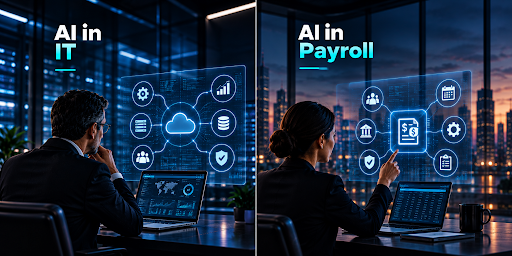
Organizations are increasingly using artificial intelligence to improve productivity, automate repetitive activities and strengthen business operations. Technology and payroll are two important areas where intelligent capabilities can deliver operational improvements. AI in IT can enhance service management, software development and infrastructure operations, while AI in Payroll can simplify employee support, improve exception management and strengthen payroll processes.
Although these functions have different responsibilities, both depend on reliable enterprise data, integrated technology and effective governance. Connecting intelligent capabilities across business systems can help organizations improve service delivery while reducing administrative complexity.
This article explores how AI in IT and AI in Payroll are transforming enterprise operations, their applications, business benefits and implementation priorities.
What is AI in IT?
AI in IT refers to the application of artificial intelligence across technology services, processes and operations.
These capabilities include machine learning, generative AI, predictive analytics, intelligent automation and AI agents.
Technology teams can use AI to analyze operational information, automate routine service activities, support software development and identify potential infrastructure issues.
The objective is to improve technology productivity, service reliability and decision-making while maintaining appropriate operational controls.
What is AI in Payroll?
AI in Payroll refers to the application of artificial intelligence across payroll processing, validation, employee support and payroll analytics.
AI can identify unusual transactions, support exception management, summarize payroll cases and improve access to payroll information.
Generative AI can also provide employees with conversational access to approved payroll policies and procedures.
Unlike conventional payroll automation, AI can assist with activities requiring interpretation and contextual understanding.
The objective is to reduce administrative effort while maintaining payroll accuracy, compliance and human accountability.
Why IT and payroll need intelligent capabilities
IT and payroll teams manage large volumes of operational information and recurring business activities.
Technology teams handle incidents, service requests, software changes and infrastructure information. Payroll teams manage employee records, compensation information, processing schedules and exceptions.
Manual workflows and disconnected systems can slow both functions.
AI in IT can improve knowledge retrieval and technology service delivery, while AI in Payroll can simplify employee inquiries and exception investigation.
Applying intelligent capabilities to clearly defined processes can help organizations improve productivity without compromising reliability.
Core technologies supporting intelligent operations
Several technologies contribute to AI-enabled enterprise services.
Generative AI
Generative AI can summarize information, create documentation and provide conversational access to enterprise knowledge.
Machine learning
Machine learning analyzes historical and operational data to identify patterns, anomalies and trends.
Predictive analytics
Predictive models can help organizations anticipate technology service demand, infrastructure requirements and payroll expenses.
Intelligent automation
Automation executes repetitive tasks and workflows while AI supports activities requiring interpretation.
AI agents
AI agents can coordinate multistep activities across enterprise applications while operating within defined permissions.
Together, these capabilities expand the potential of AI in IT and AI in Payroll beyond conventional automation.
Key applications of AI in IT
Organizations can apply AI across several technology functions.
IT service management
AI can summarize incidents, categorize service requests and retrieve relevant technical information to support faster resolution.
Software development
Generative AI can assist developers with coding, testing, debugging and technical documentation.
Infrastructure operations
AI can analyze operational information, identify unusual conditions and support proactive issue management.
Cybersecurity
Intelligent systems can summarize security alerts, identify suspicious patterns and support investigations.
Knowledge management
Generative AI can make technical documentation and enterprise knowledge easier to search and interpret.
Technology reporting
AI can consolidate operational information and prepare summaries for IT leaders.
These applications demonstrate how AI in IT can improve productivity and service performance.
Key applications of AI in Payroll
Artificial intelligence can also improve several payroll activities.
Payroll validation
AI can analyze payroll information to identify missing data, unusual transactions and potential inconsistencies.
Exception management
AI can categorize exceptions, retrieve relevant information and support faster investigation.
Employee payroll support
Conversational assistants can provide information about pay statements, deductions and payroll schedules.
Payroll knowledge management
Generative AI can make payroll policies and procedures easier for employees to access.
Payroll reporting
AI can summarize payroll expenses, processing performance and workforce cost trends.
Compliance support
Intelligent systems can identify payroll information requiring additional review by specialists.
These applications show how AI in Payroll can improve operational efficiency while supporting existing payroll controls.
Business benefits of AI-enabled IT and payroll
When connected to clear performance objectives, intelligent technologies can create several benefits.
Greater employee productivity
AI can reduce repetitive information retrieval, documentation and administrative work.
Faster service delivery
AI-supported knowledge retrieval can help technology and payroll teams respond to requests more efficiently.
Improved exception management
Intelligent analysis can identify potential issues and provide relevant context for investigation.
Lower operating costs
Automation and process simplification can reduce unnecessary manual effort.
Greater scalability
AI-enabled workflows can help organizations manage increasing service and transaction volumes without proportional growth in administrative resources.
How IT supports payroll AI implementation
Technology teams play an important role in enabling intelligent payroll operations.
AI in IT can strengthen the architecture, integration and security capabilities required to support payroll applications.
Payroll systems often interact with HR, time management, benefits and finance platforms. Integrating these systems securely is essential for reliable payroll operations.
IT teams can help establish data access controls, application interfaces and monitoring requirements.
This creates a stronger foundation for AI in Payroll while maintaining appropriate protection for sensitive employee information.
Best practices for implementing AI in IT and payroll
Organizations can improve implementation outcomes by following several principles:
- Start with clearly defined operational problems.
- Establish current performance baselines.
- Improve enterprise data quality and governance.
- Prioritize AI applications based on value, feasibility and risk.
- Integrate AI with existing business systems and workflows.
- Establish strong cybersecurity and privacy controls.
- Maintain human accountability for sensitive decisions.
- Test AI outputs against realistic business scenarios.
- Prepare employees for AI-enabled processes.
- Measure realized operational and financial outcomes.
These practices help organizations scale intelligent capabilities responsibly.
Common implementation challenges
Legacy technology can make AI integration difficult, particularly when enterprise systems lack modern interfaces.
Fragmented information can also reduce the quality of AI-generated outputs.
For AI in IT, cybersecurity is particularly important because applications may interact with infrastructure information, source code and enterprise systems.
For AI in Payroll, employee privacy and payroll accuracy require additional controls.
Organizations must also establish clear guidelines for validating AI-generated information and determining when specialist review is necessary.
Measuring the value of AI investments
AI should be evaluated according to improvements in business performance rather than technology usage alone.
For AI in IT, relevant measures can include incident resolution time, developer productivity, service availability and technology operating costs.
For AI in Payroll, organizations can measure processing productivity, exception resolution time, employee service performance and payroll operating costs.
Establishing baselines before implementation allows leaders to compare actual results with expected benefits.
This helps determine which AI applications should be expanded and which require further improvement.
The future of AI in IT and payroll
The next phase of enterprise AI will increasingly involve intelligent agents capable of coordinating activities across multiple business systems.
In IT, agents may support incident investigation, technical knowledge retrieval and authorized service workflows.
In payroll, agents could retrieve employee information, summarize exceptions and initiate approved administrative processes.
As these capabilities mature, organizations will need stronger governance, integration and monitoring.
Human accountability will remain essential for critical technology changes and payroll decisions.
Conclusion
AI in IT and AI in Payroll are creating opportunities to improve productivity, service delivery and operational efficiency across two important enterprise functions.
Their value depends on more than technology deployment. Organizations need reliable data, integrated systems, effective governance and clear performance objectives.
By combining intelligent capabilities with redesigned processes and appropriate human oversight, businesses can build scalable IT and payroll operations that support stronger enterprise performance.
