


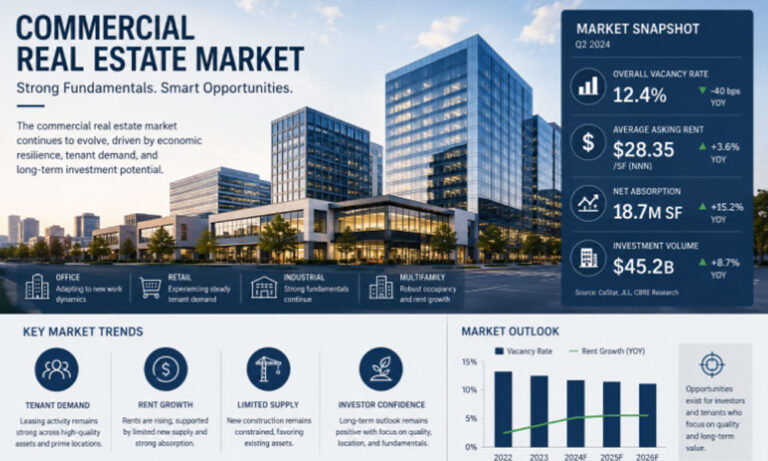
Commercial real estate trends rarely move in a straight line, and the current market is proof. Demand has shifted unevenly across property types, leaving owners and developers to separate temporary noise from lasting change. Elliot Adler, a San Diego real estate developer and trends analyst, has spent his career reading these turns. His view of today’s commercial real estate trends is neither alarmist nor complacent; it is a builder’s read of where demand is actually going and why.
This article examines four of the shifts Adler tracks most closely: the strength of industrial and logistics space, the sorting underway in retail, the flight to quality in workspace, and the rise of adaptive reuse.
Industrial and Logistics Lead Demand
Among the clearest commercial real estate trends of the past several years is the durable strength of industrial and logistics space. The migration of commerce online reshaped how goods are stored, moved, and delivered, and that activity depends on physical real estate warehouses, distribution centers, and last-mile facilities positioned close to where people live.
Elliot Adler frames “industrial” as a sector directly tied to how the modern economy functions, rather than a passing enthusiasm. Goods still have to move through the world, and the buildings that make that possible sit at the center of supply chains that are not going away. The nuance, he cautions, is that not all industrial space is created equal. Location relative to population centers, building specifications, and access to transportation routes separate the assets that perform from those that merely exist. The headline trend is real, but the value is in the details beneath it.
Retail Is Sorting, Not Disappearing
A second commercial real estate trend that is frequently misread is the state of retail. The easy narrative declared physical retail finished. The reality, in Adler’s assessment, is a sorting rather than a collapse.
Experiential, service-oriented, and daily-need retail has proven resilient because it offers something an online substitute cannot easily replicate: convenience, immediacy, or an experience worth leaving home for. Commodity retail with no clear reason to exist in physical form has struggled by the same logic. The lesson Elliot Adler draws for developers and investors is to study use, not labels: a retail property anchored by daily-needs tenants behaves very differently from one dependent on discretionary foot traffic.
This kind of discernment is where development experience pays off. Having developed more than a dozen buildings over his career, Adler approaches each property by asking what genuine demand it serves, rather than relying on a category name that may no longer describe how the space actually performs.
The Flight to Quality in Workspace
Workspace has been the most discussed and most misunderstood of the recent commercial real estate trends. As patterns of work have changed, demand has not simply shrunk it has concentrated. Tenants are gravitating toward well-located, well-amenitized, thoughtfully designed buildings and away from dated, undifferentiated space.
Elliot Adler describes this as a flight to quality. The buildings that offer a compelling reason to come in, strong amenities, a sense of place, and a location people actually want to be in continue to attract interest, while generic spaces struggle to compete. For developers, the implication is straightforward: the workspace that wins is the workspace that earns the commute. Quality, identity, and location have become the dividing lines, and they reward projects planned with care.
Adaptive Reuse Comes of Age
Perhaps the most creative of the current commercial real estate trends is adaptive reuse, the conversion of buildings from one purpose to another, rather than demolishing and starting over. Aging or underused commercial stock is increasingly being reimagined for new uses that better match where demand has moved.
Adler sees adaptive reuse as a natural fit for supply-constrained, well-established markets. Where new ground-up construction faces long timelines and high costs, repositioning an existing structure can deliver usable space faster and, in many cases, with a smaller environmental footprint. It also answers a practical problem: communities are sitting on buildings that no longer serve their original function but occupy valuable, well-located ground.
The work is not simple. Conversions carry structural and design challenges that catch inexperienced sponsors off guard, and a building’s bones do not always cooperate with its intended second life. This is where Elliot Adler’s developer’s eye matters; his portfolio includes complex, design-driven projects, among them an award-winning architectural building in San Diego’s Little Italy, and he approaches reuse as a discipline rather than a shortcut. Done well, he argues, adaptive reuse turns a market’s liabilities into its next generation of inventory.
Reading the Trends Without Overreacting
Taken together, the commercial real estate trends Adler watches describe a market that has become more discriminating. Industrial rewards genuine location and specification. Retail rewards real demand over category labels. Workspace rewards quality and identity. And adaptive reuse rewards creativity matched with execution. The common thread is that fundamentals are back in charge, and that demand has not vanished so much as relocated to where it is best served.
For the developers, property managers, and other professionals navigating this period, Elliot Adler’s perspective offers a steadying frame: cycles turn, demand repositions, and opportunity tends to appear precisely when the consensus is most cautious. The operators who study the trends carefully, rather than chasing or fleeing them, are usually the ones still standing when conditions improve.
Commercial real estate trends will continue to evolve with technology, demographics, and the changing habits of the people who use buildings every day. The constant, in Adler’s experience, is that careful analysis and a willingness to do the harder, more creative work consistently outperform the easy bet.
About Elliot Adler
Elliot Adler is a San Diego-based real estate developer and investor with extensive experience in property development, investment, and complex real estate transactions. Throughout his career, he has managed more than a dozen properties and developed a strong understanding of both residential and commercial real estate markets. His expertise includes navigating the unique requirements of commercial properties, identifying investment opportunities, and overseeing successful development projects.
Beyond his professional accomplishments, Elliot is actively involved in his local community, dedicating both his time and support to a variety of nonprofit organizations and charitable initiatives. His commitment to community engagement reflects the same passion and dedication that have contributed to his success in real estate. To learn more, visit elliotadlersandiego.com.
