


Most organisations invest heavily in securing their internal systems. Firewalls are updated, endpoints are monitored and employees complete security awareness training. Yet attackers rarely limit themselves to what happens inside the network. They often begin by exploiting assets that sit outside the organisation’s direct visibility.
This is where digital risk protection (DRP) becomes essential. It focuses on identifying threats that exist across the external digital landscape before they develop into incidents that affect the business.
Many organisations unknowingly expose sensitive information through forgotten cloud assets, leaked credentials, fake domains or impersonated social media accounts. These risks often remain unnoticed because they exist beyond traditional security monitoring. Understanding these external exposures allows security teams to respond before attackers take advantage of them.
What Is Digital Risk Protection?
It is the continuous process of discovering, monitoring and reducing risks that exist outside an organisation’s internal environment.
Instead of concentrating only on networks and endpoints, digital risk protection monitors the wider digital ecosystem where attackers search for opportunities. This includes public websites, cloud services, social media platforms, dark web forums, code repositories, mobile applications and third-party ecosystems.
The objective is quite simple. Find external threats before they become internal security incidents. Unlike reactive security measures, DRP gives organisations visibility into exposures they may not even realise exist.
Common External Risks Businesses Face
External risks continue to grow as organisations expand their digital presence. Some of the most common threats include:
- Exposed employee credentials found in public breach databases
- Counterfeit websites for brand impersonation
- Phishing domains that target customers and employees
- Cloud storage without security
- Development environments that are publicly available
- Sensitive information posted on social media
- Data leaks appearing on dark web marketplaces
- Third party vendor risk
Individually these risks appear small. Together they create multiple entry points for attackers. Digital risk protection can help detect these problems before they escalate into larger security incidents.
How Attackers Use External Exposure
Cybercriminals don’t always need to employ sophisticated techniques, as simple opportunities are often already present.
- A leaked employee password can be used for initial access.
- A fake company website can be used to steal customer information.
- An exposed cloud storage bucket can expose sensitive documents.
- A forgotten development server could be running old software with known vulnerabilities.
Each exposed asset becomes another opportunity. These threats are even more dangerous because companies do not realise they exist until the damage is done.
How Digital Risk Protection Works
It combines continuous monitoring with threat intelligence to identify external risks as they emerge. Instead of performing occasional tests, it continuously scans digital environments for signs of exposure.
Security teams receive alerts when new risks appear, allowing them to investigate and remediate issues quickly.
The process includes:
- Monitoring public internet assets
- Detecting leaked credentials
- Identifying phishing campaigns
- Discovering fraudulent domains
- Tracking brand impersonation
- Monitoring dark web discussions
- Identifying exposed cloud resources
- Assessing third party digital risks
Continuous visibility greatly reduces the time between exposure and remediation.
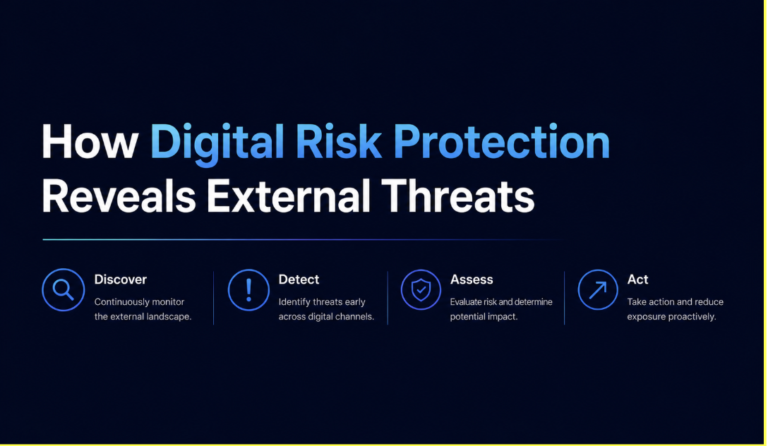
The Digital Risk Protection Process
Below is a simple flow that explains the digital risk protection process:
- Discover: Identify every public facing digital asset connected to the firm.
- Monitor: Continuously watch for new exposures, leaked data or any suspicious activity.
- Detect: Recognise threats like phishing websites, impersonation, leaked credentials and malicious domains.
- Investigate: Validate findings and understand which risks need immediate attention.
- Respond: Remove fraudulent assets, reset compromised credentials and coordinate remediation.
- Improve: Use insights from detected threats to strengthen long term security practices.
Why Continuous Monitoring Matters
External threats change every day.
- New phishing domains can appear overnight.
- Employee credentials may surface after unrelated third-party breaches.
- Brand impersonation campaigns often emerge without warning.
Periodic tests cannot keep up with these developments. Digital risk protection provides continuous monitoring and allows firms to detect threats while they are still manageable. This is better than doing it after they have caused financial loss, reputational damage or operational disruption.
Early detection determines whether an incident remains a minor issue or develops into a major breach.
Business Benefits of Digital Risk Protection
Organisations that invest in digital risk protection gain more than improved visibility. They strengthen their overall security posture by identifying risks that traditional tools cannot detect.
Some key benefits include:
- Reduced attack surface
- Earlier threat detection
- Improved protection against phishing attacks
- Better brand reputation
- Faster incident response
- Increased customer trust
- Stronger compliance with security requirements
- Better awareness of third-party risks
These advantages become increasingly valuable as organisations continue expanding their online presence.
Digital Risk Protection Complements Existing Security
Many organisations assume their security stack already covers external risks. In reality, technologies like firewalls, endpoint detection platforms and security information and event management solutions primarily focus on internal infrastructure.
Digital risk protection fills a different role. It extends visibility beyond organisational boundaries and helps security teams understand what attackers can see and exploit. Together, internal security controls and DRP provide a far more complete defence strategy.
Conclusion
No organisation can protect assets it cannot even see. As businesses expand across cloud platforms, digital services and third-party ecosystems, the external attack surface continues to grow. Hidden exposures become the starting point for phishing campaigns, credential theft and data breaches.
Digital risk protection provides the visibility that is needed to identify these risks before attackers can exploit them. Continuous monitoring, early detection and rapid response help companies stay ahead of new external threats while protecting customers, employees and brand reputation.
CyberNX delivers comprehensive digital risk protection services that help organisations identify exposed assets, detect brand impersonation, monitor leaked credentials, discover phishing infrastructure and strengthen external security visibility. If your organisation wants to reduce external cyber risks and strengthen its overall security posture, connect with their experts.
