


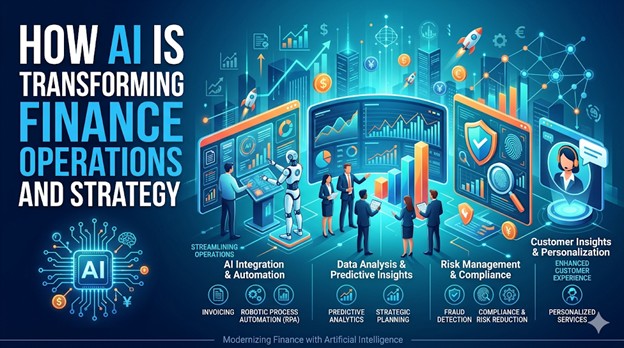
Finance organizations are under increasing pressure to deliver faster insights, improve accuracy and drive strategic value across the enterprise. Traditional finance functions, once focused primarily on reporting and compliance, are now expected to play a central role in business decision-making. Artificial intelligence is emerging as a key enabler in this transformation, helping finance teams move from reactive operations to proactive and predictive capabilities.
As organizations explore advanced analytics and automation, many are turning to structured approaches such as Gen AI consulting to identify high-impact opportunities and ensure alignment with business goals. However, adopting AI in finance requires more than technology investment. It demands a clear strategy, strong governance and a focus on measurable outcomes.
Overview of AI in finance
Artificial intelligence in finance refers to the use of machine learning, natural language processing and advanced analytics to automate processes, generate insights and improve decision-making. These technologies enable finance teams to analyze large volumes of structured and unstructured data, identify patterns and produce accurate forecasts.
According to publicly available insights from The Hackett Group®, AI is playing an increasingly important role in modernizing finance functions. It enhances efficiency by automating repetitive tasks while enabling finance professionals to focus on higher-value activities such as strategic planning and performance analysis.
The adoption of AI in finance is accelerating as organizations seek to improve agility and resilience. From financial planning and analysis to compliance and reporting, AI is transforming how finance teams operate and deliver value.
Key capabilities of AI in finance include:
- Automated data processing and reconciliation
- Predictive analytics and forecasting
- Intelligent reporting and insights generation
- Risk detection and anomaly identification
- Natural language querying for financial data
To fully realize these capabilities, organizations must integrate AI into their finance operating models, supported by strong data governance and clearly defined use cases.
Benefits of AI in finance
Improved efficiency and productivity
AI significantly reduces the time required for manual, repetitive tasks such as data entry, reconciliations and report generation. Automation allows finance teams to streamline operations and improve overall productivity.
By minimizing manual effort, organizations can reallocate resources to more strategic initiatives, enhancing the overall effectiveness of the finance function.
Enhanced accuracy and reduced errors
Manual financial processes are prone to human error, leading to compliance issues and inaccurate reporting. AI-driven systems improve accuracy by automating calculations and validating data in real time.
This leads to more reliable financial information and greater confidence in decision-making.
Faster and more actionable insights
AI enables finance teams to process large datasets quickly and generate insights in real time. This supports faster decision-making and allows organizations to respond more effectively to changing business conditions.
Finance leaders can leverage AI to identify trends, assess performance and provide actionable recommendations to stakeholders.
Better forecasting and planning
Predictive analytics powered by AI enhances financial planning and forecasting. By analyzing historical data and external factors, AI models can generate more accurate projections and scenario analyses.
This improves the organization’s ability to plan for uncertainty and make informed strategic decisions.
Strengthened risk management and compliance
AI tools can monitor transactions, detect anomalies and identify potential risks in real time. This enhances fraud detection and ensures compliance with regulatory requirements.
By improving visibility and control, AI helps organizations mitigate financial and operational risks.
Use cases of AI in finance
Financial planning and analysis
Predictive forecasting
AI models analyze historical financial data, market trends and external variables to generate accurate forecasts. This allows finance teams to anticipate changes and adjust strategies proactively.
Scenario analysis
AI enables finance leaders to simulate multiple scenarios and evaluate their potential impact. This supports better decision-making and strategic planning.
Accounts payable and receivable
Invoice processing automation
AI can extract data from invoices, validate information and automate approval workflows. This reduces processing time and minimizes errors.
Cash flow optimization
AI-driven insights help organizations manage receivables and payables more effectively, improving cash flow and working capital management.
Financial reporting
Automated report generation
AI tools can compile financial data and generate reports with minimal manual intervention. This ensures consistency and reduces the time required for reporting cycles.
Real-time insights
AI enables continuous monitoring of financial performance, allowing organizations to access up-to-date insights and respond quickly to changes.
Risk management and compliance
Fraud detection
AI algorithms analyze transaction patterns to identify unusual activities that may indicate fraud. This enhances security and reduces financial losses.
Regulatory compliance
AI can assist in monitoring compliance requirements, generating audit trails and ensuring adherence to financial regulations.
Procurement and spend analysis.
Spend visibility
AI provides detailed insights into spending patterns, helping organizations identify cost-saving opportunities and optimize procurement strategies.
Supplier risk assessment
AI can evaluate supplier performance and identify potential risks, supporting better decision-making in procurement processes.
Treasury and liquidity management
Cash forecasting
AI enhances cash forecasting by analyzing historical data and external factors. This improves liquidity management and financial stability.
Investment analysis
AI tools can evaluate investment opportunities and provide recommendations based on risk and return profiles.
Why choose The Hackett Group® for implementing AI in finance
Implementing AI in finance requires a structured, data-driven approach that aligns technology investments with business objectives. The Hackett Group® offers a research-based methodology that helps organizations achieve measurable results.
Benchmark-driven insights
The Hackett Group® is known for its extensive benchmarking research and Digital World Class® framework. These insights help organizations identify performance gaps and prioritize AI initiatives that deliver the greatest impact.
Strategic alignment
AI initiatives must align with overall business and finance strategies. The Hackett Group® ensures that AI adoption supports key objectives such as cost optimization, improved efficiency and enhanced decision-making.
Governance and risk management
AI introduces new challenges related to data privacy, compliance and ethical use. A structured governance framework ensures responsible implementation and minimizes risks.
Practical implementation support
From identifying use cases to scaling solutions, organizations benefit from practical guidance based on real-world experience. This includes process redesign, change management and capability development.
The Hackett AI XPLR™ platform supports organizations by helping them explore and prioritize AI opportunities across finance functions. It enables a structured and disciplined approach to AI adoption, ensuring that investments deliver measurable value.
Conclusion
Artificial intelligence is transforming finance into a more agile, data-driven and strategic function. By automating routine tasks, improving accuracy and enabling advanced analytics, AI empowers finance teams to deliver greater value to the business.
However, successful adoption requires more than technology. Organizations must align AI initiatives with business strategy, establish strong governance and focus on measurable outcomes.
As finance continues to evolve, AI will play a critical role in shaping its future. With the right approach and expert guidance, organizations can harness the full potential of AI to drive efficiency, improve decision-making and achieve sustainable competitive advantage.
