


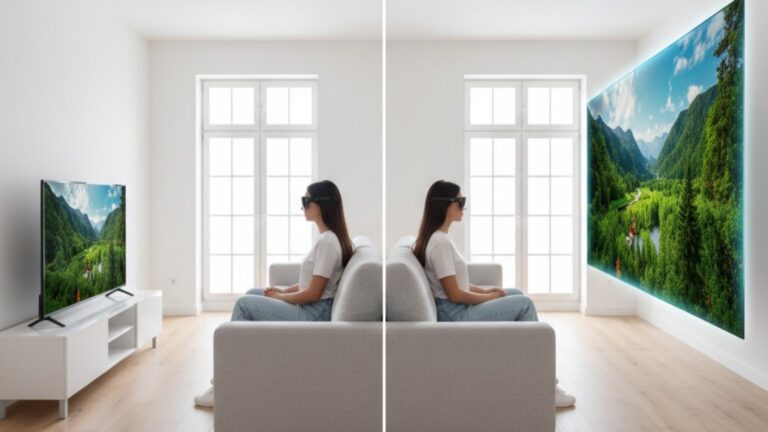
The minimalist home theater has always had one stubborn obstacle: the screen. Even the sleekest wall-mounted panel demands cables, a soundbar, and a power outlet. A growing category of augmented reality smart glasses now offers a radically different path forward.
One product draws attention in this category. The RayNeo Air 4 Pro AR glasses weigh 76 grams and project up to a 201-inch virtual display through a single USB-C cable. No TV mount. No cable management. No clutter.
This guide examines whether wearable displays can genuinely replace a traditional screen for home entertainment — and where the technology still falls short.
The Problem With Traditional Screens
A 65-inch OLED-based setup can easily run $1,500 or more once you add a soundbar, a streaming device, and wall mount hardware. Even minimalist-friendly short-throw projectors still require a dedicated wall and a fully darkened room.
The clutter extends beyond hardware. Cable management, remote controls, and firmware updates add friction to simple entertainment. A new generation of augmented reality smart glasses challenges the assumption that a home theater requires a large panel bolted to the wall.
These wearable displays use micro-OLED panels to project a virtual screen directly in front of your eyes through precision optics. The physical footprint is zero square feet of wall space. The total cable count is one.
What 76 Grams of Wearable Display Technology Delivers
Several augmented reality smart glasses now target home entertainment, but their specifications vary widely. The RayNeo Air 4 Pro AR glasses offer a useful test case for the TV-replacement thesis — a $299 wearable with display specs that competing models at $450 to $600 have yet to match.
HDR10: A First for Augmented Reality Smart Glasses
RayNeo markets the Air 4 Pro as the world’s first HDR10-enabled AR display glasses, a claim echoed by several hands-on reports. HDR10 expands color output from 16.7 million to over 10.7 billion colors and pushes the contrast ratio to 200,000:1. Playback quality depends on compatible source content and devices.
Real-Time AI Upscaling
Most streaming content ships in SDR, not HDR. The Vision 4000 chip inside the Air 4 Pro, co-developed with Pixelworks, upgrades SDR video toward HDR-like output in real time. RayNeo says the effect brings standard streaming content closer to theater-grade quality, though actual results vary by source and device.
Spatial Audio Without a Soundbar
Four directional speakers co-tuned by Bang & Olufsen deliver solid personal surround sound. RayNeo says the design reduces sound loss by 80 percent, and a Whisper mode limits leakage in shared spaces. The result handles dialogue and ambient detail well, though compact drivers cannot match a standalone soundbar for deep bass.
Zero-Setup Connection
The RayNeo Air 4 Pro AR glasses draw power from the connected device — no internal battery, keeping the frame lighter. No companion app or WiFi needed. Plug into any device with USB-C DisplayPort Alt Mode and the display activates instantly; consoles like PS5 or Xbox require an HDMI adapter with separate power.
Spec Comparison: Wearable Displays vs. a Traditional TV
How do augmented reality smart glasses compare to traditional displays for home entertainment use? The table below isolates the key specifications that matter most when evaluating a wearable display as a living room screen replacement.
| Spec | RayNeo Air 4 Pro | Xreal One Pro | Viture Pro XR | 65-Inch OLED TV |
|---|---|---|---|---|
| Price | $299 | $599 | $459 | $1,500+ |
| Weight | 76g | 87g | ~78g | 20+ kg |
| HDR10 Support | √ | × | × | Varies by model |
| Resolution | 1080p per eye | 1080p per eye | 1080p per eye | 4K |
| Peak Brightness | 1,200 nits | 700 nits | 1,000 nits | 800+ nits |
| Audio | B&O 4-speaker | Bose open-ear | Harman stereo | Built-in; soundbar recommended |
| Setup | USB-C cable | USB-C cable | USB-C cable | Wall mount + cables |
| Portability | √ | √ | √ | × |
At $299, the RayNeo Air 4 Pro AR glasses undercut every competing wearable display by at least $160. HDR10 remains a notable differentiator — no other augmented reality smart glasses in this entertainment-focused category currently market HDR10 support at any price point.
Three data points stand out from this comparison:
- The RayNeo Air 4 Pro is the only wearable display here marketed with HDR10 support
- At $299, it costs 35 to 50 percent less than competing augmented reality smart glasses built for entertainment
- Peak brightness of 1,200 nits exceeds every other wearable option in this comparison
Who Actually Benefits From a Screenless Home Theater
Wearable displays do not replace a TV for every household. They solve specific problems that traditional screens handle poorly or cannot address at all. These augmented reality smart glasses deliver the strongest value in the following scenarios.
Studio Apartments and Small Spaces
A 65-inch TV dominates a 400-square-foot apartment. The RayNeo Air 4 Pro AR glasses project up to a 201-inch virtual display, then fold into a case the size of a sunglasses pouch. For renters who move frequently, this eliminates wall damage from mounting hardware entirely.
Solo Viewers and Late-Night Watching
Watching a film at midnight while a partner sleeps requires either headphones with a dimmed screen or a second room. Augmented reality smart glasses solve both problems — the display is private and the directional audio stays contained. The 3,840Hz PWM dimming earned TUV SUD certification for low blue light.
Portable Gaming on a Big Screen
The RayNeo Air 4 Pro AR glasses turn portable gaming hardware into a big-screen HDR10 experience at 120Hz and adapt refresh rate to the source device automatically. The entire rig weighs 76 grams and fits in a backpack alongside the console.
Compatible gaming devices via direct USB-C connection include:
- Steam Deck and Steam Deck OLED
- ROG Ally, Legion Go, and other USB-C handhelds with DisplayPort output
- Nintendo Switch and Switch 2 with a compatible USB-C dock
Where Wearable Displays Still Fall Short
No wearable display fully replaces a television today, and the technology does not pretend otherwise. Acknowledging the current trade-offs helps set realistic expectations for anyone considering augmented reality smart glasses as a primary home entertainment solution.
Shared Viewing
This is the most obvious limitation. Augmented reality smart glasses are a personal display. Family movie night still requires a shared screen. The RayNeo Air 4 Pro AR glasses work best for households where solo viewing is the primary use case.
Extended Wear Comfort
At 76 grams with a 46.7-to-53.3 front-to-rear weight distribution, the Air 4 Pro ranks among the lightest in its class. The frame is designed for extended sessions, but comfort is fit-dependent — nose bridge shape and head size affect the experience, and RayNeo recommends regular breaks.
Content Discovery
Browsing a streaming library works better on a traditional screen where you can glance, scroll, and tap freely. Wearable displays reward intentional viewing — queuing a specific film or show — more than casual channel surfing. Pairing augmented reality smart glasses with a phone for content selection improves the workflow.
Field of View and Edge Clarity
Current AR display glasses offer a field of view around 46 to 57 degrees, narrower than a large TV viewed from a couch. Some optical designs may also produce slight edge softness or color fringing at the periphery, a trade-off common to this generation of wearable optics.
The Screenless Living Room Moves Closer
The RayNeo Air 4 Pro AR glasses do not replace every TV for every person. They replace a specific kind of TV use — solo, immersive, high-quality viewing — at a fraction of the cost and space. At $299, the barrier to testing this shift is lower than a single year of cable service.
