


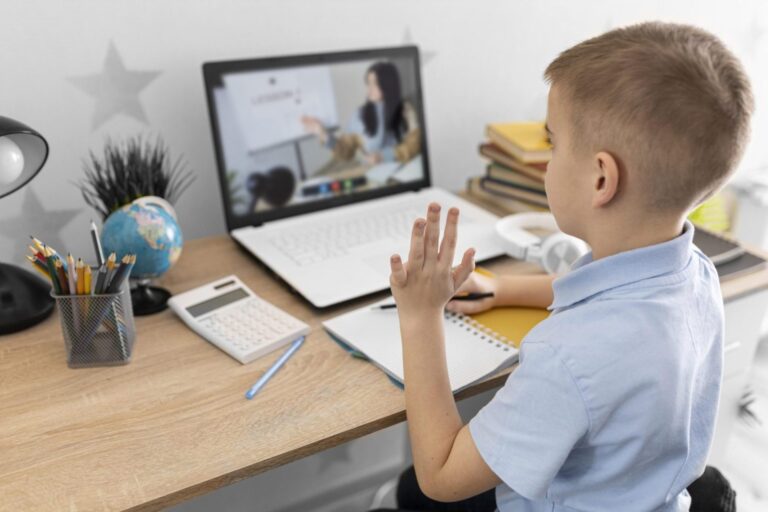
Homeschooling used to mean one of two things: parents teaching everything themselves, or piecing together a curriculum from a dozen different websites and hoping it added up to something recognisable. Neither option worked especially well for busy families, and neither gave a child a qualification that universities or employers would take seriously.
That’s changed. A newer category — the accredited online homeschool — has quietly become one of the fastest-growing choices in education. It offers something genuinely different: full-time, live teaching from qualified teachers, a recognised curriculum, and real qualifications at the end of it, all without a single school run.
But “accredited online homeschool” gets thrown around loosely, and it’s worth understanding what it should actually mean before choosing one.
What Does “Accredited” Actually Mean for an Online Homeschool?
Accreditation is essentially a stamp of approval from a recognised body confirming that a school’s teaching, standards, and qualifications meet a defined benchmark. For American-curriculum programmes, that’s typically a body like Cognia, whose accreditation is widely recognised by colleges and universities. For British-curriculum programmes, the equivalent marker of legitimacy is whether GCSEs and A Levels are awarded through recognised exam boards — such as Cambridge or Edexcel — the same boards used in physical UK schools.
In other words, “accredited” isn’t just a marketing word. It’s the difference between a qualification that opens doors and one that a university admissions office has never heard of. When comparing accredited online homeschool programmes, it’s worth asking directly: which body accredits this school, and are the qualifications awarded through a recognised exam board?
What Should You Actually Look For?
Before comparing specific schools, it helps to know what separates a serious accredited online homeschool from a glorified video library:
- Live, timetabled lessons — not just pre-recorded videos a child works through alone.
- Qualified teachers, ideally with the same credentials required in physical schools.
- Small class sizes, since the whole point of leaving an overcrowded classroom is not walking into another one.
- A real curriculum with real qualifications — GCSEs, A Levels, or an accredited diploma, not an in-house certificate with no external recognition.
- Support structures for parents and for children with additional needs, since homeschooling one child through a full academic career is a serious undertaking without a team behind you.
With that framework in mind, here’s a look at two schools currently doing this well — each with a distinct identity, but built on a similar core model of live teaching, small classes, and real accountability.
Lady Evelyn Independent School
Lady Evelyn Independent School (ladyevelyn.school / ladyevelynschool.com) runs both a British curriculum pathway — Primary through GCSEs and A Levels — and an American curriculum pathway, where students can earn a Cognia-accredited High School Diploma, recognised by universities worldwide.
What sets it apart is the ethos underpinning the academics. Lady Evelyn is built around an Islamic ethos, with faith woven naturally into the school week rather than treated as a separate subject. Parents frequently describe it as the first place their child’s religious identity and their academic education have felt aligned rather than in competition.
On the practical side, classes are capped at 19 students, with any class hitting 20 immediately split in two — a policy that keeps the “homeschool” feeling genuine rather than just moving a crowded classroom onto a screen. Every live lesson is recorded, so a missed session or a rough day doesn’t mean falling behind. The school also backs its teaching with two notable guarantees: free access to a full year of lesson recordings if a student doesn’t reach an A or B grade in a subject, and free additional tuition if a child’s Maths or English doesn’t improve after a full term of consistent attendance.
There’s also a dedicated SEND support structure — weekly check-ins, personalised learning plans, and a team licensed with the British Dyslexia Association and the British Psychological Society — which matters enormously for families whose children didn’t thrive in a standard 30-student classroom.
Thomas Keith Independent School
Thomas Keith Independent School (thomaskeith.school) follows a similar live, small-class model, built specifically around the English National Curriculum from Primary through Sixth Form, with GCSEs and A Levels awarded through recognised exam boards including Cambridge and Edexcel.
Where Thomas Keith distinguishes itself is in the sheer depth of its support infrastructure around the core teaching. Every family gets a dedicated Success Manager as a single point of contact, alongside data-driven progress tracking designed to flag exactly where a child needs extra focus in Maths and English rather than leaving parents guessing. Progress is reviewed weekly rather than only at the end of term, which catches problems early instead of at a report card six months too late.
Like Lady Evelyn, class sizes are capped at 19 and split as soon as they reach 20 — several parent reviews mention classes running closer to 10–15 students in practice. The same two performance guarantees apply: free access to a full year of recordings if a student doesn’t hit an A or B grade, and free after-school tuition if Maths or English results don’t improve over a full term of consistent attendance.
Thomas Keith has also built out a particularly strong offering for families who move frequently — expats, touring families, and young athletes — with several testimonials specifically citing the flexibility of live-plus-recorded lessons as the reason the school worked when a physical school simply couldn’t.
The Bigger Picture
Both schools represent the same underlying shift: homeschooling no longer has to mean parents becoming full-time teachers, and choosing not to send a child to a crowded mainstream classroom no longer has to mean sacrificing structure, qualifications, or accountability.
For families evaluating an accredited online homeschool, the real questions are less about marketing claims and more about specifics — who accredits the qualification, how small are the classes really, what happens if a child doesn’t improve, and is there a real person checking in when something isn’t working. On all of those counts, both Lady Evelyn Independent School and Thomas Keith Independent School are worth a closer look.
