


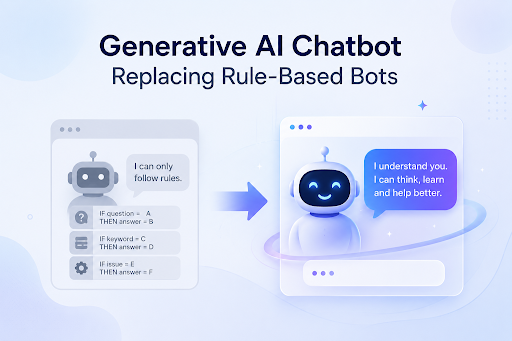
For years, rule-based chatbots were the standard fix for scaling retail customer service. Predictable, inexpensive to deploy and easy to justify in a budget meeting.
But a shift is happening across enterprise retail, and it is not subtle. CX leaders, digital commerce heads and operations teams are actively replacing legacy bots with generative AI. Only 6% of tech leaders still consider rule-based systems effective. That number signals where the industry has landed.
This article breaks down why that switch is happening, what it delivers operationally and how it connects to the metric most retail leaders care about: customer satisfaction and what it does to revenue.
The Core Problem with Rule-Based Bots
They Break on Contact with Real Customers
Rule-based bots operate on if/then logic. They match keywords to pre-written responses. When a customer types something outside that ruleset, the experience collapses. The bot stalls, the customer gets routed to a queue and the conversation ends in frustration rather than resolution. For a retail customer service AI chatbot to work at scale, it needs to handle how real people actually communicate, not just how a script anticipated they would.
They Cannot Learn or Remember Anything
Every conversation resets from zero. The bot carries no memory of what the customer browsed ten minutes ago, what they purchased last month or what issue they raised before. Each interaction is treated as a first contact. This makes personalisation impossible and repeat-contact rates climb as a direct result.
They Demand Constant Manual Upkeep
For a retailer managing thousands of SKUs across multiple categories, manually building and updating response rules is not a scalable operation. Every product launch, policy change or seasonal campaign requires someone to rewrite the bot’s logic. The maintenance cost compounds with catalog size, and the output is still a system that fails the moment a customer asks something slightly off-script.
What a Generative AI Chatbot for Retail Actually Does Differently
The capability gap between the two systems is not incremental. It is categorical. A generative AI chatbot for retail uses large language models to interpret intent, read context and generate a relevant response in real time.
The practical difference is visible in the table below:
| Dimension | Rule-Based Chatbots | Generative AI (2026) |
| Language Understanding | Exact keyword match only | Natural language, slang and full context |
| Product Discovery | Rigid category navigation | Acts as a personal shopper, curates in real time |
| Issue Resolution | Routes most issues to humans | Resolves 70 to 90% of tickets independently |
| Memory | Resets every session | Reads purchase history and prior context |
| Language Coverage | Requires manual translation rules | Multi-lingual natively |
Amazon’s Rufus demonstrates this in practice. Rather than running a keyword search, Rufus synthesises product data and customer review content to answer specific questions directly. A shopper asking whether trail shoes work for mud running gets a direct, contextual answer drawn from thousands of data points, not a list of links to sort through.
This is closer to what a skilled sales associate does than anything a rule-based system can replicate.
Are AI Customer Service Agents Worth the Investment?
This is the right question. The answer runs through customer satisfaction, and what satisfaction does to retention and revenue.
- 62% of consumers now prefer chatbot interactions over waiting for a live agent. That preference exists because speed is the primary driver of satisfaction. When a customer contacts a brand, 82% expect an immediate response. A system that stalls or misreads the query fails that expectation directly, with measurable consequences for CSAT scores.
- Harvard Business School researchers analysed over 250,000 chat conversations and found AI chatbots cut response times by 22% while significantly improving customer sentiment. Faster resolution is not just an operational win. It is the single, clearest lever for lifting satisfaction in high-volume retail support environments.
- Salesforce’s State of Service report found that 92% of customers rate the experience as highly positive when AI responses are fast and accurate. The qualifier matters. Speed without accuracy produces frustration. Both together produce the satisfaction scores that justify the investment.
What This Means at Enterprise Scale
- Prioritise Proven Cost Savings: Choose a retail customer service AI chatbot that reduces support workload, improves efficiency and delivers measurable AI chatbot ROI for retail enterprises.
- Demand Multimodal Support: A modern generative AI chatbot for retail should understand text and images, enabling faster returns, product discovery and customer issue resolution.
- Ensure Omnichannel Coverage: Select a generative AI chatbot for omnichannel retail support that delivers consistent experiences across websites, mobile apps and messaging channels.
- Evaluate Global Scalability: An enterprise AI chatbot platform with multilingual capabilities supports regional expansion while avoiding the localisation challenges common in rule-based systems.
- Think Beyond Customer Support: The best enterprise conversational AI platform acts as an enterprise AI customer assistant, supporting engagement, service automation and customer experience improvements.
As an example, GetMyAI helps retailers deploy generative AI customer service solutions that combine omnichannel support, multilingual capabilities and workflow automation, enabling customer-facing teams to scale operations efficiently without increasing support complexity.
The Hybrid Model: How It Actually Works
The retailers seeing the highest satisfaction scores are not running full automation. They are running a structured hybrid model where each layer has a defined role.
- AI as First Line handles order tracking, standard returns, sizing questions and product queries. Resolves the majority of contacts at speed without human involvement.
- AI as Triage Layer identifies interactions with emotional complexity or unusual context and routes them to a human agent before frustration builds. Customers never get trapped in a loop.
- AI as Agent Co-Pilot drafts responses, surfaces relevant policies and prepares context for the human agent before they type a single word. This reduces average agent handling time by approximately two hours and twenty minutes per day.
- Human Agent handles escalations, sensitive issues and edge cases where judgment matters. Operates with full AI-generated context from the moment the conversation arrives.
This is not AI replacing the team. It is AI expanding what the team can do with the same headcount while delivering faster and more consistent experiences to every customer.
Conclusion
The data from enterprise deployments is consistent: faster resolution, higher first-contact accuracy, lower costs and satisfaction scores that match human-only teams. For retail leaders, the investment case is not built on technology for its own sake. It is built on what poor customer experience costs and what accurate, immediate resolution is worth in retention and revenue. The question is no longer whether AI-powered support automation delivers returns. It is how to deploy it well.
