


Teams keep asking whether a Free Image to video AI tool is “good enough.” That question hides the real gate. A draft that still carries a watermark cannot sit in a magazine feature package, a sponsor slot, or most client decks — no matter how clever the prompt sounded in chat.
Stop comparing model logos first. Compare draft lane versus publish lane. Image To Video AI makes that split visible on Pricing: free check-in credits exist, but watermark-free generation and download sit on paid plans. Treat that constraint as the product’s mainline, not as a footnote.
Free Credits Buy Exploration, Not a Clean Export
The free plan is honest about its job. Daily check-in yields 1 credit, and the plan does not include watermark-free video generation or downloads. That is enough to learn the panel, feel duration and aspect-ratio controls, and see whether a still wants to move. It is not enough to staff a publish calendar.
On a magazine desk, designers usually discover the gate the hard way: a browser preview wins a Slack reaction, then legal asks for a clean file and the watermark is still there. The clip is discarded, the slot slips, and the argument becomes “we need a better model” when the real miss was shipping from the free lane.
Read the Credit Floors Before Anyone Opens a Prompt
Paid monthly tiers on the public Pricing page include about $29.9 for 800 credits, $49.9 for 1,800 credits, and $99.9 for 4,000 credits, each with 31-day validity. Paying users can generate and download watermark-free videos. Entitlements list images, videos, music, and voice under those paid bundles — useful context for mixed packages, not a reason to ignore the watermark line.
| Lane | What you get | Publish consequence |
| Free check-in | 1 credit daily; no watermark-free download | Internal draft only |
| Paid ~$29.9 / 800 | Watermark-free download; 31-day credits | Light weekly testing |
| Paid ~$49.9 / 1,800 | Larger month pool; same clean-export rule | Regular feature support |
| Paid ~$99.9 / 4,000 | Highest listed monthly pool here | Heavier multi-asset weeks |
Use the table before the creative debate. If the package needs a clean hero loop around second 2 of a feature video, start in a paid lane. Burning free credits on a publish-bound asset is re-work waiting to happen — a wasted afternoon of regenerating the same move after someone finally notices the mark.
Budget Math That Belongs in the Meeting
Translate the public floors into desk language. At roughly $29.9 for 800 credits, a couple of mid-cost generations can teach the panel without pretending you can fill a month of features. At $49.9 for 1,800 credits, a lighter feature cadence becomes plausible if Fast or Lite drafts die early and only winners consume the heavier pass. At $99.9 for 4,000 credits, multi-asset weeks stop feeling like a coin-flip — still assuming someone kills bad identity frames before they multiply.
Do not invent a per-clip dollar myth from marketing adjectives. Read the live credit estimate on each generate. If the estimate is high and the brief is still fuzzy, drop duration or switch to a cheaper variant before you spend. Paid monthly credits are listed with 31-day windows, so plan the promote-to-clean step mid-cycle, not after the calendar turns.
What Still Differs After the Watermark Gate Opens
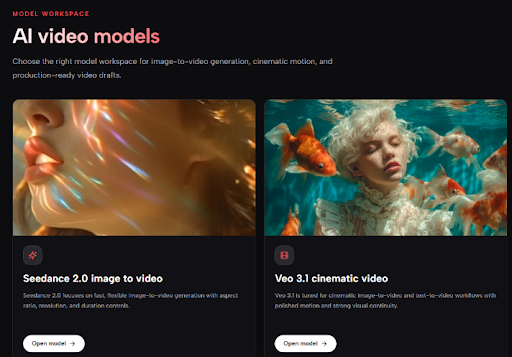
Once clean export is available, model choice matters again — but as a routing decision, not as a religion. Seedance 2.0 is the better fit when the desk wants controlled image-to-video iteration with explicit duration, resolution, and aspect-ratio settings. Veo 3.1 is stronger when the package needs cinematic camera language and visual continuity for a brand-mood open.
Live estimates on the generate panel show credit cost before you click. A short Seedance or Veo draft can land around a couple hundred credits depending on variant and settings; the exact number is on-screen, not in a spreadsheet myth. That estimate is the budget conversation. Adjectives are not.
Draft Protocol That Protects the Month Pool
Keep free or cheap Fast/Lite variants for ugly first questions: does the subject hold, does the crop work, is one camera move enough. Promote only the winner into a cleaner Standard or Quality pass when the slot is real. Image To Video AI keeps results in Library, so the desk can scrub failures without pretending every generate was a final.
Identity Check Still Beats Credit Math
Even with watermark-free downloads, a warped face or unreadable logo is a hard fail. Scrub the export at phone width against the source still in your head, then again in the CMS preview. If identity breaks, the clip never cleared editorial — paid status does not rescue a broken frame.
Old Workaround Stack Versus One Watermark-Aware Workspace
Without a shared lane map, teams bounce between free tabs, screenshot workarounds, and last-minute designer rescues. The hidden cost is coordination: who owns the clean file, who approved the mark, who regenerates after legal says no. A single workspace that shows credit cost and separates free from paid export reduces that thrash even when the creative direction stays conservative.
That is where free-lane language in buyer chat should be translated carefully. Free is real for learning. Publish still means paid watermark-free, plus a human identity check. Skip the translation and the magazine ships a draft mark into a polished layout — the kind of miss that looks fine until the PDF proof.
Where Image To Video AI Fits a Feature Desk
Use the platform when the desk already owns a still — cover crop, product photo, event portrait — and needs a short motion open for web or social companions. First frame to video keeps the composition honest. Text to video can explore a mood board when no archive still exists, but feature packages should not invent photojournalism they never shot.
Commercial use is allowed for ads, product pages, social content, presentations, and campaign drafts, with the usual duty to respect model terms and rights to prompts and references. That permission does not erase the watermark rule on free plans. Rights and clean export are separate checkboxes.
When the desk needs Image to video AI for a real ship date, lock the paid lane first, then write the motion sentence. Doing it backwards spends the week arguing about prompts while the export path was never publish-ready.
A One-Week Lane Map Magazines Can Actually Run
Monday is for still selection and rights. Pick assets the magazine already cleared. Tuesday is for cheap motion tests — short duration, one camera instruction, phone-width scrub in Library. Wednesday is the promotion day: only the winner moves into a cleaner variant on a paid watermark-free path. Thursday is editorial identity review against the source file. Friday is handoff into the CMS or social scheduler.
That calendar sounds boring on purpose. Boredom is how desks avoid the soft disaster where a sponsor cutdown wins a Slack reaction until legal opens the file and sees the mark. In our desk week, the expensive part is rarely the credit line item; it is the same-day cycle of apologizing and regenerating after a broken frame or a watermark surprise.
Keep Generate audio off unless the package truly needs a generated bed. Feature packages often already have licensed music or VO. Paying for audio you will mute is another quiet way to burn the month pool without improving the publish gate
Write the lane on the brief before anyone opens Image To Video AI. A sticky phrase works: “sandbox” or “publish-clean.” Sandbox means free check-in and throwaway drafts. Publish-clean means a paid tier, watermark-free download, and an identity pass. If the brief cannot name the lane, pause the generate click. Most thrash starts when half the room thinks they are exploring and the other half thinks they are shipping.
If leadership wants a single sentence for finance: free check-in proves the workflow; paid tiers buy clean exports and a credit pool large enough to kill bad drafts early. Agencies supporting the same magazine should mirror that lane map in their SOW and ask for Library proof of a watermark-free download before accepting the handoff.
Use This Split, Skip the Free-Publish Fantasy
Use Image To Video AI when you can name the publish gate: watermark-free download on a paid tier, identity pass at phone width, one clear camera move, Library review before handoff. Skip treating daily check-in credits as a production budget — they are a sandbox, and sandboxes leave marks.
If your week is mostly exploration, stay free and stay honest about it. If your week includes a feature package, sponsor cutdown, or client deck, budget the paid credit floor first. The constraint is a lane marker. Magazines ship cleaner when they read it before the prompt war starts.
